Vector Databases Explained
Introduction to Vector Databases
Beyond Exact Matches
Traditional databases are masters of precision. You ask for a customer named "John Smith," and they find every exact match. Think of it like a library catalog: you search for a specific title and get a specific book. But what if you wanted to find books like the one you just read? That's a different kind of problem.
This is where vector databases come in. They aren't built to find exact matches. They're designed to find relationships and similarities in your data. Instead of storing information in neat rows and columns, they store it as a special kind of numerical representation called a vector.
A vector database is a specialized database designed to index and store vector embeddings for fast retrieval and similarity search.
Everything from a word, a sentence, an image, to a song can be converted into a vector, also known as an embedding. This vector isn't just a random string of numbers; it captures the meaning and context of the original data. A vector for the word "king" will be mathematically close to the vector for "queen" but far from the vector for "car."
Traditional databases, like those using SQL, are built for structured data—information that fits nicely into tables. They struggle with the ambiguity of unstructured data like text and images. Vector databases thrive on it. They organize data based on semantic similarity, allowing you to search by concept rather than by keyword.
Powering Modern AI
The ability to find "what's similar" is a superpower for modern applications, especially in artificial intelligence. It's the engine behind many of the smart features we use every day.
Recommendation Engines: When a music service suggests a new song you might like, it's comparing the vector of the song you just heard to a massive database of other song vectors to find the closest matches.
Image Search: You can upload a photo of a chair and find visually similar chairs for sale. The system converts your image into a vector and searches for others like it.
Semantic Search: Instead of just matching keywords, you can search for a concept. Asking "what are some healthy lunch ideas?" can return articles about salads, quinoa bowls, and lean protein, even if they don't use those exact words. This is because the database understands the meaning behind your query.
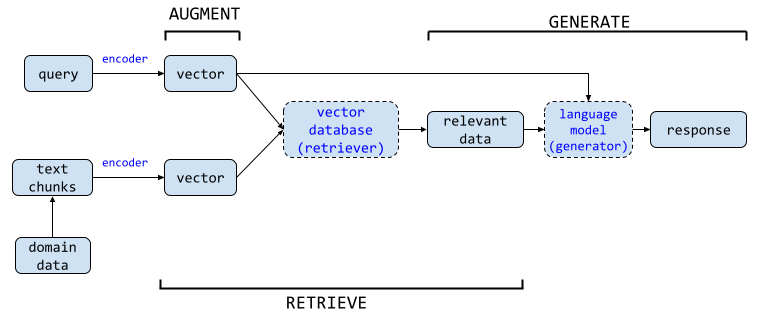
One of the most important applications today is enhancing Large Language Models (LLMs). A process called Retrieval-Augmented Generation (RAG) uses a vector database as a long-term memory for an AI. When you ask a chatbot a question, it can search the vector database for relevant, up-to-date information to provide a more accurate and context-aware answer.
What's Next
Over the next few articles, we'll dive deeper into how this technology works. You'll learn about:
- Embeddings: How we turn complex data like text and images into meaningful vectors.
- Similarity Metrics: The math used to measure how "close" two vectors are to each other.
- Indexing Algorithms: The clever techniques that make searching through billions of vectors fast and efficient.
- Building an Application: A practical look at how to use a vector database in a real-world project.
What is the primary strength of a vector database compared to a traditional database?
The numerical representation of a piece of data (like a sentence or an image) that captures its semantic meaning is called a(n) __________.
By the end, you'll have a solid grasp of why vector databases are a foundational piece of the modern data and AI landscape.