No history yet

Explain me about any interesting topic which blows my mind

I would love to share a topic that will completely shift how you think about reality! We're going to dive into quantum entanglement—a phenomenon so strange that even Albert Einstein couldn't fully accept it, calling it "spooky." Before we begin our journey into the quantum world, it helps me to know how to tailor our conversation. To help me explain this in the best way for you, how much background do you have in physics or science in general?

I am a complete beginner, keep it simple!

Welcome aboard! Let's start with a beautiful roadmap of our journey so far and where we are heading next.

Your path
Real-World Implications & Future Tech

The Magic of Two Particles as One

To understand quantum entanglement, we first have to throw out our everyday rules of how objects behave. In our normal, macroscopic world, if you have two separate objects—say, two normal tennis balls—what you do to one ball has absolutely no instant effect on the other. If you paint one ball blue in New York, the other ball in Tokyo doesn't suddenly, magically turn red. They are completely independent. But in the subatomic world, things get incredibly weird. When two particles, like electrons or photons, become entangled, they form an . Once this bond is forged, they stop acting like two individual objects. Instead, they act like a single, unified system, no matter how much physical distance separates them.
Imagine you have a pair of magical, matching shoes, but instead of left and right, they are colored red and blue. You place each shoe into its own identical, sealed box. You keep one box and send the other box to a friend living on Mars. Before anyone opens a box, neither of you has any idea which color shoe you have. In the quantum world, it is even stranger: the shoe in your box isn't secretly red or secretly blue. It is actually a fuzzy mix of . But the moment you open your box and look at your shoe, the mystery instantly collapses. If you see that your shoe is blue, you know with 100% certainty, at that exact microsecond, that your friend's shoe on Mars is red. The two shoes are locked in a perfect correlation.

Why doesn't this happen with everyday objects like shoes?

That is the ultimate question! It comes down to a matter of scale and how easily quantum states get disrupted.

The Crowd Ruins the Magic

In our everyday world, objects are made of trillions upon trillions of atoms. A single shoe is constantly being bumped, warmed, and hit by air molecules, light rays, and heat. In physics, this constant environmental interference causes a process called . Think of a quantum state like a delicate house of cards: in a perfectly quiet, sealed room (the microscopic scale), you can build a highly fragile structure. But in a chaotic wind tunnel (our macroscopic world), the cards are blown down instantly. Because everyday objects are constantly interacting with their surroundings, their quantum fuzzy states "decohere" into standard, predictable classical states in a fraction of a millisecond.

To make this visual, let's look at how scale changes the rules of the universe, shifting from the delicate quantum domain to our busy, everyday world.

A quantum system of fuzzy, isolated particles on the left, contrasted with a sharp macroscopic shoe bombarded by environmental factors on the right.

Even though we don't see entanglement in our everyday lives, knowing that it exists at the fundamental level of the universe drove scientists crazy—especially Albert Einstein, who spent years trying to prove there was a catch.

Make me a diagram of quantum decoherence

You've got it! Visualizing how the fuzzy, delicate quantum state collapses under the pressure of the chaotic, noisy environment is the perfect way to lock this concept in.

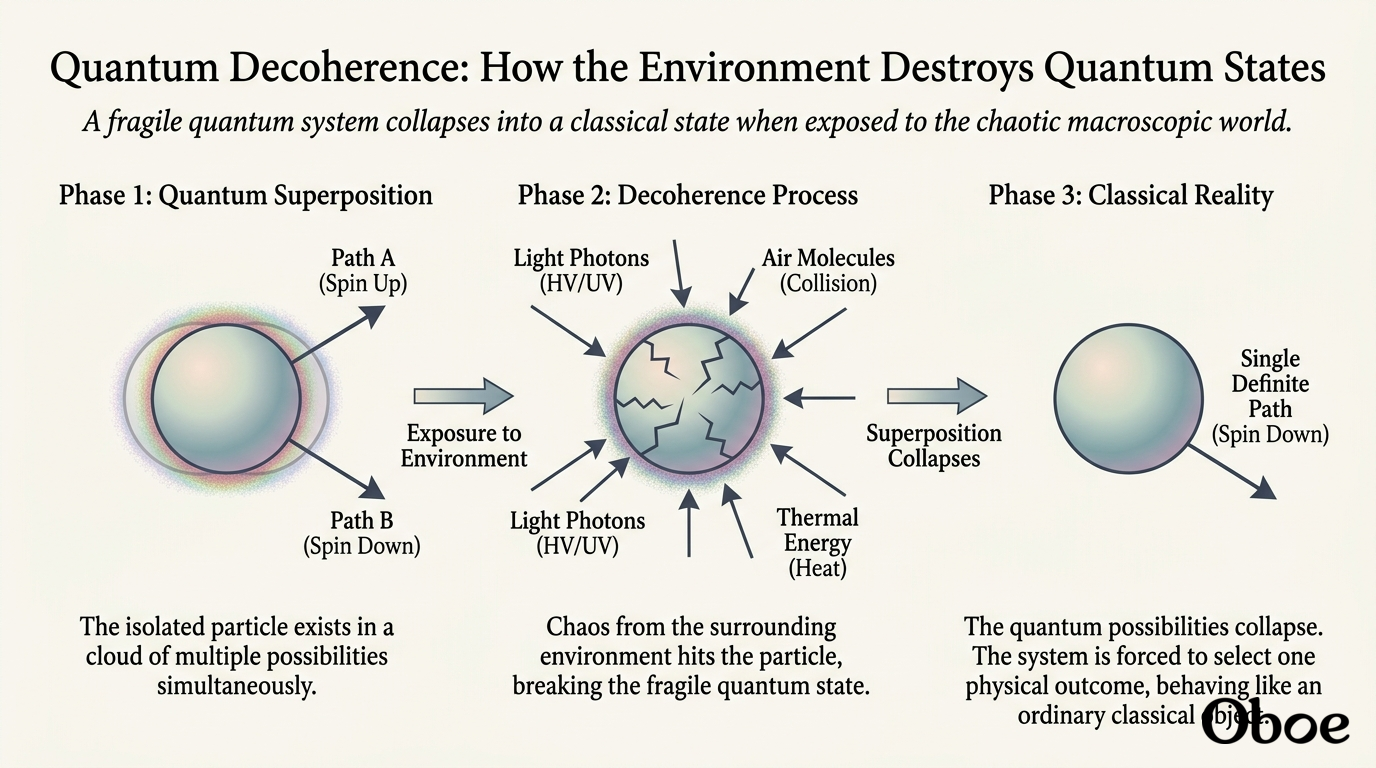
DIAG
Diagram
Generated course diagram
While you wait for that diagram to build, let's step right into why this whole setup made Albert Einstein's blood boil. Einstein was a firm believer in : the idea that physical objects have definite properties even when we aren't looking at them, and that nothing can influence something else faster than the speed of light. Entanglement flew directly in the face of this. Because of the speed-of-light limit, Einstein argued that looking at a particle in New York couldn't possibly force its partner in Tokyo to instantly make a choice. To him, the information would have to travel across the planet faster than light, which his own theory of relativity declared impossible. This is why he mocked the idea as "spooky action at a distance."

How did Einstein try to explain this mystery?

Einstein tried to explain away this mystery by arguing that the particles must have made their decisions long before they were ever separated. To make his point, Einstein used a wonderfully simple analogy involving a glove. Imagine he took a pair of gloves, placed each one in its own identical, sealed box, and gave one box to you. If you opened your box and found a left-handed glove, you would immediately know the other box contained the right-handed glove. To Einstein, there was nothing "spooky" or magical about this. The glove in your box didn't magically transform into a left-handed glove the moment you looked at it. It was already decided from the moment it was packed. Einstein argued that entangled particles must work the exact same way: they carry hidden, pre-determined information that dictates their states from the start.
But this is where the story takes a mind-bending turn. Decades later, scientists actually figured out a way to test this idea in a lab, and they proved that Einstein was wrong. The particles do not have a hidden plan. The choice really is made instantly, across vast distances, only when we observe them. This means the act of measurement itself is what shapes our reality. Are you ready to explore how this act of measurement actually forces the universe to make up its mind?