Uniform Circular Motion Explained
Circular Motion Basics
Moving in Circles
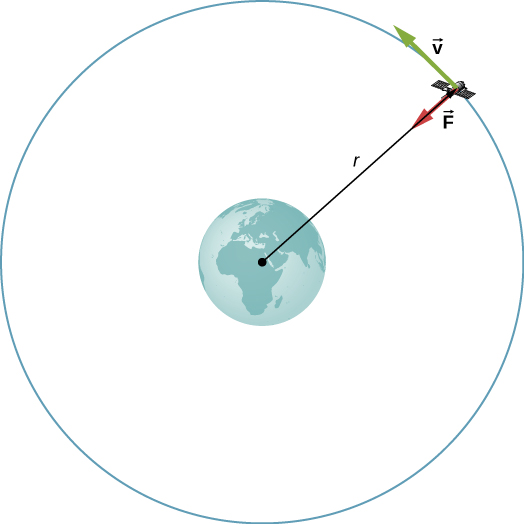
Imagine a car driving on a perfectly circular racetrack. If the speedometer stays locked at 60 miles per hour, the car's speed is constant. But its velocity is not. Velocity includes both speed and direction, and since the car is constantly turning, its direction is always changing.
This is the core idea behind uniform circular motion: an object moving in a circle at a constant speed. The path is circular, but the speed doesn't change.
Describing Rotation
To describe linear motion, we talk about distance. For circular motion, we talk about angles. As an object moves along a circle, it sweeps through an angle. This change in angle is called angular displacement, usually represented by the Greek letter theta ().
While we often measure angles in degrees, in physics, it's much more useful to use radians. A full circle is , which is equal to radians.
Radian
noun
A unit of angle, equal to an angle at the center of a circle whose arc is equal in length to the radius.
This definition gives us a simple way to connect the angle an object has rotated through to the actual distance it has traveled along the circle's edge, called the arc length ().
The relationship is beautifully simple when is in radians:
Here, is the arc length, is the radius of the circle, and is the angular displacement in radians.
Angular Speed
Just as linear speed is the rate of change of distance, angular speed is the rate of change of the angle. It tells us how quickly an object is rotating. We represent angular speed with the Greek letter omega (\\[omega]).
If an object sweeps through an angular displacement of in a time interval of , its average angular speed is:
Angular speed is typically measured in radians per second (rad/s).
For example, a wheel that completes one full rotation ( radians) in 2 seconds has an angular speed of rad/s.
Connecting Angular and Linear Speed
So how does the rotational speed (\\[omega]) relate to the linear speed () of a point on the rotating object? Think about an old-fashioned record player. A point on the outer edge of the record has to travel a much larger circle in the same amount of time as a point near the center. This means the point on the edge is moving faster.
All points on the record have the same angular speed—they all complete a circle in the same amount of time. But their linear speeds are different because they are at different distances from the center.
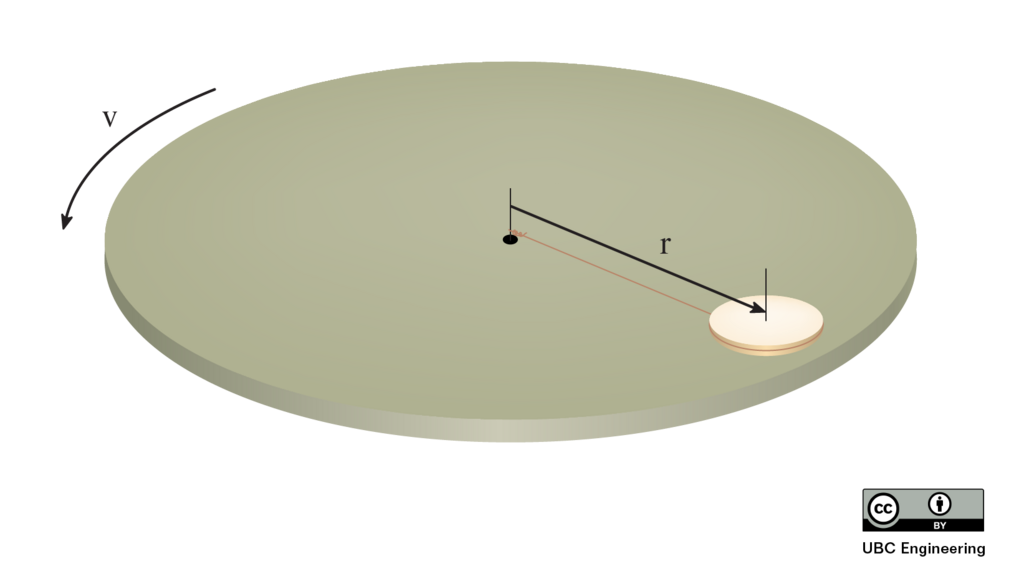
We can find the relationship by starting with the arc length equation, . If we look at how these quantities change over time, distance per time is linear speed () and angle per time is angular speed (\\[omega]). This gives us a direct link:
This simple equation connects the two types of speed. The linear speed () of any point on a rotating object is equal to its distance from the center of rotation () multiplied by its angular speed (\\[omega]). This confirms our intuition: the farther you are from the center, the faster you move.
Let's check your understanding of these fundamental concepts.
A car travels at a constant 60 mph around a perfectly circular track. Which statement best describes its motion?
Two bugs, A and B, are sitting on a spinning record. Bug A is near the center and Bug B is on the outer edge. Which of the following is true?
With these basics of angular displacement and speed, you're ready to explore what causes objects to move in a circle in the first place.