Understanding the Silent Mind
Neurobiology of An-endophasia
The Brain's Silent Pathways
When we think, many of us hear a voice. This internal narration feels central to our consciousness, but for individuals with an-endophasia, the mind operates without this constant chatter. This isn't a deficit, but a difference in cognitive wiring. The brain, ever adaptable, simply finds other ways to process information. To understand this, we need to look at the specific neural structures typically associated with inner speech.
One of the key players is the (LIFG), a region of the brain that's famously home to Broca's area. For over a century, we've known this area is crucial for producing spoken language. It's the part of the brain that coordinates the muscles of your mouth and larynx to form words. Neuroimaging studies show that the LIFG also activates when we generate inner speech, essentially running a simulation of talking without engaging the muscles. In those with an-endophasia, this region isn't necessarily silent. Instead, its role during cognitive tasks may shift, potentially being less involved in moment-to-moment thought and more engaged during explicit linguistic tasks like reading or preparing to speak aloud.
Connected to the LIFG is a superhighway of nerve fibers called the . This white matter tract links the brain's language production centers (like Broca's area) with its language comprehension centers further back in the temporal lobe (Wernicke's area). It's the physical connection that allows you to hear a question, understand it, and formulate a spoken reply. This bundle of fibers is also essential for the phonological loop, the process by which you can repeat a phone number to yourself to keep it in your short-term memory.
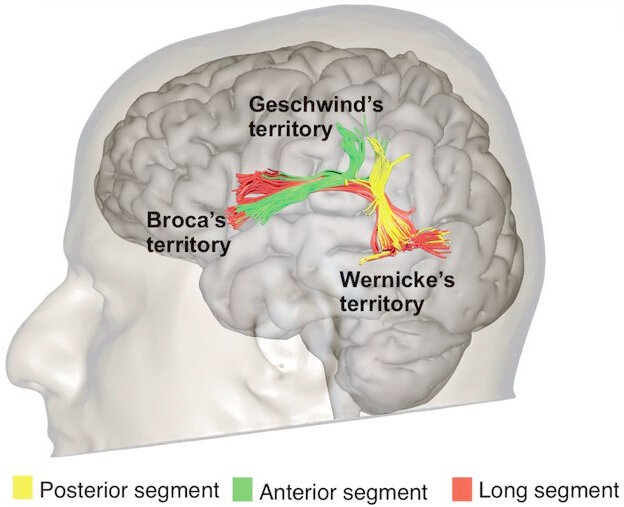
In non-verbal thinkers, the structure of the arcuate fasciculus might differ. Diffusion Tensor Imaging (DTI), a type of MRI that tracks water molecules moving along white matter tracts, can reveal variations in the density and direction of these connections. Some research suggests that in an-endophasia, this pathway may be less robust, or it might form stronger connections with regions involved in visual or spatial processing, rerouting the flow of thought away from language centers.
Remapping the Mind's Landscape
Beyond individual structures, the brain operates in large-scale networks. One of the most important is the Default Mode Network (DMN), a collection of brain regions that are most active when we are at rest, letting our minds wander, daydreaming, or thinking about ourselves and others. For many people, DMN activity is heavily populated by inner speech. We talk to ourselves about the past, plan for the future, and reflect on our feelings.
In an-endophasia, the DMN is still active, but the nature of its activity changes. Instead of a linguistic narrative, self-reflection might take the form of a series of images, abstract concepts, or unsymbolized feelings. Functional MRI (fMRI) studies show that during these resting states, there might be greater connectivity between DMN regions and the visual cortex or parietal lobes, areas involved in sensory integration and spatial awareness.
This points to the brain's incredible capacity for neural plasticity. The brain is not a static organ with rigidly defined functions. It constantly adapts to experience, rerouting pathways and repurposing regions to achieve cognitive goals. The absence of a phonological loop doesn't create a vacuum; it creates an opportunity for other cognitive systems to become dominant. Thought isn't erased, it simply takes a different form.
Neuroimaging studies comparing individuals with and without inner speech during problem-solving tasks illustrate this beautifully. When asked to perform a verbal memory task, verbal thinkers show strong activation in the LIFG and temporal lobe. In contrast, those with an-endophasia might show heightened activity in the occipital lobe (vision) or parietal lobe (spatial reasoning), suggesting they are encoding the information visually or spatially rather than phonologically.
Interestingly, while inner speech aids memory, individuals with anendophasia have developed alternative strategies.
This isn't a simple trade-off, but rather a different allocation of cognitive resources. The physical representation of 'thought' in a brain without an inner monologue is simply less reliant on the language network and more deeply integrated with sensory and abstract processing systems.
Let's test your understanding of these neural foundations.
What is the primary function of the Left Inferior Frontal Gyrus (LIFG), also known as Broca's area, in relation to inner speech?
Which brain structure acts as a 'superhighway' connecting language production and language comprehension centers?
The brain's ability to develop diverse cognitive strategies, like thinking without words, showcases its remarkable flexibility and the many different ways there are to process the world.