The geomorphic process of tectonic plates
Welcome! I am excited to help you explore how tectonic plates sculpt our planet's mountains, valleys, and oceans.
To help me tailor this session, could you tell me a little about your background in geology or physical geography, and why you are interested in learning about tectonic plates?
I am a total beginner and just curious about how Earth works
Earth's Rigid Outer Shell
Continue to how plates float and move
A cross-section of Earth's rigid lithospheric plates resting on top of the warmer, semi-fluid asthenosphere.
Continue to see what happens when plates interact at these boundaries
It's at the boundaries—the margins where these massive plates meet—that the real geological drama unfolds. Because the plates are constantly being dragged by the underlying mantle, they cannot help but run into each other.
The Three Types of Plate Boundaries
- Pulling apart (): Here, plates mimic ships drifting away from each other, leaving a gap where fresh magma can rise from below to create brand-new crust.
- Crashing together (): Here, plates smash head-on. One plate might get shoved deep down back into the hot mantle to be recycled, or they might crumple upward to form massive mountain ranges.
- Sliding past (): Here, plates grind sideways past one another, getting temporarily stuck before violently slipping and causing powerful earthquakes.
Which of these three boundaries would you like to explore first?
Continue to divergent boundaries and see how plates pull apart
Let's dive into divergent boundaries, where the Earth is literally pulling itself apart to construct brand-new real estate.
Ripping Earth Apart at Spreading Centers
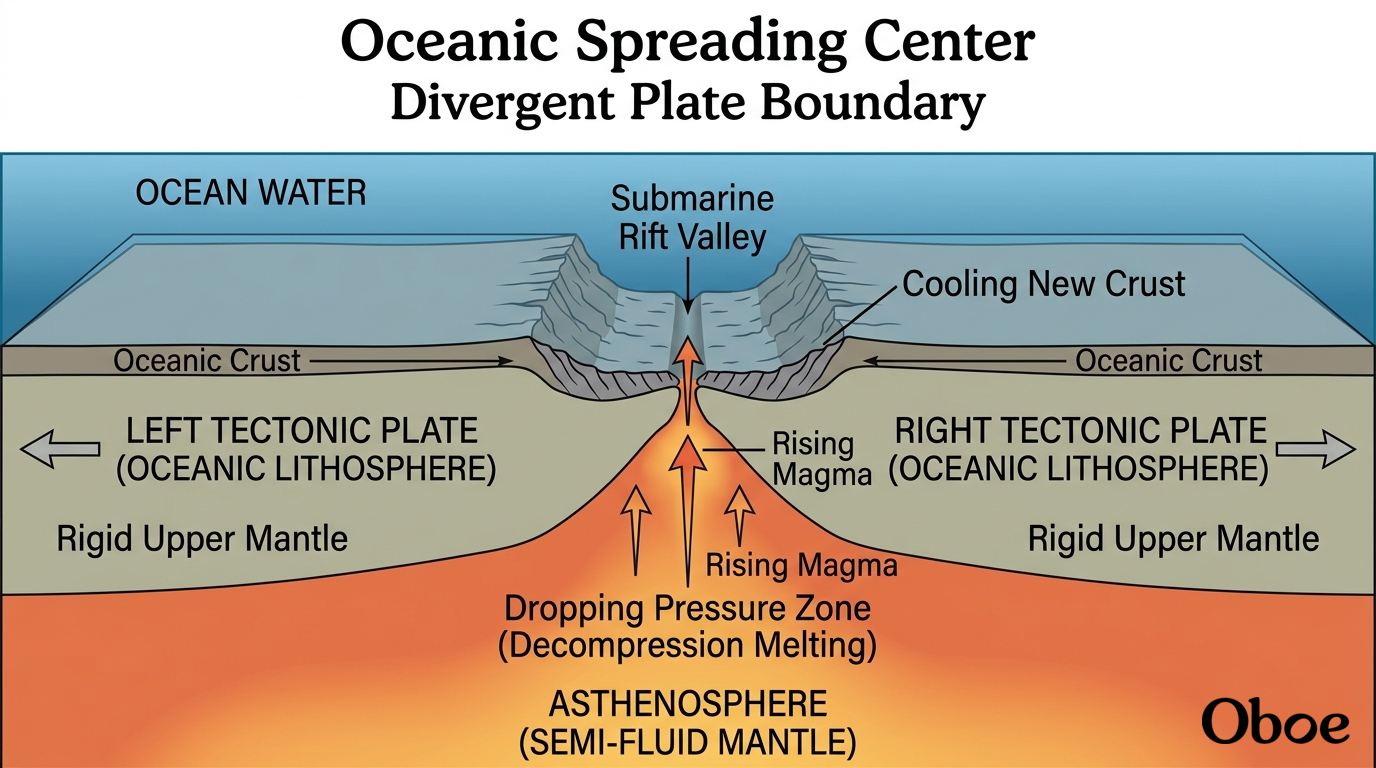
Show me a diagram of a spreading center
You got it! Let's take a look at how this process operates.