The French Revolution
Welcome! I'm really excited to dive into this incredible period of history with you. Before we chart our path through the dramatic downfall of the French monarchy, I'd love to know a bit more about what brings you to this topic so we can tailor our journey perfectly.
I'm a complete beginner, just curious about the history!
It's wonderful to have you here! Since you're a complete beginner, we're going to take this step by step, starting right at the root of the drama. To understand why France exploded into revolution, we have to look at how unfair daily life was under the old system, known as the .
Your path

Key Events and Turning Points (1789-1791)
Radicalization and the Reign of Terror
The Rise of Napoleon and the End of the Revolution
The Pyramid of Inequality
Before 1789, French society was legally divided into three rigid classes called Estates. Your entire life—your taxes, your job opportunities, and your rights—was determined by which Estate you were born into.
Imagine a pyramid where the top two percent of the population holds all the power and pays almost zero taxes, while the bottom 98 percent carries the entire country on its back.
| Estate | Who they were | Population % | Tax Burden |
|---|---|---|---|
| First Estate | The Clergy (Catholic Church) | ~0.5% | Virtually 0% |
| Second Estate | The Nobility (Aristocrats) | ~1.5% | Virtually 0% |
| Third Estate | Everyone else (Peasants, merchants, doctors) | ~98% | Almost 100% |
As you can see, the was a massive, diverse group. It included wealthy bankers, merchants, lawyers, rural peasants, and starving city workers.
Yet, despite their differences, they all shared the same boiling frustration: they did all the hard work, generated France's wealth, paid all the taxes, and had absolutely no say in how the country was run.
Create a diagram of the Three Estates
I would be happy to visualize that for you. To help you see how skewed this social structure really was, I have started generating a diagram that maps out the three different Estates.
DIAG

Diagram
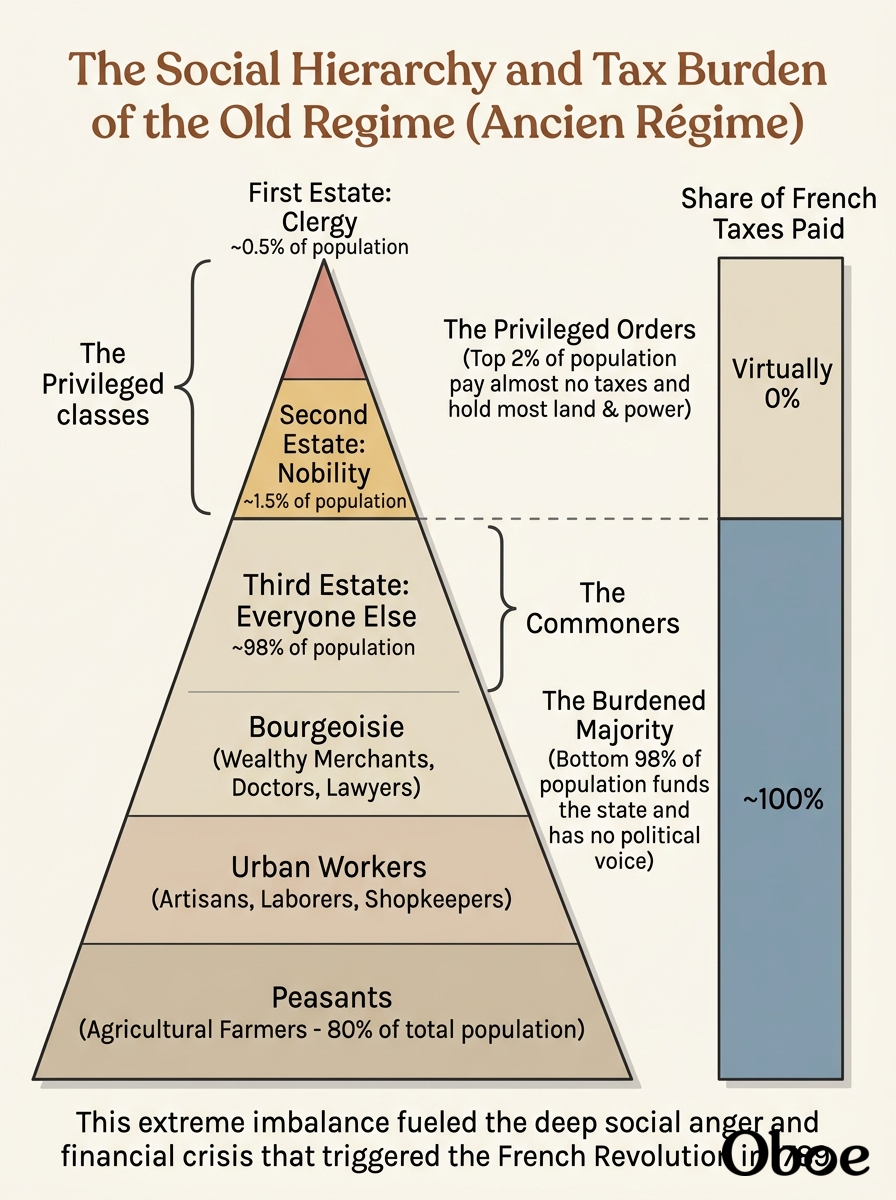
While that diagram is being put together, let's look at the spark that began to light this dry tinder. Even with all this social tension, a system can limp along for a long time until a crisis forces everyone's hand.
That crisis was a total . France was completely broke, largely because they had just spent massive amounts of money helping out in the American Revolution. Ironically, by helping the Americans win their freedom from King George III, the French monarchy drove itself right to the edge of bankruptcy.
Continue to the intellectual influence of the Enlightenment
It's fascinating how ideas can act like a slow-burning fuse. While the French government was sliding into bankruptcy, an intellectual movement called the was quietly reshaping how people thought about power, authority, and human rights.
Thinkers like argued that governments only have the right to rule if they protect the people's interests—an idea called the social contract.
If a king fails to protect his subjects, the people have a right to replace him. To a starving, heavily taxed population, these weren't just abstract philosophy concepts; they were a direct challenge to the "divine right" of King Louis XVI.
Continue to the political instability and the weaknesses of King Louis XVI
To make matters worse, France was led by a ruler who was completely unequipped to handle a crisis of this scale. was not a cruel tyrant; rather, he was a deeply indecisive, well-meaning, but remarkably weak leader who preferred hunting and lock-making to governing a country.
His political weakness was compounded by his highly unpopular marriage to Marie Antoinette, an Austrian princess. The French public deeply distrusted her foreign origins and frequently scapegoated her for the crown's financial troubles, labeling her "Madame Déficit" due to rumors of her lavish lifestyle while ordinary people starved.
As the country spiraled toward bankruptcy, Louis tried to pass tax reforms to make the wealthy nobility pay. However, the powerful aristocrats blocked his plans. Lacking the political willpower to force the reforms through, Louis XVI backed down, demonstrating to the entire country that the monarchy was no longer fully in control.
With his options exhausted, the desperate king was forced to call a meeting of the , a representative assembly that had not met for 175 years, to solve the financial crisis.