No history yet

the world cup

Welcome! I'd love to help you understand the World Cup. To get us started, could you tell me a little bit about what you already know about soccer or the World Cup, and if there's a specific reason you're interested in learning about it right now?

I know the basics, but I want to dive deep into its history and iconic moments.

It is great to have you here! Since you already know the basics, we can skip the standard rulebook and dive straight into what makes this tournament so legendary.

The Ultimate Stage

At its heart, the is an international association football (soccer) competition contested by the senior men's national teams of the members of , the sport's global governing body. But calling it just a "tournament" doesn't quite do it justice. It is widely considered the most prestigious, viewed, and followed sporting and cultural event on the planet. To put its scale into perspective, the global governing body estimated that the 2022 tournament in Qatar reached an astonishing 5 billion viewers, with about 1.5 billion people tuning in just to watch the final match. That is over half of the entire human population sharing the exact same cultural moment.

To understand how we get to those iconic, high-stakes moments, we should look at how the basic scale of the tournament is changing today.

Continue to the modern scale of the World Cup

Let's zoom out and look at the sheer heartbeat of this tournament: its timing and its massive new scale.

Every Four Years

Since the inaugural tournament in , the World Cup has been played every four years. This deliberate gap is what makes the tournament so incredibly special. It is not an annual league where you can easily "try again next year." For a professional football player, a four-year cycle means they might only get two or three chances in their entire lifetime to play on this stage in their prime. One bad game or one ill-timed injury can completely shatter a lifelong dream. The only times the four-year cycle was broken were in 1942 and 1946, when the tournament was cancelled due to the devastation of . But otherwise, it has remained the ultimate, highly anticipated quadrennial summit of global sport.

The Gigantic Modern Scale

While the tournament traditionally featured 32 teams, the modern era of the World Cup has undergone a massive expansion. Starting with the , the tournament has expanded to include a record-breaking 48 teams. This massive change allows more nations from Africa, Asia, and North America to compete on the global stage, bringing the total number of matches to a staggering 104. To make this massive footprint work, hosting duties have also adapted. The tournament is now so large that it is jointly hosted across three giant nations: the United States, Canada, and Mexico.

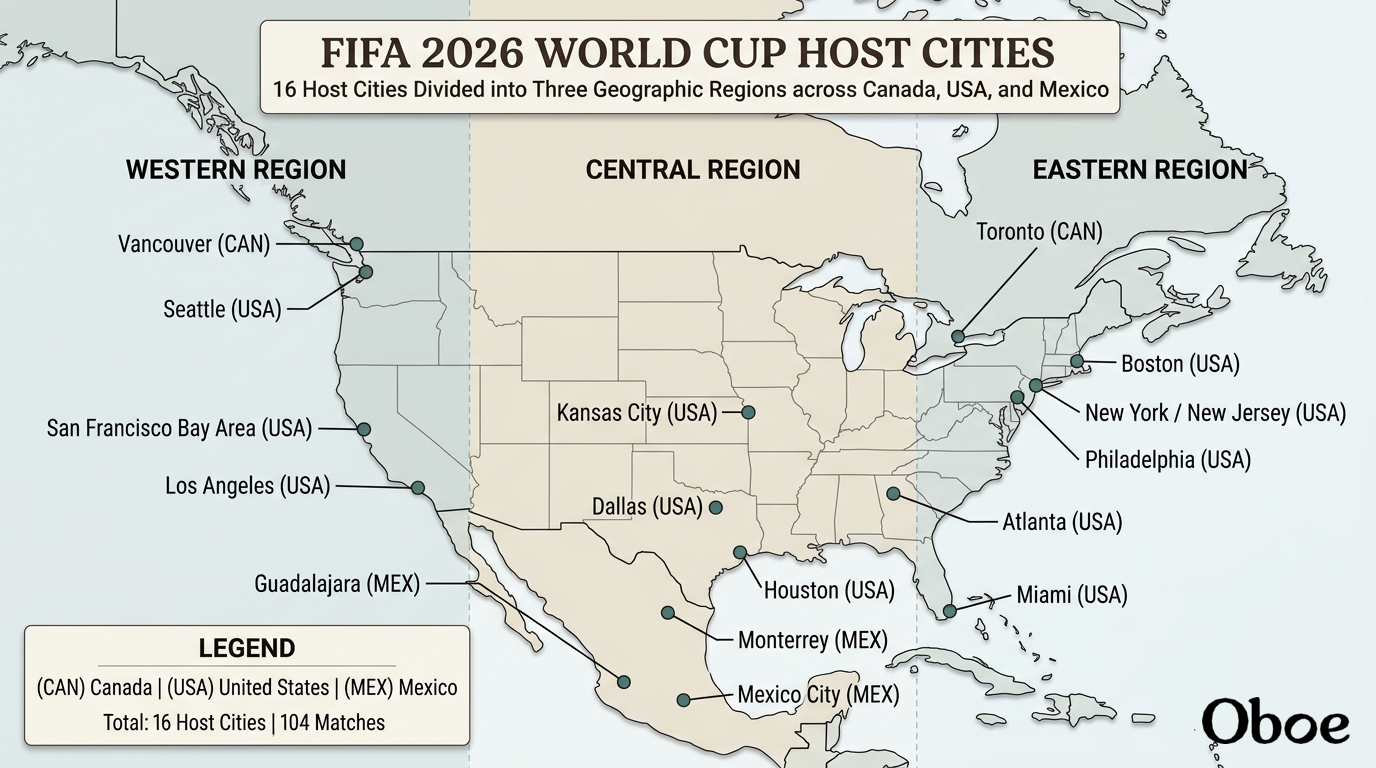
Make me a diagram of the host cities

You got it! Mapping out the host cities is the perfect way to visualize just how massive this tournament has become. Because the spans three entire countries, the organizers split the 16 host cities into three main geographic regions (Western, Central, and Eastern) to keep travel times somewhat manageable for the teams and fans. Let's start generating a visual layout of these host cities across Canada, Mexico, and the United States so you can see exactly how the tournament is spread out.
DIAG
Diagram
Generated course diagram

Now that we have visualized the massive layout of the host cities, we can move on to how a country actually gets to play in this tournament.

It is a brutal, years-long journey just to make it to the opening match. Would you like to explore how the qualification process works, or shall we jump straight into how the tournament's group stages work?

Make a quick quiz on World Cup basics

You got it! Let's put your knowledge to the test and see how well you have grasped the fundamental scale, history, and timing of the tournament so far.

Think about the unique pacing that makes this event so incredibly high-stakes for the players involved. Based on what we have covered, how often is the men's World Cup played under normal, peaceful circumstances?