No history yet

Tectonic plates

Welcome! I'm so excited to explore the dynamic forces shaping our planet with you today. Before we dive into the moving pieces of our planet, I'd love to know a bit about where we are starting from.

Could you tell me a little bit about what you already know about tectonic plates, or what makes you curious to learn about them today?

I'm a complete beginner, starting from scratch!

Starting from scratch is the absolute best way to learn! It means we can build a really solid foundation together without having to unlearn any weird myths.

Your path
How and Why Plates Move
Types of Plate Boundaries
Geological Effects of Plate Tectonics

The Cracked Eggshell

To understand , it helps to think of the Earth not as a perfectly smooth, solid marble, but as a giant hard-boiled egg that has been gently tapped all over. Its outer shell is cracked into about 15 to 20 massive, interlocking slabs of rock. These giant puzzle pieces make up the Earth's outer shell, which scientists call the .

A stylized, 2D cracked egg representing the Earth, with irregular shell segments outlining tectonic plates over a glowing mantle.

As you can see, these plates form the solid floor of our oceans and the foundation of our continents. Next, we should look at how the Earth is built from the inside out so we can see what these massive slabs are actually sitting on.

Continue to the structure of the Earth

Let's journey straight to the center of the Earth to see exactly what lies beneath our feet.

The Layers Beneath

If we sliced the Earth in half like an apple, we would find three main layers: the core, the mantle, and the lithosphere. At the very center is the , a super-hot, dense ball of metal. Wrapping around that is the , a massive layer of rock that represents about 84% of the Earth's total volume. Finally, floating right on top is the cool, rigid shell we already met—the lithosphere, which contains the crust we walk on. This simple structure is key to understanding how our planet operates. Because the deeper layers are incredibly hot, they behave in surprising ways that directly impact the surface.

A cross-section showing the concentric interior layers of the Earth: the small core, the thick mantle, and the paper-thin crust.

Now that we know the basic three-layer structure, we are ready to look at the transition zone where the rigid plates actually meet that hot mantle.

Make me a diagram of the Earth's layers

I would love to help you visualize this! I'm initiating a diagram that shows exactly how the rigid outer plates interact with the hot layers deep beneath our feet.

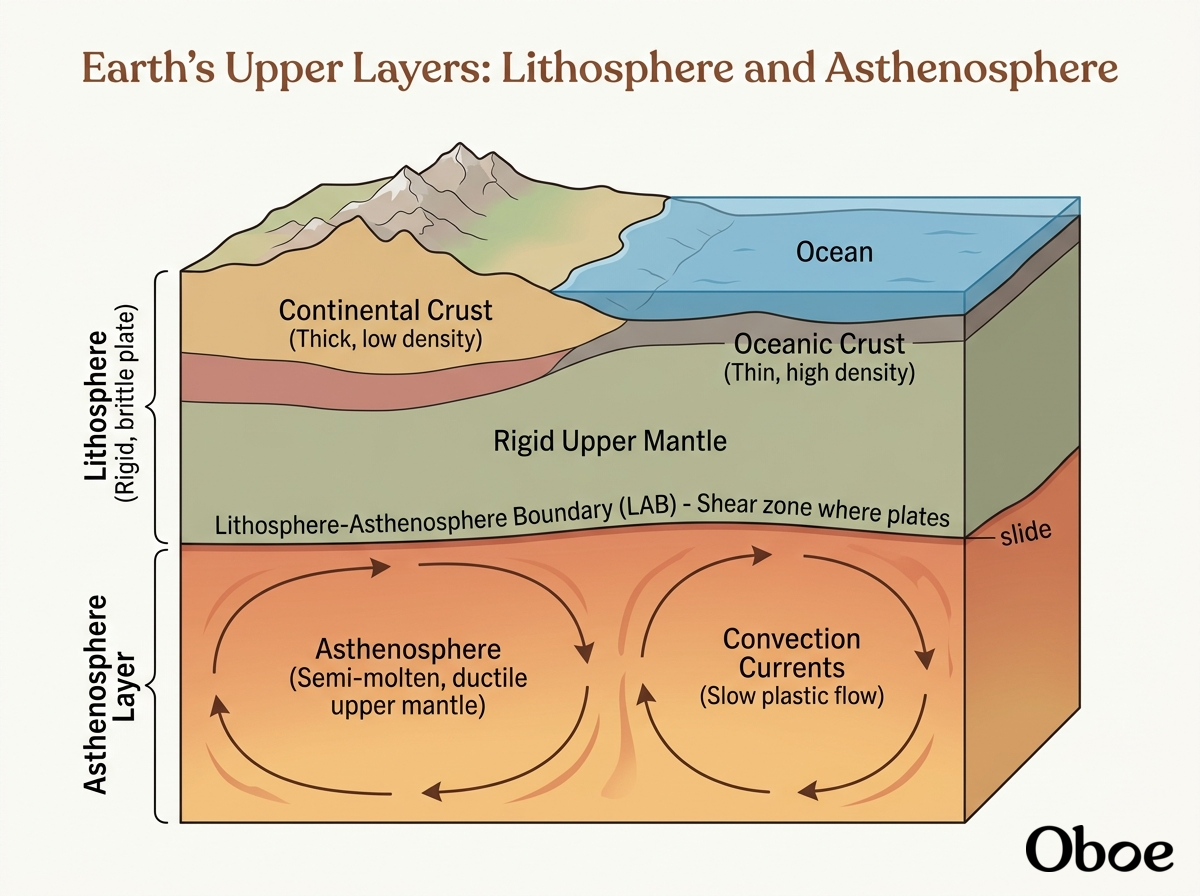
DIAG
Diagram
Generated course diagram

Where the Plates Float

This diagram gives us the perfect transition into our next big concept: how these solid rock slabs actually sit on top of the mantle. While the is hard and brittle, it doesn't rest on solid ground. Instead, it floats on top of a special, hot layer of the upper mantle called the . Because of the intense heat and pressure from the core, the rock in the asthenosphere isn't rigid like a typical stone. It behaves like thick, hot caramel or silly putty. It is solid enough to support the massive plates above it, but flexible enough to slowly deform and flow over millions of years.

What is the difference between oceanic and continental crust?

That is one of the absolute best questions you can ask, because the answer explains why we have deep ocean basins in some places and massive mountain ranges in others! Even though both are part of the Earth's rigid outer crust, and are built very differently. It all comes down to a cosmic recipe of thickness, density, and the specific rocks they are made of.
PropertyOceanic CrustContinental Crust
ThicknessThin (~5-10 km)Thick (~30-70 km)
Primary RockBasalt (Heavy, dark)Granite (Light, buoyant)
DensityHigh densityLow density
AgeVery young (constantly recycled)Very old (billions of years old)
Because the dense oceanic crust is so heavy, it actually sinks deeper into the asthenosphere below. The lighter, thicker continental crust floats much higher, just like a block of Styrofoam floating higher in water than a heavy piece of wet wood. This difference in density is the main reason why oceans and dry land exist where they do! Now that we know what these different plates are made of, we can look at the fact that they are not just sitting still—they are actually on the move.