learn about the civilizing process
Welcome! I'm excited to explore Norbert Elias's groundbreaking sociological work with you. Before we dive into the history of manners and how medieval warriors transformed into modern citizens, I'd love to know what brings you to this topic today.
I'm just curious and learning for fun.

Why did people start changing their behavior?
That is the million-dollar question, and Elias's answer is brilliant: we changed our behavior because our lives became deeply tangled up with one another, a concept he calls social interdependency.
In the early Middle Ages, most people lived in small, isolated pockets. If you were a feudal lord, you grew your own food, ruled your own land, and protected yourself with raw physical force. Because you didn't rely on distant strangers for your survival, you had very little reason to care about what they thought of your behavior. You could blow your nose on the tablecloth, lose your temper, or turn to violence without worrying about ruining a complex trade deal. But as towns began to grow and trade expanded, this isolation shattered.
A comparative diagram contrasting a sparse network of isolated nodes on the left with a highly dense, interconnected mesh of nodes on the right.
Give me a modern analogy for this social web
A perfect modern analogy for this social web is road traffic and the transition from driving a tractor on a private farm to navigating a busy city highway.
Imagine you are driving a tractor on your own vast, isolated farmland. You can drive as fast or as slow as you want, make sudden sharp turns without signaling, blast your music, or stop dead in the middle of a path to look at a bird. Because there is nobody else around, your unpredictable behavior has zero consequences. You do not need to restrain your impulses because your actions do not ripple out to affect anyone else.
Now, imagine taking that same tractor onto a multi-lane city highway during rush hour. Suddenly, you are part of a dense . If you want to survive and keep traffic moving, you must obey a highly strict, internalized set of rules. You cannot just brake on a whim; you must anticipate how the drivers behind you will react. You must signal before you turn, maintain a predictable speed, and control your road rage when someone cuts you off.
Your survival on the highway depends on everyone else behaving predictably, and their survival depends on you doing the same. Self-restraint is not just a nice moral choice; it is the only thing keeping the entire system from crashing.
This shift from the isolated farm to the busy highway is exactly what happened to Western Europe over hundreds of years. As towns grew, we were all forced onto the same crowded highway, making self-restraint absolutely essential.
But this brings us to a really important point in Elias's theory: this shift towards "civilized" behavior was not a moral triumph. It was not about people suddenly becoming "better" or more ethical human beings; it was a practical response to a changing social structure. Elias emphasizes that "civilization" is a continuous historical process, not a final state of moral perfection.
Give me a diagram of these dependency chains
I can absolutely help you visualize that! Here is a diagram that maps out how those isolated medieval nodes slowly knit themselves into the complex, crowded web of modern dependency.

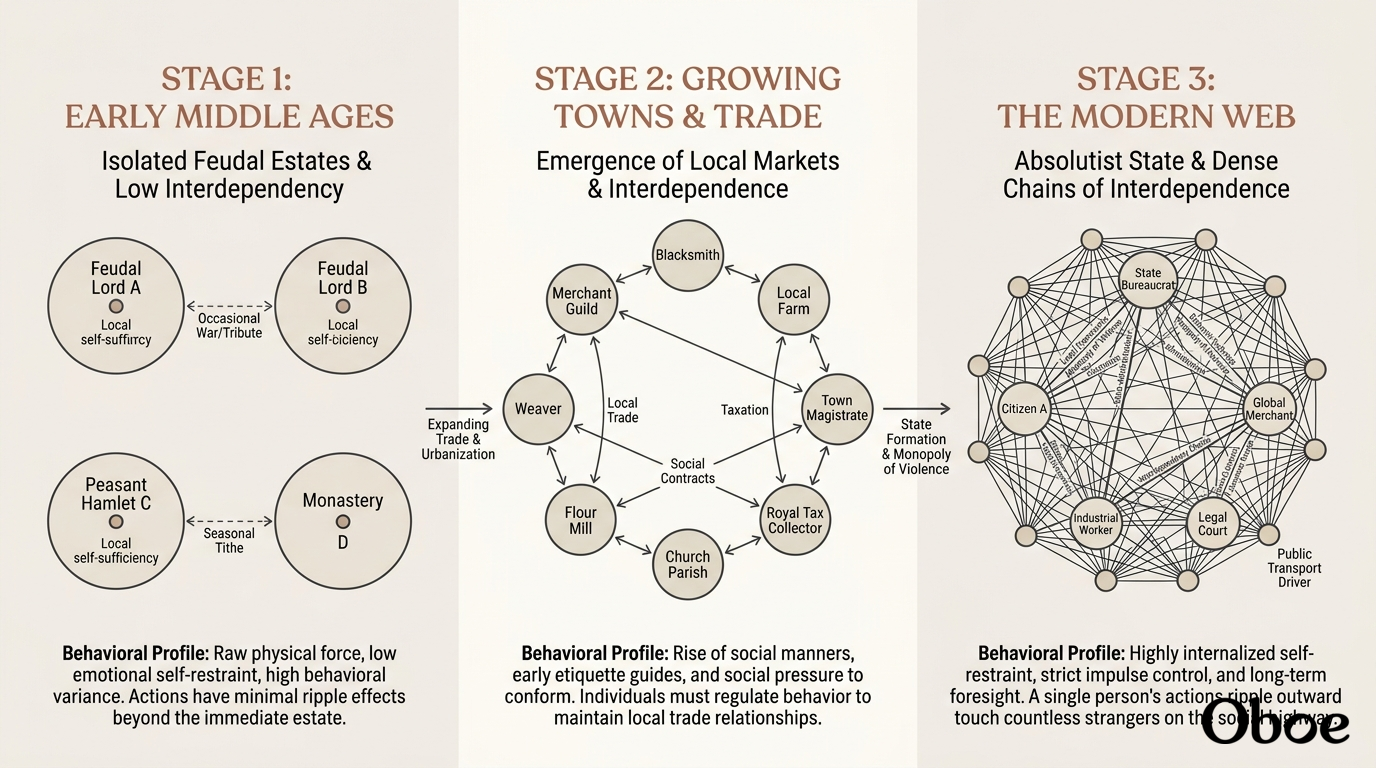
As you can see in the diagram, when those chains of connection multiply and tighten, any unpredictable behavior becomes incredibly disruptive to the whole system.
But this brings us to a major point that Elias wanted to emphasize: this shift toward "civilized" behavior is a historical process, not necessarily a form of moral progress. We didn't become nicer or inherently better people; we simply adapted our psychology to survive the highly complex social structures we built around ourselves.
Before we move on to how this social pressure actually shaped the modern state, how are you feeling about these core concepts of self-restraint and interdependency?
Wait, why isn't 'civilization' considered moral progress?
Did Elias think this emotional suppression makes modern people unhappy?
Continue to the Sociogenesis of the State and the monopoly of violence
A four-by-four grid of colored feudal territories where one estate has swallowed an adjacent neighbor.
Why did taxation play such a big role in this process?
Continue to how this centralized power reinforced self-restraint
It all comes down to a fundamental swap: we traded our personal weapons for a massive, collective shield.
Continue to the next subtopic: Psychogenesis and Personality
It is fascinating to watch how these political shifts directly shape who we are on the inside. By stepping into this next chapter, we are bridging the gap between the birth of modern governments and the evolution of our inner minds. Elias called this psychological side of the equation psychogenesis.
The Internalization of Social Control
Continue to the role of Court Society in accelerating this psychogenesis
A centralized king node surrounded by eight nobility nodes in a balanced dynamic radial layout.
Give me an example of a bizarre court etiquette rule
Continue to how courtly behavior filtered down to the rest of society
Continue to the next subtopic: Impact of Court Society
A centralized node representing a King is surrounded by six Nobility nodes with bidirectional arrows indicating mutual pressure.