Intermolecular forces
Welcome! I'm excited to explore intermolecular forces with you.
To help me tailor this session, could you tell me a bit about your background in chemistry? For example, are you currently studying this for a class, or are you learning it for personal interest?
I'm preparing for an exam (like AP Chemistry or MCAT).
That exam goal helps a lot! For tests like AP Chemistry or the MCAT, mastering IMFs is critical because they explain why substances behave the way they do in real life.

To start with our first topic, let's look at the basic definition: (IMFs) are attractive or repulsive forces that act between neighboring molecules.
Continue: Compare intermolecular and intramolecular forces
Comparing intermolecular and intramolecular forces is one of the most tested distinctions on exams like AP Chem and the MCAT.
Think of it like a group of people holding hands to form a chain. An is like the strong skeletal bones inside a person's arm holding their individual body together. An intermolecular force, by contrast, is just the gentle handshake between two different people.
Show me a diagram comparing intra and intermolecular forces
Here is a comparison diagram showing how covalent intramolecular bonds inside molecules compare to the weaker intermolecular forces between distinct molecules.

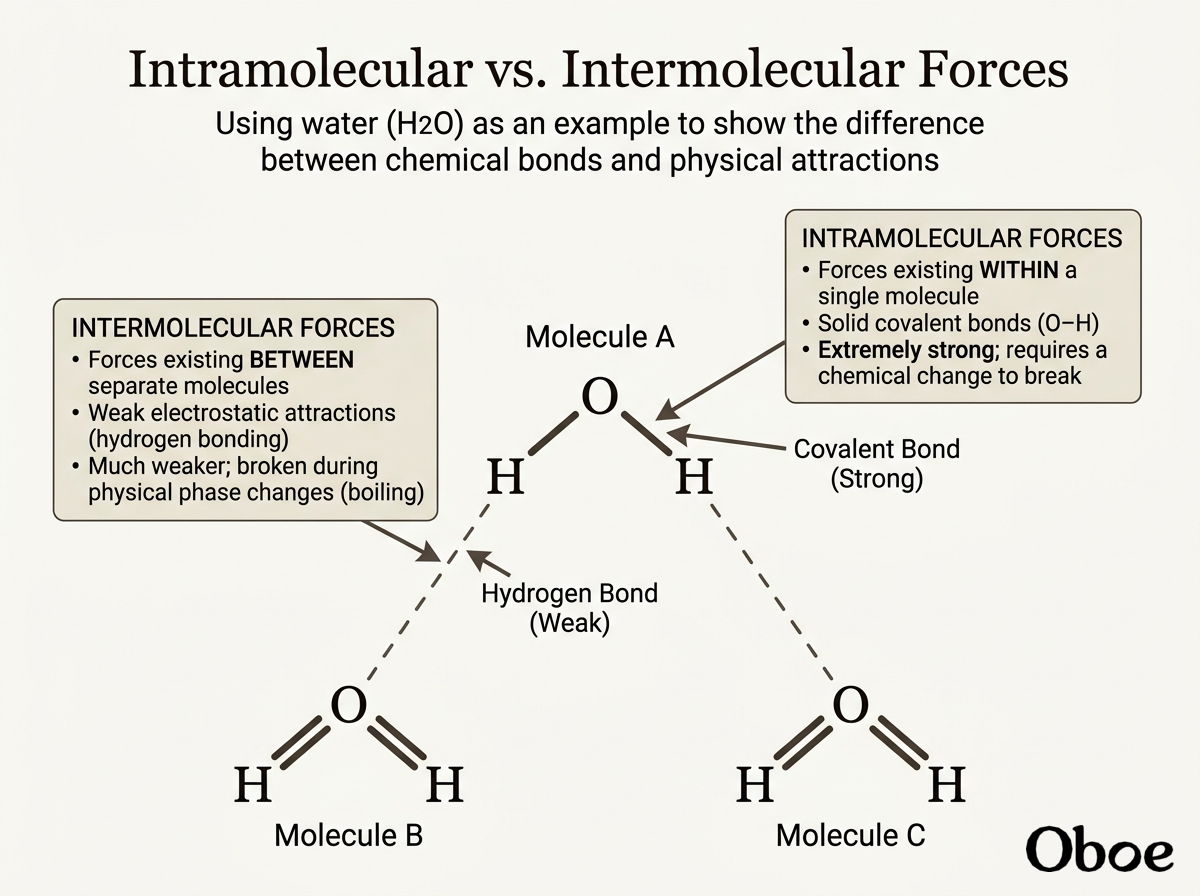
Now that we see how intermolecular forces keep molecules attracted to one another, it makes sense that they directly control a substance's physical properties.
Continue: Explore the different types of intermolecular forces
Now let's zoom in on the specific types of intermolecular forces, starting with the baseline force present in all matter.
London Dispersion Forces
Even completely nonpolar, neutral molecules attract one another due to (LDFs).
At any given instant, the electrons orbiting an atom or molecule might end up unevenly distributed purely by chance. This creates a temporary, fleeting (a tiny partial negative charge where the electrons piled up, and a partial positive charge on the opposite side).
That momentary partial charge then pushes or pulls electrons in a neighboring molecule, inducing a temporary dipole there too. The two temporary dipoles attract each other briefly before shifting again.
Because larger molecules have larger, more electron-dense clouds, their electron clouds are far easier to distort—a property known as . More electrons mean stronger temporary dipoles, which is why larger molecules experience significantly stronger London dispersion forces and have higher boiling points.