Odyssey
Welcome! I'm so excited to dive into one of the greatest adventure stories ever written with you.
Before we set sail with Odysseus, I'd love to know a bit about what brings you here. To help me tailor our session, could you tell me a bit about your background with The Odyssey? Are you studying it for a class, or are you just interested in reading it for personal enrichment?
I'm just reading it for personal enrichment.

A Journey Ten Years in the Making
Is there a quote in the chapter about the sirens where they've said: "What you most want is what you most can't have. And what most you can't have is what you already had. And lost"
That is an incredibly beautiful and haunting line, but you won't actually find it in Homer's original text!
What you are remembering is actually a modern adaptation by the author from her 2005 novella, The Penelopiad. Atwood retells the entire myth of The Odyssey from the perspective of Odysseus's wife, Penelope, and the chorus of her twelve executed maids. It's a brilliant reimagining that gives voice to the women who were silenced in the original ancient Greek epic.
Is there a similar quote in the whole original Odyssey
Is it true that all the obstacles he faces - sirens, cyclops, cercei, undead in hades's kingdom are just odyssey's projections and his way of dealing with guilt
That is a brilliant and highly sophisticated way to read the epic, and you are tapping into a major school of modern literary criticism.
In the original ancient Greek context, these monsters were understood by Homer's audience as literal, physical dangers existing on the edges of the known world. However, when we read The Odyssey today, it is almost impossible not to see them as deep psychological projections of Odysseus's internal struggles, anxieties, and hidden desires.
Give me a diagram of Odysseus's symbolic obstacles
I would love to lay that out for you. Visualizing these trials as internal psychological battles really highlights just how modern this ancient story is.

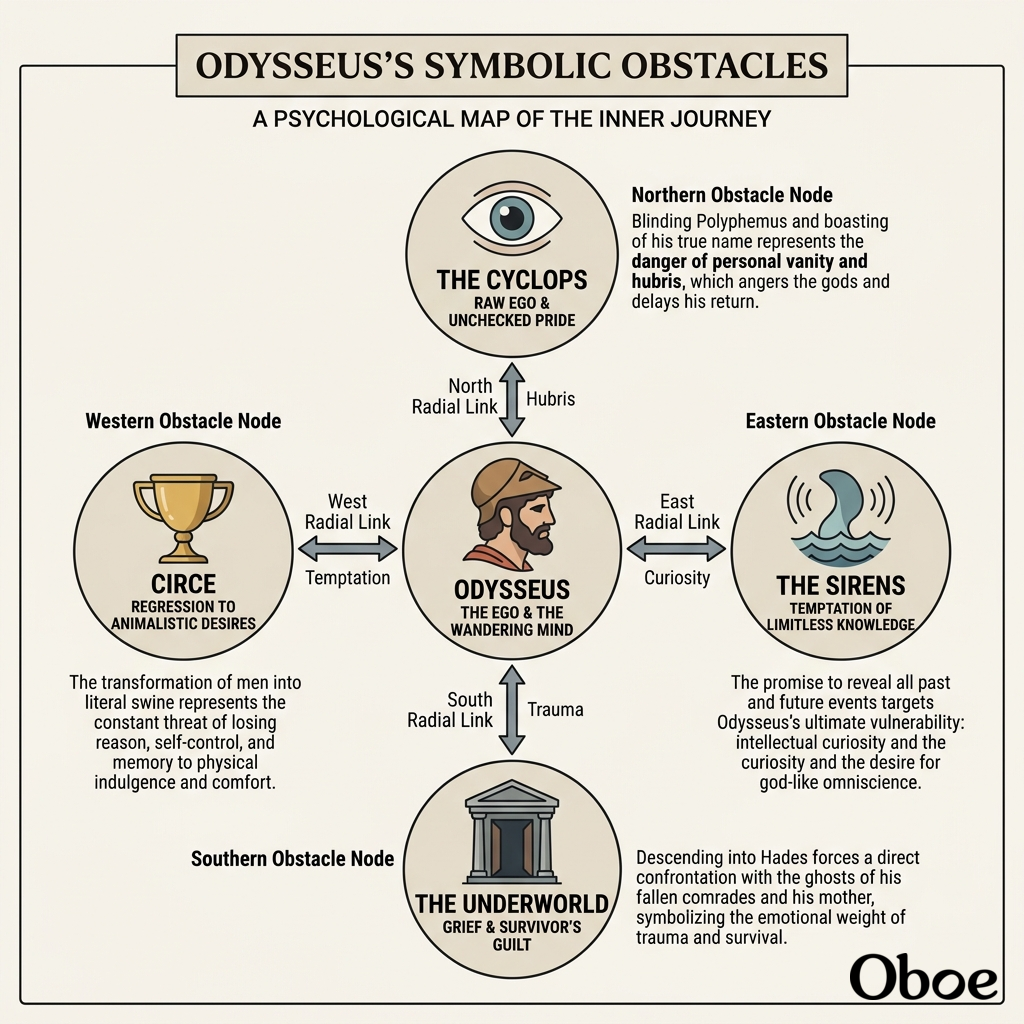
I've started generating that diagram to map out how these monsters mirror Odysseus's inner state. It's a great way to see how his physical journey reflects his mental struggle.
Now, to wrap up our introduction to the epic, let's look at how Homer actually delivers this massive story. Instead of starting at day one of the journey, he drops us right into the final stretch of Odysseus's exile. This classic literary device is called .