Expert system
Welcome! I am excited to dive into the world of expert systems with you. Before we start exploring how these early digital brains mimic human specialists, could you tell me a little bit about your background in computer science or AI, and what specifically interests you about Expert Systems?
I have some CS background and want to see how they compare to modern AI.

What is an Expert Syste m?
Continue to the core purpose of expert systems
Let's move on to the core architecture of these programs. To understand how they mimic human reasoning, we need to look under the hood at their three main building blocks: the knowledge base, the inference engine, and the user interface.
The Anatomy of an Expert System
An architecture diagram of an Expert System, displaying the structural relationships and bidirectional query/response flows among the User Interface, Inference Engine, and Knowledge Base.
Make me a comparison table of these components
You got it! Let's lay out how these three core parts differ structurally and operationally before we contrast them directly with modern AI.
| Component | Role / Metaphor | Implementation Details |
|---|---|---|
| Knowledge Base | The Brain's Memory | Explicit database storing structured semantic facts and human-written IF-THEN rules. |
| Inference Engine | The Reasoning Logic | Independent processing unit running search algorithms (like forward/backward chaining) to apply rules to data. |
| User Interface | The Bedside Manner | The translation layer taking natural-style queries, formatting them for the engine, and displaying the logical decision path. |
Continue to how expert systems work (Reasoning)
How Expert Systems Think

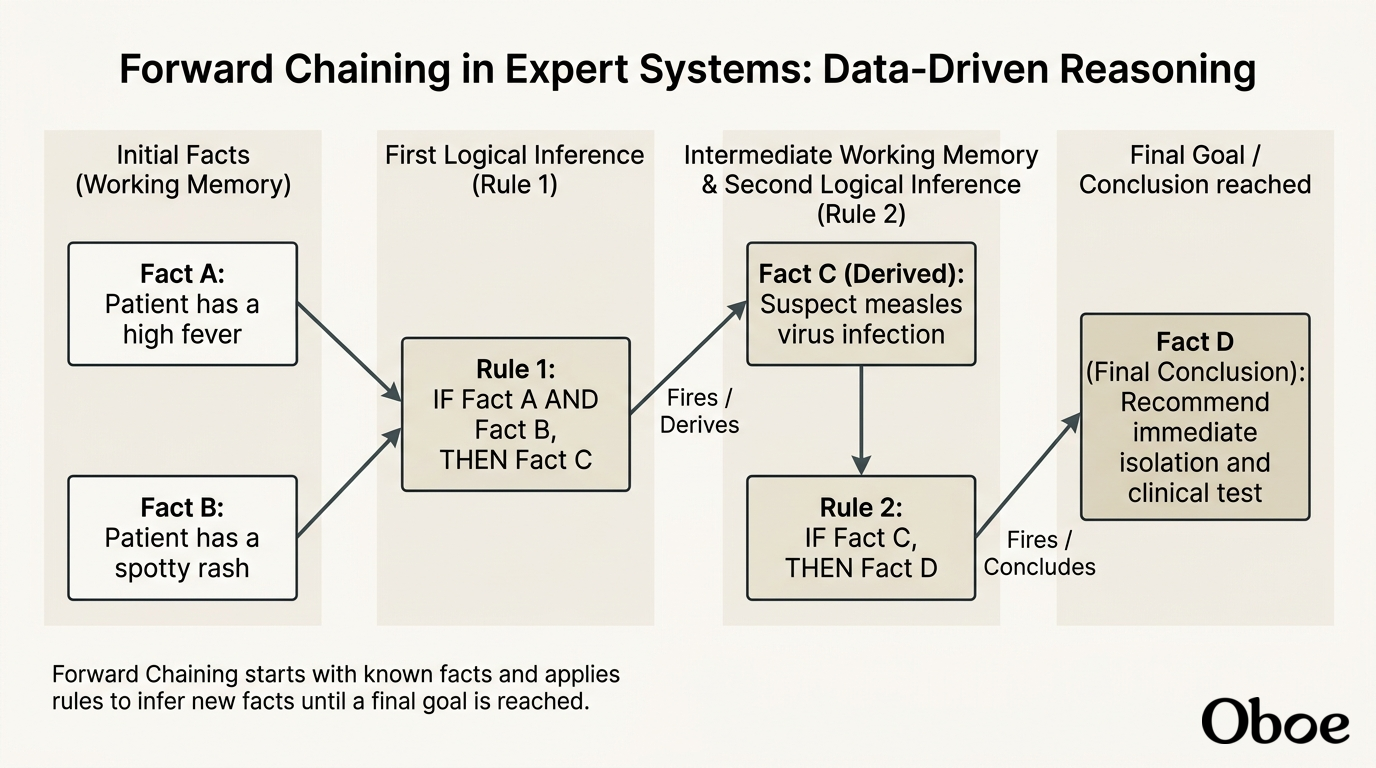
[Engine does not crank] and [Headlights are dim].
Our system has the following rule database:
- Rule 1: IF
[Engine does not crank]AND[Headlights are dim]THEN infer[Battery is dead] - Rule 2: IF
[Battery is dead]THEN infer[Alternator is faulty]or[Battery needs charging]
[Battery is dead] to our memory.
Now, with this new fact in hand, the engine scans the rules again. It notices that the condition for Rule 2 is now met because we just proved the battery is dead. It fires Rule 2, concluding that the alternator is faulty or the battery needs charging. We started with raw symptoms and marched forward to a diagnosis.