Trigonometry Essentials
Trigonometric Ratios
Naming the Sides
Trigonometry is all about the relationships between the angles and side lengths of triangles. To start, we need a clear way to talk about the sides of a right-angled triangle.
First, there's the hypotenuse. This is always the longest side, and it's the one directly across from the right angle. The other two sides are called legs. But their names change depending on which angle we're focusing on.
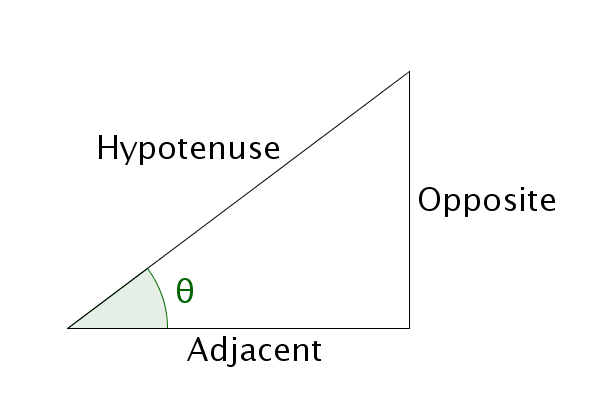
Let's pick one of the acute angles (one of the angles that isn't the 90° one) and call it (theta).
- The Opposite side is the leg directly across from our angle .
- The Adjacent side is the leg next to our angle that is not the hypotenuse.
If you switch to the other acute angle, the opposite and adjacent sides also switch. The hypotenuse always stays the same.
The Three Basic Ratios
For any given angle in a right triangle, the ratio of its side lengths is always the same, no matter how big or small the triangle is. Mathematicians gave these constant ratios special names: sine, cosine, and tangent.
sine
noun
The ratio of the length of the side opposite an angle to the length of the hypotenuse.
cosine
noun
The ratio of the length of the side adjacent to an angle to the length of the hypotenuse.
tangent
noun
The ratio of the length of the side opposite an angle to the length of the side adjacent to it.
It can be tough to keep these straight. A popular mnemonic for remembering them is "SOH CAH TOA".
SOH: Sine is Opposite over Hypotenuse. CAH: Cosine is Adjacent over Hypotenuse. TOA: Tangent is Opposite over Adjacent.
Let's Calculate
Let's work with a classic 3-4-5 right triangle. The side lengths are 3, 4, and 5. The hypotenuse must be the longest side, which is 5.
Let's find the trigonometric ratios for angle .
- Opposite side to : 3
- Adjacent side to : 4
- Hypotenuse: 5
Using SOH CAH TOA, we get:
Now, let's look at angle . From its perspective, the opposite and adjacent sides are different.
- Opposite side to : 4
- Adjacent side to : 3
- Hypotenuse: 5 (still 5!)
This gives us a new set of ratios for :
These ratios form the foundation of trigonometry. By knowing just one angle and one side length in a right triangle, you can use these relationships to find all the other sides and angles.
In a right-angled triangle, which side is always located directly across from the right angle?
If you are focusing on a specific acute angle, θ, the side next to it that is not the hypotenuse is called the ________ side.