Trigonometry Essentials
Introduction to Trigonometry
What is Trigonometry?
Trigonometry is the study of the relationship between the angles and side lengths of triangles. That's really it. The name might sound complicated, but the core idea is simple: if you know a little bit about a triangle, you can figure out everything else about it. This is incredibly useful for everything from building a house to navigating a ship.
Trigonometry lets us find unknown distances and angles by relating them to ones we already know.
For now, we'll focus on a special kind of triangle that forms the foundation of trigonometry: the right-angled triangle.
The Right-Angled Triangle
A right-angled triangle (or just a right triangle) is any triangle with one angle that is exactly 90 degrees. You can usually spot it by the little square symbol in the corner. The sides of a right triangle have special names that depend on which angle you're looking at.
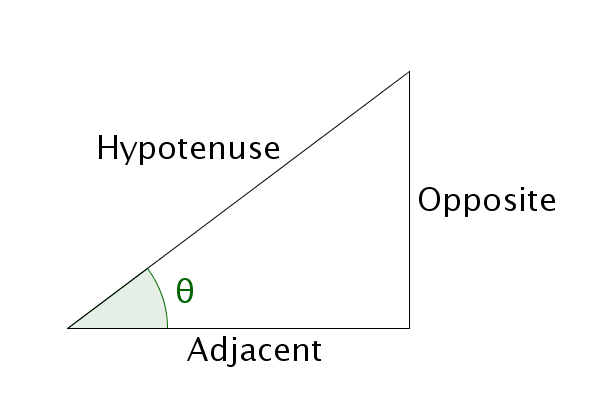
Here's the breakdown:
- Hypotenuse: This is always the longest side, and it's always opposite the right angle.
- Opposite: This side is directly across from the angle we're interested in (which we often call theta, or ).
- Adjacent: This side is next to the angle , but it's not the hypotenuse.
The names for the opposite and adjacent sides change depending on which of the two non-right angles you're focusing on. The hypotenuse always stays the same.
The Three Basic Ratios
The magic of trigonometry comes from three fundamental ratios that are true for any right triangle. These ratios relate an angle to the lengths of the triangle's sides. They are called sine, cosine, and tangent.
sine
noun
The ratio of the length of the side opposite an angle to the length of the hypotenuse.
cosine
noun
The ratio of the length of the side adjacent to an angle to the length of the hypotenuse.
tangent
noun
The ratio of the length of the side opposite an angle to the length of the side adjacent to it.
A common way to remember these is the mnemonic SOHCAHTOA:
- SOH: Sine is Opposite over Hypotenuse
- CAH: Cosine is Adjacent over Hypotenuse
- TOA: Tangent is Opposite over Adjacent
Putting It to Use
Let's see how these ratios work. Imagine you want to find the height of a tree. You can't easily measure it with a ruler, but you can measure two other things: the distance from the tree's base and the angle from the ground to its top.
Let's say you are standing 50 feet away from the tree, and the angle of elevation to the top is 30 degrees. You want to find the height ().
-
Identify the sides: From the 30° angle, the height of the tree is the opposite side, and your distance from the tree is the adjacent side.
-
Choose the right ratio: Which ratio uses Opposite and Adjacent? That's tangent (TOA).
-
Set up the equation:
To find , we can rearrange the equation:
Using a calculator, you'll find that is about 0.577. So:
feet.
The tree is about 28.85 feet tall. No climbing required!
You can also use these ratios to find a missing angle if you know the lengths of two sides. For that, you'd use the inverse trigonometric functions (, , ) on your calculator.
This is the core of trigonometry: using simple ratios to find unknown measurements. These principles are applied in fields like engineering, physics, video game design, and astronomy.