Transformer Model Explained
Introduction to Neural Networks
The Brain's Blueprint
Artificial neural networks are inspired by the structure of the human brain. They're not nearly as complex, but they borrow the same basic idea: lots of simple, interconnected units working together to solve a problem. The most fundamental unit is the artificial neuron.
Neuron
noun
A single computational unit in a neural network that receives one or more inputs, performs a calculation, and produces an output.
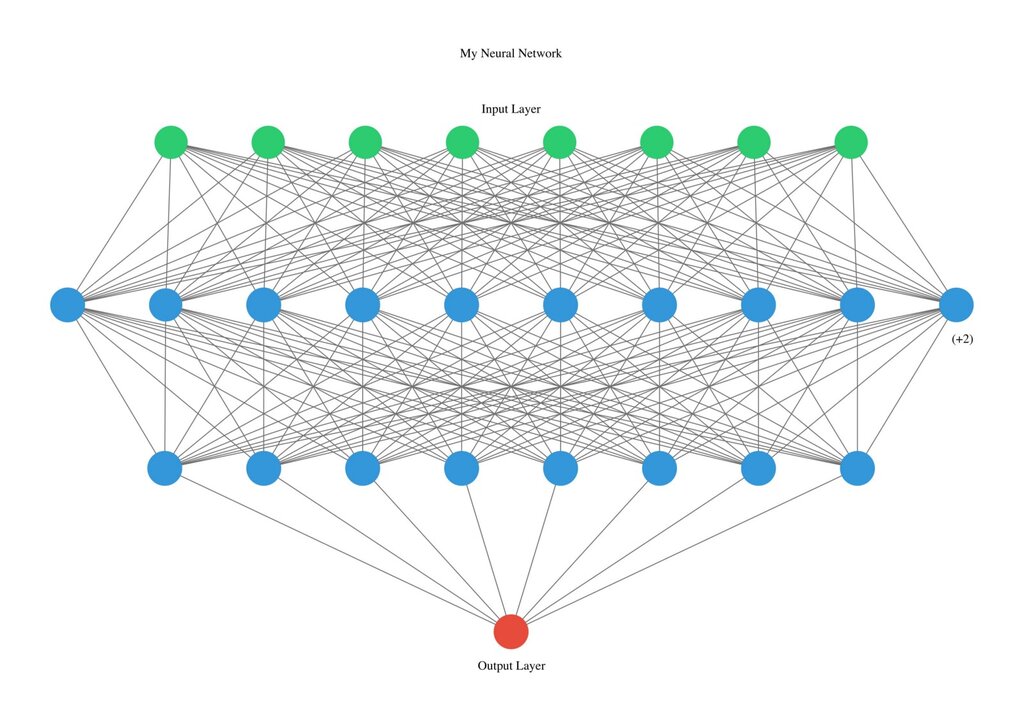
A single neuron isn't very smart. Its power comes from being connected to many other neurons in a layered structure. A basic neural network has at least three types of layers:
- Input Layer: This is the network's front door. It receives the initial data, like the pixels of an image or the words in a sentence. Each neuron in this layer represents a single feature of the data.
- Hidden Layers: These are the intermediate layers between the input and output. This is where most of the computation happens. A network can have many hidden layers, and the term "deep learning" comes from networks with a large number of them.
- Output Layer: This layer produces the final result. It could be a single neuron that predicts a probability (e.g., 90% chance of rain) or multiple neurons for classifying the input into different categories (e.g., identifying a picture as a cat, dog, or bird).
Making the Decision
Inside each neuron, two things happen. First, it sums up all the inputs it receives. Each input is multiplied by a "weight," a number that signifies its importance. A higher weight means that input has more influence on the neuron's output.
Second, the neuron passes this weighted sum through an activation function. This function is a simple rule that determines whether the neuron should "fire" (send a signal to the next layer) and what that signal should be. Think of it as a gatekeeper that decides how much information should pass through.
Without activation functions, a neural network would just be a complex linear equation. These functions introduce non-linearity, which allows the network to learn much more complicated patterns.
One common activation function is the Sigmoid function. It squishes any input value into a range between 0 and 1. This is useful for the output layer when we need to predict a probability.
Another popular and simpler function is the Rectified Linear Unit, or ReLU. It's a very straightforward rule: if the input is negative, the output is 0. Otherwise, the output is the same as the input. It's computationally efficient and works very well in many situations.
Learning from Mistakes
A neural network learns by adjusting its weights. But how does it know whether to increase or decrease them? This happens through a process of trial and error called training.
The training process involves two main steps: forward and backward propagation.
Propagation
noun
The process of transmitting signals through the layers of a neural network.
Forward Propagation is the easy part. You feed the network an input (like a picture of a cat), and the data flows forward through the layers. Each neuron does its calculation and passes its output to the next layer until the final output layer produces a prediction. At first, this prediction will be random and likely wrong. It might say the cat picture is a dog.
Now comes the learning part. The network compares its prediction to the correct label ("cat"). The difference between the prediction and the reality is the error, calculated by a loss function. The goal is to minimize this error.
Backward Propagation, or backpropagation, is how the network learns from this error. It sends the error signal backward through the network, from the output layer to the input layer. As the signal travels back, it calculates how much each weight contributed to the overall error. It's like assigning blame.
Think of it like a team project. If the final result is wrong, a good manager goes back and figures out which team members' contributions led to the mistake and helps them adjust for next time. That's backpropagation.
To adjust the weights, the network uses an optimization algorithm, most commonly Gradient Descent. Imagine you're standing on a foggy mountain and want to get to the lowest valley. You can't see the whole landscape, but you can feel the slope of the ground beneath your feet. The smartest move is to take a step in the steepest downward direction.
Gradient descent does exactly this. The "slope" is the gradient of the loss function, which tells the network the direction to adjust the weights to decrease the error the fastest. The network takes a small step in that direction, updates its weights, and then repeats the whole process with the next piece of data. Over thousands or millions of examples, these tiny adjustments guide the network toward a set of weights that makes accurate predictions.
These core concepts—neurons, layers, activation functions, and the cycle of forward and backward propagation—are the building blocks for nearly all modern AI, from simple classifiers to the powerful language models we see today.
What is the primary role of the hidden layers in a neural network?
During the training process of a neural network, what is the main purpose of backpropagation?