Thesis Variable Breakdown
Understanding Variables
What Are Variables?
In research, a variable is simply anything that can change or be changed. Think of it like a factor in an experiment that can be measured, manipulated, or controlled. From the temperature of a room to a person's exam score, anything that can vary from one observation to another is a variable.
Understanding variables is the first step in asking good research questions. It allows us to explore relationships between different factors and figure out how one thing might affect another. The two most fundamental types are independent and dependent variables.
The Cause and Effect Duo
The easiest way to think about independent and dependent variables is to see them as a cause-and-effect pair.
Independent Variable
noun
The variable that is changed or controlled in a scientific experiment to test its effects on the dependent variable. It is the 'cause'.
An independent variable stands alone and isn't changed by the other variables you are trying to measure. For example, if you want to know how the amount of sunlight affects plant growth, the amount of sunlight is the independent variable. You, the researcher, would control how much sun each plant gets.
Dependent Variable
noun
The variable being tested and measured in a scientific experiment. Its value depends on the independent variable. It is the 'effect'.
The dependent variable is what you observe or measure. Its outcome is expected to change in response to the independent variable. In our plant example, the plant's growth depends on the amount of sunlight it receives.
Independent Variable (IV) = The Cause Dependent Variable (DV) = The Effect
Here are a few more examples to make the distinction clear.
| Research Question | Independent Variable (Cause) | Dependent Variable (Effect) |
|---|---|---|
| Does studying more improve test scores? | Hours spent studying | Score on the test |
| How does a new drug affect blood pressure? | Dosage of the drug | Patient's blood pressure |
| Does advertising increase sales? | Amount spent on advertising | Number of product sales |
Why It Matters
Correctly identifying your independent and dependent variables is the bedrock of any research study. If you mix them up, your entire experiment will be flawed, and your conclusions will be meaningless. It's like trying to figure out why your phone isn't charging by testing the volume buttons. You're looking at the wrong cause for the effect you're seeing.
A clear definition of your variables shapes your research hypothesis and guides your entire method. It ensures you are actually measuring what you intend to measure and allows others to understand and even replicate your study.
Understanding and correctly identifying variables is crucial in designing and interpreting research.
To get a reliable result, researchers also have to think about other factors they need to keep the same. These are called control variables.
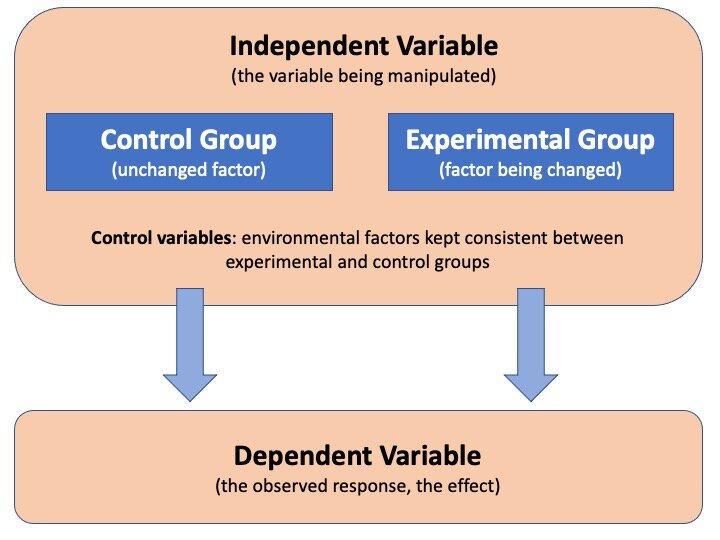
For our plant experiment, control variables would be things like the type of soil, the amount of water, and the pot size. By keeping these constant for all plants, we can be more confident that any difference in growth is actually due to the amount of sunlight—our independent variable—and not something else.
Let's review these key concepts.
In a research experiment, what is the role of the independent variable?
A scientist wants to determine if the temperature of the water affects the time it takes for a sugar cube to dissolve. What is the dependent variable?
Getting these basic building blocks right is the first step toward conducting sound research and drawing valid conclusions from data.