
Oboe
No history yet

how do we get a tan?

It is great to have you here! Before we dive into the science behind how your skin changes color in the sun, I would love to know what brings you to this topic.

I am curious about how to tan safely.

It is wonderful that you are looking to approach tanning with safety in mind. Before we can talk about how to minimize the risks, we first need to understand what is actually happening at the cellular level when your skin changes color.

Your path
UVA vs. UVB Rays
Risks vs. Benefits and Safe Practices

The Body's Defense System

At its core, a suntan is not a sign of optimal health—it is actually a protective against injury. When you step outside, the sun hits your skin with invisible ultraviolet (UV) radiation. Your body recognizes this radiation as an active threat that can scramble your cellular DNA. To keep those vital genetic blueprints safe from being mutated, your skin goes into an immediate cellular lockdown.

A single epidermal cell protecting its central nucleus from incoming ultraviolet rays with a supranuclear shield of pigment granules.

Think of it like a biological umbrella. The dark pigment that makes up a tan is deployed to shade the most sensitive parts of your cells from being cooked by the sun. Let's look at the specific cells that build and deploy these umbrellas.

Make a diagram of the skin layers

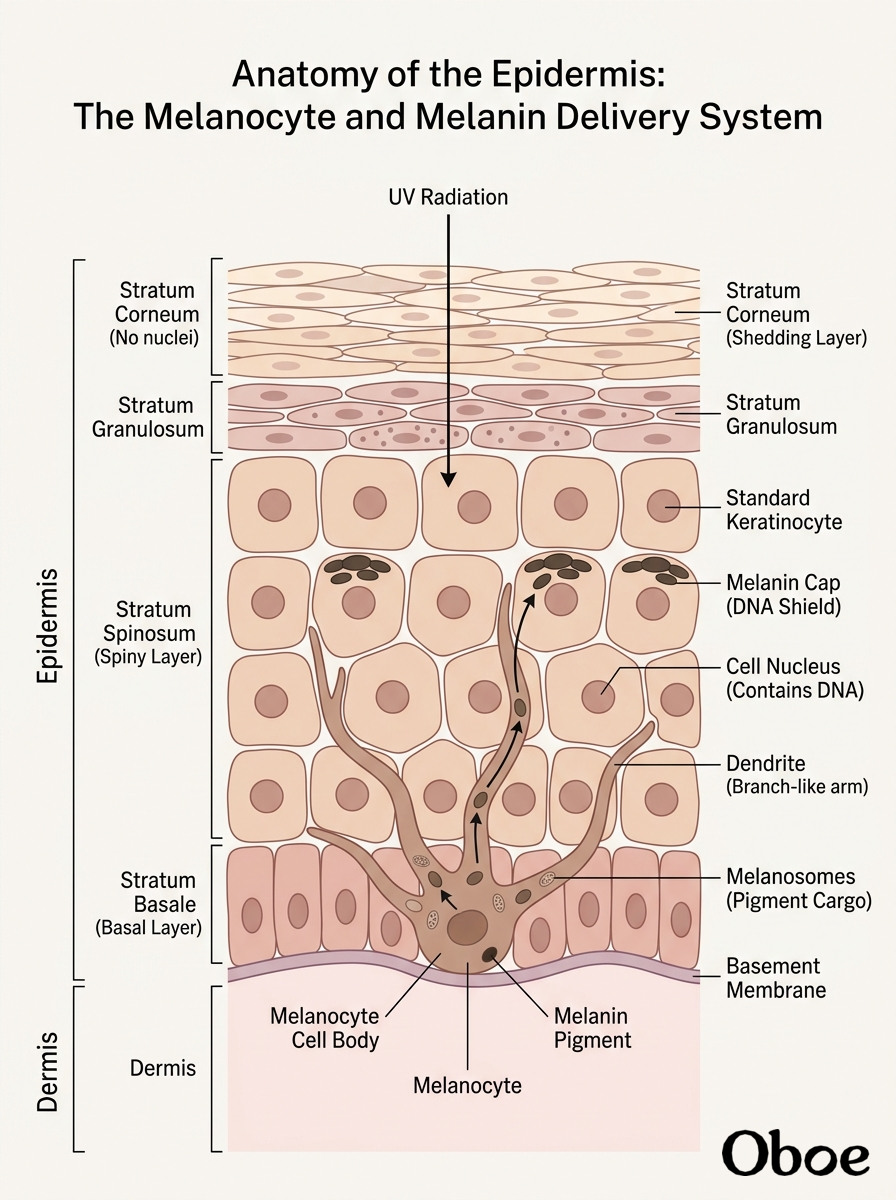
I would be happy to visualize that for you. To understand where these sun-shading cells live, we have to look at the very top layer of your skin, the .

DIAG
Diagram
Generated diagram
This diagram will show you exactly how your outer skin is structured. Notice how the epidermis is divided into distinct sub-layers. At the very bottom sits the , a single layer of cells that acts as the starting line for your skin's constant regeneration.

How often does this outer skin layer renew itself?

It is a continuous, busy cycle! Under normal conditions, your outer skin layer fully replaces itself about every 28 to 40 days. Because this renewal is happening non-stop, any pigment deposited in those rising cells is eventually carried to the surface and sloughed off. This is why a suntan naturally fades over a few weeks if you stay out of the sun—those pigment-packed cells are simply reaching the end of their lifespan and washing away. Now, let's look at exactly how those star-shaped we saw in the diagram actually deliver their protective pigment to the surrounding cells.

The Umbrellas Deploy

Melanocytes are permanently anchored in that bottom stratum basale layer, but they have long, branch-like arms called that reach upward, snaking between the neighboring skin cells. When UV light triggers these factories, they pack the dark pigment, melanin, into tiny cellular shipping crates called . These melanosomes travel up the long branches and are literally injected directly into the surrounding cells. Once inside, they don't just scatter randomly. They gather together to form a tight, protective cap right over the cell's nucleus, shielding the precious DNA inside from being mutated by incoming UV rays.

A melanocyte cell with branching dendrites delivering circular melanosome packages to adjacent keratinocytes, where they aggregate as a protective cap above each nucleus.

I've started rendering an interactive visual to show this delivery mechanism in action. You will be able to see how those packages travel up the branches to form their physical shields.

Before we talk about how different types of sun rays change this process, let's make sure this "umbrella" system makes sense.

Continue to the difference between UVA and UVB rays

The Dual Threat: UVA vs. UVB

Now that we understand how the biological protective umbrella deploys, we can look at the two different triggers behind it. Sunlight carries two distinct types of ultraviolet radiation that penetrate your skin: and . These two wavelengths play completely different roles in how your skin reacts, how a tan forms, and the type of damage left behind. One causes an immediate but temporary change, while the other forces your body to build entirely new defenses.
FeatureUVA RaysUVB Rays
Primary TargetDeep dermisSurface epidermis
Immediate EffectOxidizes existing melanin (instant tan)Direct DNA damage & sunburn
Melanin ProductionNo new melanin producedTriggers brand-new melanin synthesis
Skin ProtectionDoes not protect against future burnsBuilds a delayed, protective tan
Primary DangerPremature aging & deep cellular damageSunburn & direct DNA mutations
Think of UVA as an "oxidizer" and UVB as a "builder." When UVA hits your skin, it does not actually tell your melanocytes to make more melanin. Instead, it interacts with the melanin you already have, using oxygen to chemically darken it. This is why you might notice your skin looking darker almost immediately after stepping into the sun. However, because no new pigment is created, this instant tan fades very quickly and offers virtually no protection against future sunburns. UVB is where the real construction work begins. When UVB rays damage the DNA in your epidermal cells, the body panics and initiates . This is the actual manufacturing process of brand-new melanin. It takes a few days for the new pigment to be built, packed, and delivered up to the surface, which is why a UVB-induced tan is delayed but lasts much longer.