No history yet

The science of rainbows

Welcome! I am so excited to explore the science of rainbows with you. Before we dive into the physics of how light bends and bounces, I would love to know a bit more about you so I can tailor our conversation.

What brings you here today, and how much do you already know about how rainbows form?

I need to teach this to someone else or study for school.

It is wonderful that you are preparing to teach this! Rainbows are one of those rare science topics that feel like absolute magic until you understand the simple physics behind them. Let us look at what we will cover during our session to get you ready.

Your path
The Science Behind the Colors: Refraction and Reflection
Beyond the Primary Rainbow

What is a Rainbow, Really?

To start off, here is a secret that surprises many people: a rainbow is not a physical, touchable object. You cannot hike to the end of one, and two people standing in different spots actually see entirely different rainbows! Instead, a rainbow is an . It is a trick of light that only exists when sunlight, water, and your eyes align in a very specific way.
To make this visual trick happen, you need three key ingredients:
  1. Sunlight (providing the light energy)
  2. Water droplets suspended in the air (acting as tiny, natural mirrors and prisms)
  3. An observer (you, or the student you are teaching, positioned in the right spot)
Let us start by looking at the first ingredient: the light itself. The sunlight we see every day looks clear or white, but it is actually a crowded soup of different colors traveling together!

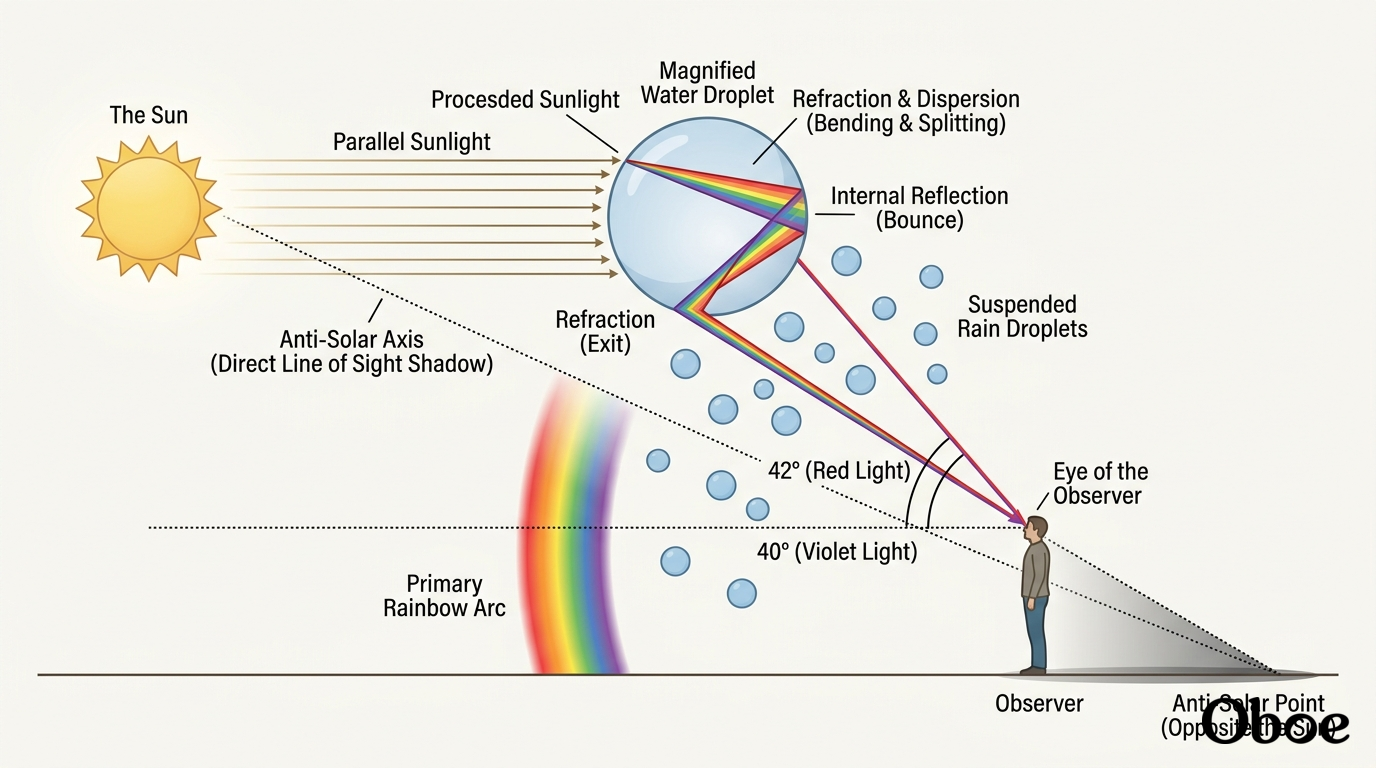
Make a diagram of the three ingredients

I would love to help you visualize how these three parts come together. Let us map out exactly how the sun, the droplets, and the observer must align.

DIAG
Diagram
Generated course diagram
I have put together a diagram showing how these pieces align. Now that we have seen the layout, let us look closer at the first key ingredient: sunlight. Even though sunlight looks clear or white, it is actually a crowded mix of different colors traveling together. Scientists refer to this range of colors as the , which our eyes perceive as a single beam of light until something separates it.