The Power of Context in Information
Context and Meaning
From Data to Meaning
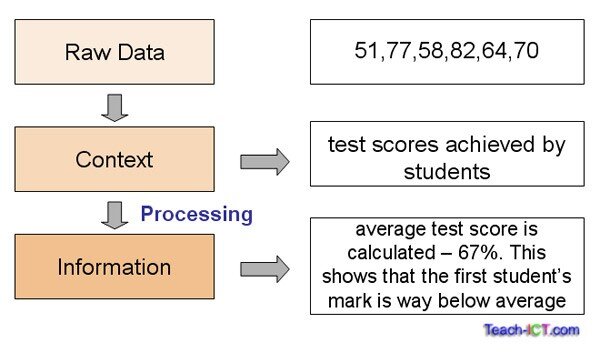
Raw data is just a collection of symbols, numbers, or characters. A list of numbers like 72, 85, 61, 93, and 77 is just data. It has no intrinsic meaning. To turn it into information, we need context.
Context is the frame of reference that gives data purpose and meaning. If we know those numbers are the test scores for a student, the data becomes information. We can now calculate an average, track performance, or compare it to the class. Information, in turn, becomes knowledge when it's understood, internalized, and connected with other information. Knowing the student's average is 77.6 is information; understanding that this student struggles with essays but excels at multiple-choice questions is knowledge.
The bridge between data and information is built on resolving ambiguity. Human language is full of words with multiple meanings, a concept known as semantic ambiguity. The word 'bank', for example, could refer to a financial institution or the side of a river. Without context, the meaning is unclear.
When someone says, "I need to go to the bank to get some cash," the financial context is obvious. If they say, "Let's have a picnic by the river bank," the geographical meaning is clear. We process this instantly because our brains are excellent at using surrounding cues to filter out irrelevant meanings.
Context is vital for understanding nuances of meaning and usage.
Types of Context
Context isn't a single thing. It's a combination of different factors that frame our understanding. The most common types are temporal, spatial, and social.
Temporal context relates to time. The statement "The temperature is 25 degrees" means something very different in Celsius during winter in Canada versus summer in Brazil. Time of day, year, or historical era all provide crucial temporal context.
Spatial context is about location. Shouting "Fire!" is a reasonable warning in a crowded theater but an odd thing to do at a barbecue. The physical environment dictates the appropriate interpretation of actions and words.
Social context involves the relationships between people and their shared cultural norms. Saying "Hey, what's up?" to a close friend is a casual greeting. Using the same phrase to address a judge in a courtroom would be interpreted very differently. Your role, the other person's role, and the setting all create social context.
| Context Type | Definition | Example |
|---|---|---|
| Temporal | The frame of reference related to time. | "See you tomorrow" means something different on Friday. |
| Spatial | The frame of reference related to location. | "It's quiet here" in a library vs. a rock concert. |
| Social | The frame of reference related to relationships. | The phrase "I'm fine" can signal distress or contentment. |
The Machine's Dilemma
Humans navigate these layers of context almost effortlessly. We operate with a vast, implicit understanding of the world we call 'shared context' or 'common sense'. This shared knowledge allows for efficient communication. We don't need to explain every detail from scratch because we assume others have a similar base of understanding.
This is where digital systems have historically struggled. A computer doesn't inherently understand that a river bank isn't a place to deposit a check. Programming a machine with the near-infinite set of contextual rules that govern human interaction is a monumental task. This challenge is related to a long-standing issue in cognitive science and artificial intelligence.
Frame Problem
noun
In artificial intelligence, the challenge of determining which information is relevant to a situation and which can be ignored. An AI trying to accomplish a task must be able to filter out an immense amount of irrelevant data about the world to focus only on what matters for the task at hand.
Early attempts at machine translation, for instance, were famously literal. They lacked the sophisticated contextual understanding to handle idioms or ambiguity. While modern AI, especially Large Language Models (LLMs), has made incredible strides by learning statistical patterns from enormous datasets, the core challenge of replicating true, human-like contextual understanding remains.
These systems are very good at predicting the next word in a sequence based on the context of the preceding words, but they don't understand in the way a human does. They are masters of syntax and pattern recognition, but the deep, semantic grasp of a situation—the core of shared context—is still an active area of research.
What is the primary factor required to transform raw data into meaningful information?
A single piece of data is the temperature '20 degrees'. Which type of context is most crucial for understanding whether this is hot or cold?
Understanding context is the key to moving beyond raw data. It's how we build meaning, resolve ambiguity, and communicate effectively, both with each other and with the machines we create.