The EPR Paradox Explained
Introduction to Quantum Mechanics
The Quantum World
Our everyday world runs on what physicists call classical mechanics. If you throw a ball, you can predict its path perfectly. You know where it is and where it's going. But when we zoom in to the scale of atoms and electrons, these familiar rules break down. Welcome to quantum mechanics, where things are fuzzy, uncertain, and exist in multiple states at once.
Is It a Wave or a Particle?
One of the first strange ideas from quantum mechanics is that tiny things like electrons can act as both particles and waves. This is called wave-particle duality.
To see this in action, physicists use the double-slit experiment. Imagine a wall with two vertical slits in it and a screen behind it. If you shoot tiny paintballs at the wall, some will go through the slits and hit the screen, forming two distinct lines. That's how particles behave.
Now, imagine sending waves, like ripples in water, toward the same two slits. When the waves pass through, they interfere with each other. Where crest meets crest, the wave gets bigger. Where crest meets trough, they cancel out. The result on the screen is an interference pattern, a series of bright and dark bands, not just two lines. This is classic wave behavior.
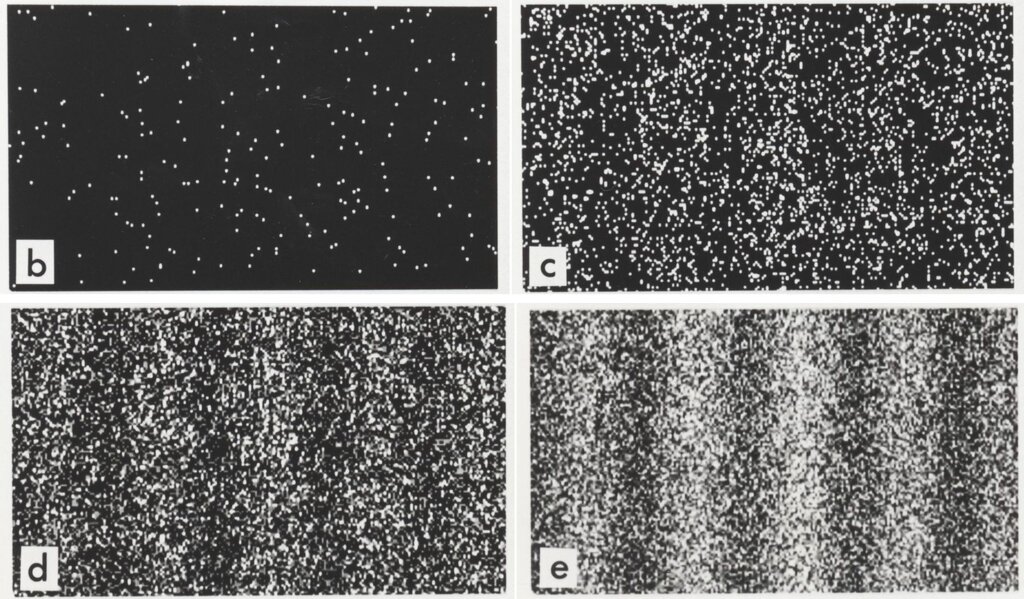
Here's the quantum mystery. When scientists fire electrons one by one at the two slits, each electron lands on the screen as a single dot, like a particle. But over time, as more and more electrons accumulate, they don't form two simple lines. They build up an interference pattern, just like waves.
It’s as if each electron, traveling by itself, somehow goes through both slits at once, interferes with itself, and then decides where to land. This experiment reveals the dual nature of quantum objects. They are neither just particles nor just waves; they are both, simultaneously.
The Uncertainty Principle
Another core concept is the Heisenberg Uncertainty Principle. It states that there's a fundamental limit to how precisely we can know certain pairs of properties of a particle at the same time. The most famous pair is position and momentum.
Momentum is an object's mass multiplied by its velocity. It tells you how much 'oomph' it has and in what direction. The uncertainty principle says the more accurately you measure a particle's position, the less accurately you can know its momentum, and vice versa. It’s not about having bad measuring tools; it’s a built-in feature of the universe.
Imagine trying to take a picture of a fast-moving car. A quick snapshot will give you a clear image of its position but tell you nothing about its speed. A long exposure will create a blur, giving you a good idea of its speed and direction but making its exact position at any moment uncertain.
This trade-off is described by a simple mathematical relationship. If is the uncertainty in position and is the uncertainty in momentum, then their product can never be smaller than a certain value, related to a fundamental constant of nature called Planck's constant ().
This means we can never know both the exact position and exact momentum of an electron simultaneously. If we pinpoint its location ( is small), its momentum becomes highly uncertain ( is large). This inherent fuzziness is a key part of the quantum world.
A State of Superposition
In our daily lives, an object is in one definite state at a time. A coin is either heads or tails. A light switch is either on or off.
In quantum mechanics, a system can exist in a combination of multiple states at the same time. This is called superposition. Think of an electron's spin, a property that can be 'up' or 'down'. Until we measure it, the electron isn't just up or down; it's in a superposition of both states at once.
Superposition
noun
The principle that a quantum system can exist in a combination of multiple states or conditions at the same time.
Imagine a spinning coin. While it's spinning in the air, you could say it's in a state of both heads and tails. It's only when you catch it and look—when you 'measure' it—that it settles into one definite outcome.
Quantum superposition is similar, but far more fundamental. The act of measurement forces the system to 'choose' one of its possible states. Before the measurement, the system is described by a mathematical object called a wave function, which contains the probabilities for all possible outcomes. When we measure, the wave function 'collapses' into a single, definite state.
Two concepts in quantum physics that are the building blocks of quantum computing are superposition and entanglement.
These three ideas—wave-particle duality, the uncertainty principle, and superposition—form the bedrock of quantum mechanics. They challenge our intuition about how the world works, but they are essential for understanding the strange and fascinating behavior of the universe at its smallest scales.
In the double-slit experiment, when electrons are sent through the slits one at a time, what pattern do they eventually form on the screen?
According to the Heisenberg Uncertainty Principle, if you measure the position of an electron with extremely high precision, what happens to the precision of its momentum measurement?