The Epic Journey of Computing
Mechanical Calculators
The First Calculators
Before gears and electricity, there was the abacus. It wasn't a machine, but a tool that made calculation faster and more reliable than just using your fingers. An abacus consists of a frame with rods, and on each rod, beads are moved up and down. Each rod represents a different place value, like ones, tens, and hundreds.
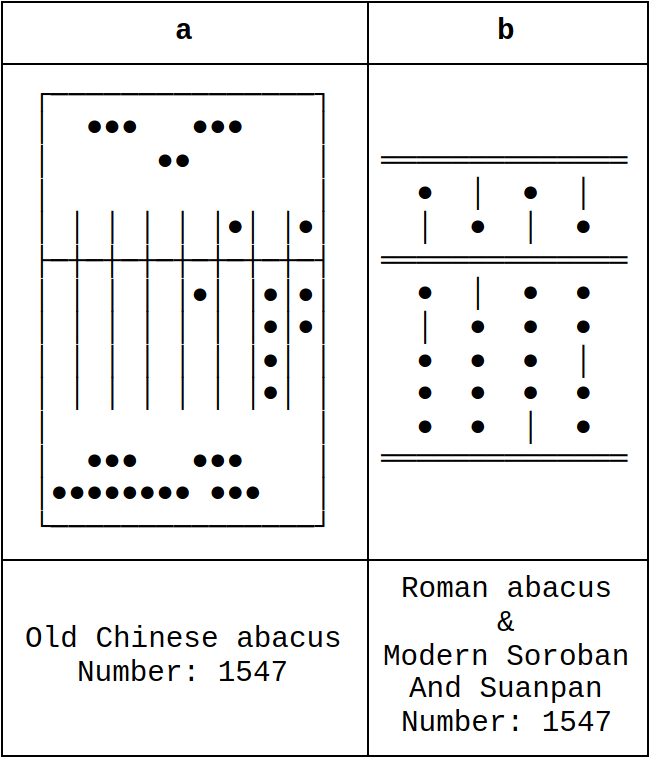
By sliding beads along the rods, a skilled user could perform addition, subtraction, multiplication, and division with surprising speed. The position of the beads represents a number, making it easy to track complex calculations without having to hold everything in your head. It was a simple, yet powerful, system that served as the primary calculating device across Asia and Europe for centuries.
Abacus, an instrument to calculate or count by using sliding counters and rod is indeed the world's first calculator.
Gears of Progress
The next major leap came from mechanizing the process of calculation. In 1642, a young French mathematician named Blaise Pascal invented a device to help his father, who was a tax supervisor. The sheer volume of tedious arithmetic inspired Pascal to build a machine that could automate it.
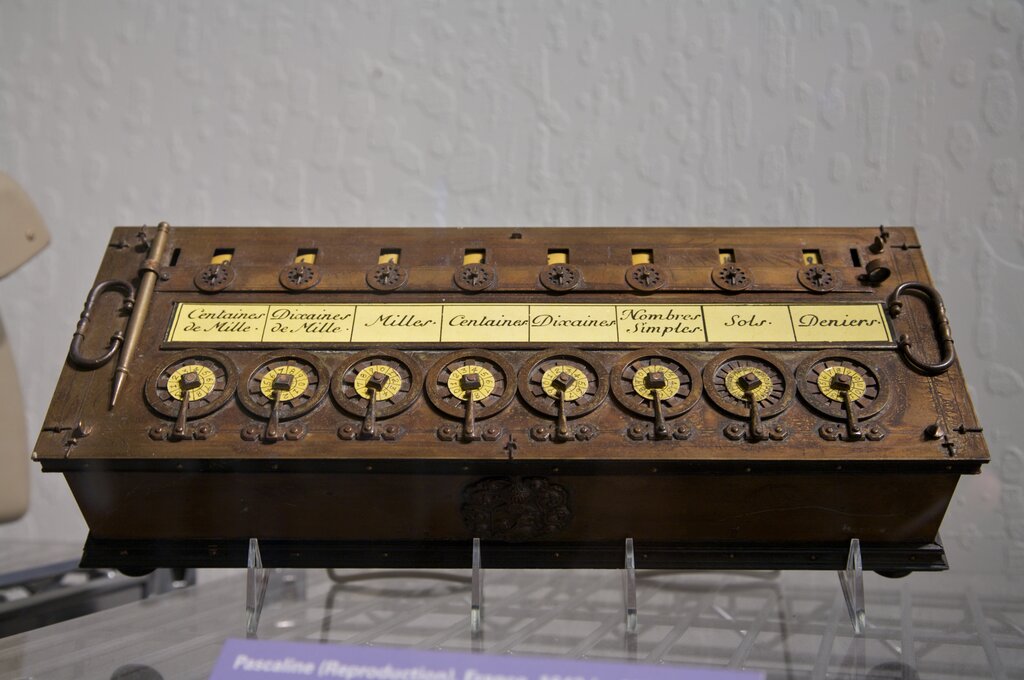
The result was the Pascaline. It was a box filled with interconnected gears and wheels, each marked with the digits 0 through 9. When a wheel completed a full rotation, from 9 back to 0, it would automatically advance the next wheel by one position. This was the mechanical equivalent of carrying a one in addition.
While revolutionary, the Pascaline was limited. It could handle addition and subtraction effectively, but multiplication and division were still cumbersome, requiring the user to perform a series of repeated additions or subtractions.
Beyond Simple Arithmetic
About 50 years after Pascal, the German polymath Gottfried Wilhelm Leibniz took on the challenge of building a more capable calculator. He was driven by a grander vision: to create a machine that could handle all the drudgery of mathematical work, freeing the human mind for more creative tasks.
Leibniz built mechanical calculators and imagined a universal logical language, in which reasoning could be reduced to calculation.
His invention, the Stepped Reckoner, was completed in 1694. Its key innovation was the "Leibniz wheel" or stepped drum. This was a cylinder with nine teeth of varying lengths. By setting an input gear along this drum, a user could multiply a number by any digit from 1 to 9 in a single crank turn. This made multiplication and division as straightforward as addition and subtraction.
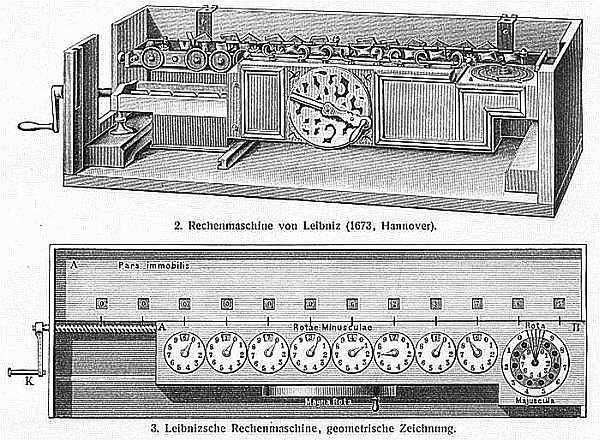
Although the Stepped Reckoner was a brilliant design, the mechanical precision required to build it was difficult to achieve in the 17th century. The two prototypes that were built were not always reliable. Still, its underlying principles laid the groundwork for the more successful mechanical calculators that would follow over the next two centuries.
Let's check your understanding of these early computing devices.
What was the primary advantage of using an abacus over manual calculation methods like using one's fingers?
Blaise Pascal was inspired to invent the Pascaline to solve a problem faced by his father. What was his father's profession?
These early mechanical devices showed what was possible. They replaced manual effort with the predictable motion of gears, a fundamental step on the path toward modern computing.