The Crucial Role of Data
Introduction to Data
What Is Data?
At its core, data is a collection of facts. These can be numbers, words, measurements, or even just descriptions of things. Think of data as the raw, unorganized material from which we can build understanding. On its own, a single piece of data, like the number 12, doesn't mean much. But when we add context, like "12 apples," it starts to become useful information.
Data
noun
A collection of discrete or continuous values that convey information, describing the quantity, quality, fact, statistics, or other basic units of meaning.
Data comes in two main flavors: discrete and continuous.
-
Discrete data can only take on specific, separate values. You can count it. For example, the number of students in a class or the number of cars in a parking lot. You can't have half a student or a quarter of a car.
-
Continuous data can take on any value within a range. You measure it. Think of someone's height, the temperature outside, or the weight of a package. These values can be incredibly precise, with many possible points between any two values.
Data is the raw material. Information is the finished product. To get from one to the other, you need context.
Organized vs. Disorganized
Not all data is created equal. The biggest difference you'll encounter is how it's organized. This splits data into two main categories: structured and unstructured.
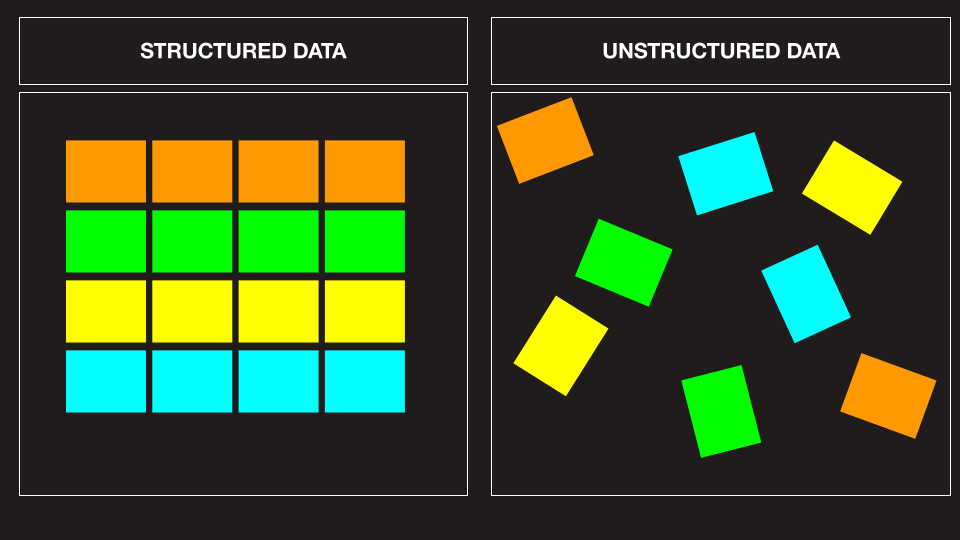
Structured data is highly organized and formatted in a way that makes it easily searchable. Think of a spreadsheet or a database. Everything has a specific place and follows a clear model. This organization makes it simple for computers to process and analyze.
| User ID | First Name | Last Name | City |
|---|---|---|---|
| 101 | Maria | Garcia | Houston |
| 102 | Chen | Wei | New York |
| 103 | Sam | Jones | Chicago |
Unstructured data, on the other hand, has no predefined format. It's the messy, complex stuff that makes up most of the digital world. Examples include emails, social media posts, photos, videos, and audio files. While it’s rich with information, it's much harder to process and analyze without advanced tools.
There is also a middle ground called semi-structured data, which doesn't fit neatly into a table but has some organizational properties, like tags, that make it easier to analyze than purely unstructured data.
Why Data Matters
Understanding data is crucial because it's the starting point for making smarter decisions. In almost every field, data helps people spot patterns, understand trends, and solve problems. A retailer might analyze sales data to figure out which products are most popular. A doctor might use patient data to diagnose an illness more accurately. A city planner could use traffic data to design better roads.
Data provides the evidence needed to move from guessing to knowing. By collecting and interpreting data, we can uncover insights that lead to innovation and progress in business, science, and our daily lives.
Now let's review what you've learned about the fundamentals of data.
Which of the following best describes data in its most basic form?
A coffee shop owner tracks the number of cappuccinos sold each day. What type of data is this?
Grasping these basic concepts is the first step toward understanding how data shapes our world.