
The chemistry of cooking
Welcome! I'm so excited to explore the science behind what makes food taste amazing. Before we dive into the delicious physics and chemistry of the kitchen, I'd love to know a bit about your background so I can make this session as helpful as possible.
To help me tailor this session, could you tell me a little bit about your current cooking experience and why you are interested in the chemistry behind it?
I just love science and think food chemistry sounds fascinating!
It is so exciting to have a fellow science lover here! Let's get right into the lab—which is exactly what your kitchen is.

The Ultimate Laboratory
When you step up to the stove, you aren't just making dinner; you are orchestrating a complex sequence of chemical reactions and physical transformations. Every time you slice an onion, sear a steak, or whisk a sauce, you're manipulating atoms and molecules.
Think about what happens to a raw egg. You start with a runny, translucent liquid. But as you apply by whisking, or thermal energy by heating, those liquid proteins uncoil, tangle up, and trap water, transforming into a solid, fluffy scramble. That's not just cooking—it's a fundamental restructuring of matter.
Continue to the role of heat as energy
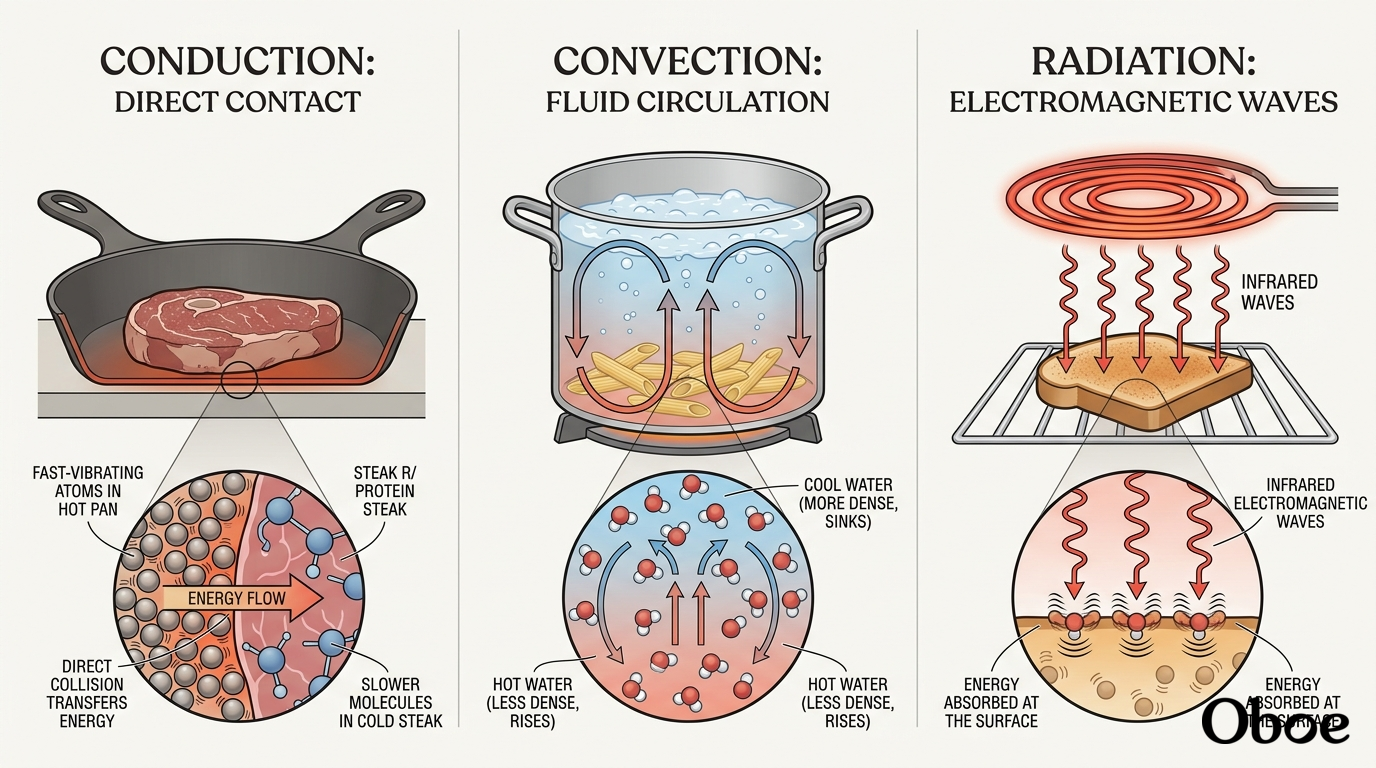
The Great Energy Relay
| Heat Transfer Method | How It Works | Kitchen Example |
|---|---|---|
| Conduction | Direct physical contact | Searing a steak on a hot cast-iron skillet |
| Convection | Movement of fluids or gases | Boiling pasta in water or baking in a fan oven |
| Radiation | Electromagnetic waves | Toasting a marshmallow over an open fire |
Give me a diagram of the three heat transfer types
You've got it! Visualizing how energy actually moves is one of the best ways to master your stovetop.

Energy vs Speed
- measures the average speed of the molecules in a substance. It tells us how fast the individual particles are vibrating or bouncing around.
- is the total energy of all those moving molecules combined. It depends not just on how fast they are moving, but on how many of them there actually are.