
The chemistry of cooking
Welcome! I'm so excited to explore the science of the kitchen with you. Before we dive into the chemical transformations of food, I'd love to know a bit more about your background so we can make this as practical as possible.
What is your current experience level with cooking, and is there a particular culinary goal or type of cooking you are most interested in?
I'm a complete beginner, and I just want to learn how to not burn my dinner!
It is great to meet you! Learning how not to burn your dinner is the absolute perfect place to start, and science is your secret weapon to make that happen.

The Energy of Your Pan
To keep your dinner from turning into charcoal, we have to look at what is actually happening when you turn on the stove.
In science, we do not just think of as a temperature setting on a dial. Heat is actually kinetic energy on a microscopic scale.
When you apply heat to a pan, you are injecting energetic, vibrating motion into the food's molecules. The higher the heat, the faster those molecules wiggle, collide, and change.
Cooking is essentially a race. We want to use this molecular energy to kickstart delicious chemical reactions (like browning your food to build flavor) before the energy gets so high that it literally tears the molecules apart, leaving you with black, bitter, carbonized ruin.
To control this race, we need to understand how that energy travels from your stove burner into your food.
Give me a quick worksheet to test my starting kitchen knowledge
I would love to help you test your starting knowledge. Let's get a worksheet set up right now to check your cooking intuition before we dive into the science of conduction, convection, and radiation.

I have put together a quick, interactive worksheet to help you test your instincts. Take a look and let me know how you feel about these concepts once you've gone through it.
Give me a quick quiz instead
You got it! Let us put the worksheet aside and jump straight into a quick quiz to test your kitchen instincts.
Before we look at the physics of how heat moves around, let us see how you would handle a real-world cooking scenario to keep your dinner from burning.
Imagine you are searing a chicken breast in a hot pan. The outside is starting to turn a dark, threatening black, but you know the inside is still completely raw.
To save your dinner from carbonizing while still making sure it is cooked safely through, which of these moves makes the most scientific sense?
Press the chicken down firmly with a spatula to cook the inside faster.
You are certainly not alone in thinking that! It is incredibly tempting to press down with a spatula when you want the heat to travel faster, but from a scientific perspective, that actually works against you.
When you press down on a piece of meat, you are not actually speeding up the transfer of heat through the middle. Instead, you are physically squeezing out the natural water and liquid fats trapped inside the cellular structure of the chicken. Because water is an excellent conductor of heat within the meat itself, losing that moisture actually slows down the cooking process on the inside, while leaving your chicken dry, tough, and much more likely to burn on the outside.
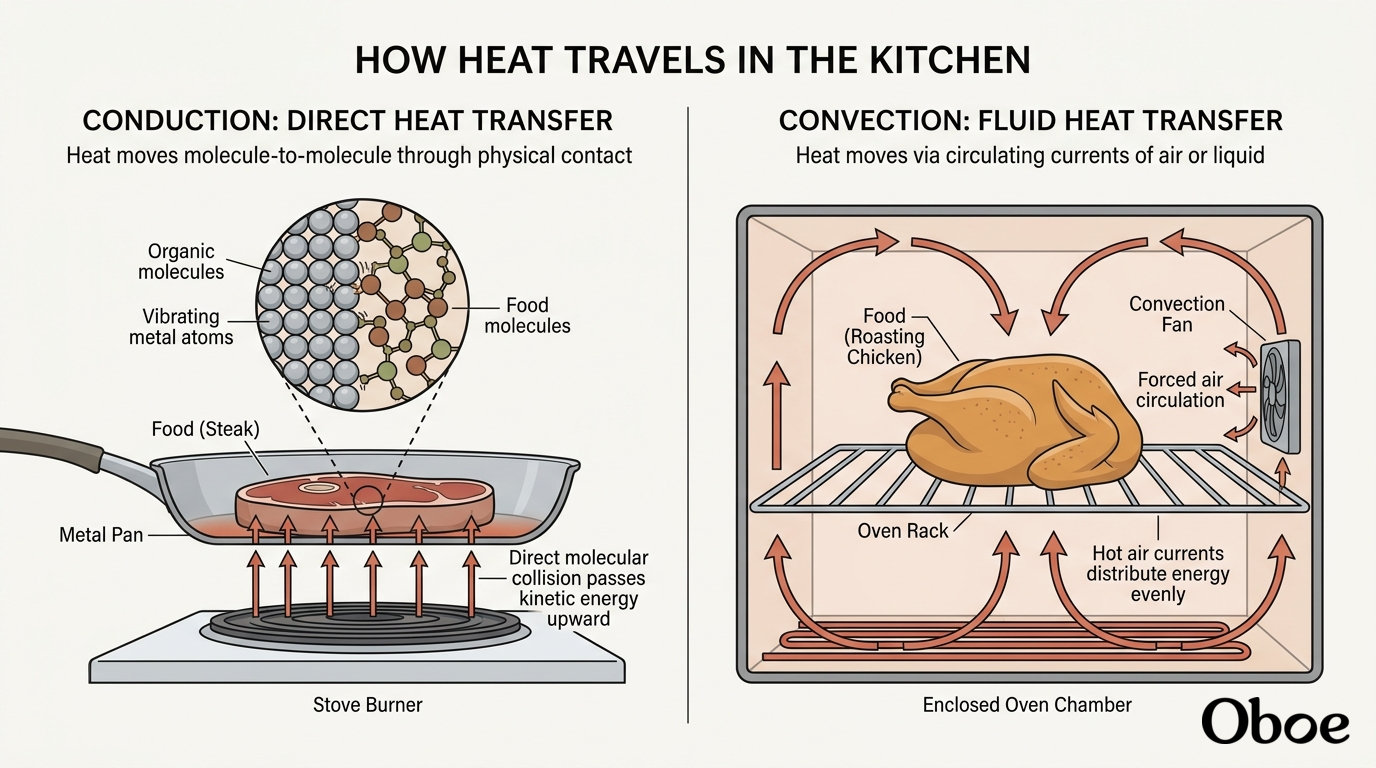
Make me a diagram of conduction vs convection
I would love to help you visualize that. Seeing how heat actually travels makes it so much easier to understand why a pan behaves differently than an oven.

Continue to the third method, radiation
Let's bring in the third and final player in our heat transfer lineup: .
Unlike conduction (which requires physical touching) or convection (which requires a moving fluid), radiation does not need a middleman. It travels directly through space as invisible energy waves.
In your kitchen, you experience this when you use a broiler or hold your hand next to a screaming-hot cast-iron pan. The intense, direct heat beaming off the heating element or the coals of a grill is radiant energy.
Because radiant heat travels in straight lines and hits only what is directly in its path, it can be incredibly intense. This is why a broiler can brown—or blacken!—the top of your cheese toast in a matter of seconds, even though the air around it isn't quite as hot.
The Ultimate Burn-Prevention Strategy
Now that you know the big three, you can start combining them to master temperature control and keep your dinners safe.
Think of every dish you cook as a balance of these three forces. When you are pan-frying chicken, you are mostly using conduction (the hot pan panicking the surface of the meat). If the outside is burning before the inside cooks, conduction is moving too fast. To fix it, you have to transition to convection (covering the pan with a lid to trap hot, circulating air) or finish it in the oven where gentle, wrap-around convection heat can finish cooking the center without scorching the crust.
By knowing how heat is entering your food, you can actively swap methods to get the perfect result.
Give me a summary diagram of all three heat transfer methods
You've got it! Visualizing how these three energy pathways collide in a single pan is the ultimate way to master your stove and keep your dinner from burning.
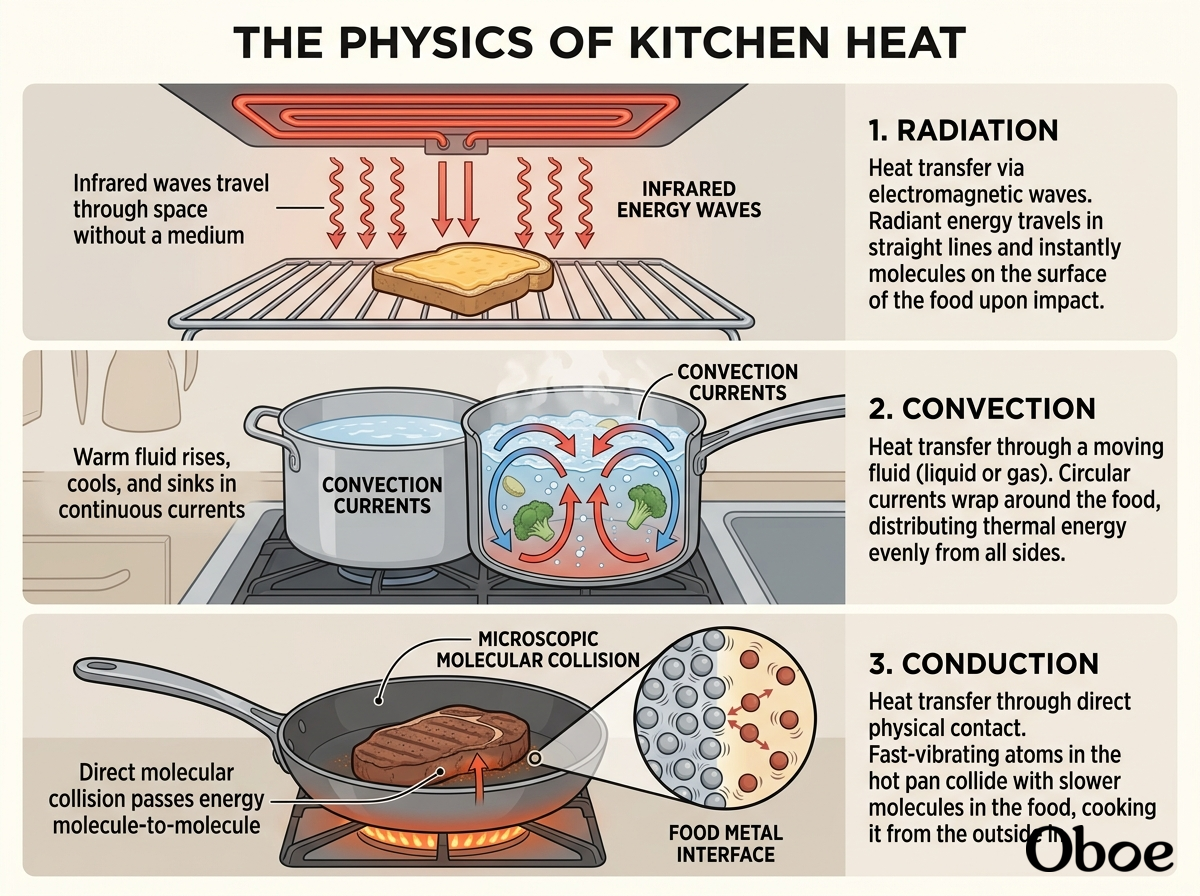
I have queued up that summary diagram for you. While it generates, let's wrap up this first step of our journey by looking at how you can use all three of these methods together to save your dinner.
Imagine you are pan-searing a thick pork chop. If you rely entirely on , the direct contact with the blazing hot metal will char the outside to ash before the middle even begins to warm up.
To prevent this, you can turn down the heat and put a lid on the pan. Now, you've introduced convection—trapping the rising steam and hot air to gently cook the top and inside of the meat from all sides. If you want to finish it with a beautiful, bubbly glaze, you can pop it under the broiler for a quick blast of to caramelize the top.
By fluidly moving between these three methods, you control the pace of the molecular race, ensuring your food cooks beautifully all the way through without ever burning.