The Building Blocks of Life Nucleic Acids
Nucleic Acid Basics
The Code of Life
Every living organism, from a tiny bacterium to a giant blue whale, has a set of instructions that tells it how to grow, function, and reproduce. This master blueprint is stored in molecules called nucleic acids. The two main types are deoxyribonucleic acid (DNA) and ribonucleic acid (RNA).
Think of them as long chains, or polymers, built from smaller, repeating units. Understanding these fundamental units is the first step to understanding genetics itself.
Meet the Nucleotide
The repeating unit that makes up both DNA and RNA is called a nucleotide. No matter which nucleic acid you're looking at, every single nucleotide has the same basic three-part structure.
A nucleotide consists of a phosphate group, a five-carbon sugar, and a nitrogenous base.
Let's break these down.
-
Phosphate Group: This is the acidic component of the nucleotide. Phosphate groups are crucial because they link nucleotides together, forming the backbone of the nucleic acid chain.
-
Pentose Sugar: This is a sugar molecule with five carbon atoms. Its identity is a key difference between DNA and RNA. In RNA, the sugar is ribose. In DNA, it's a slightly modified version called deoxyribose, which has one less oxygen atom.
-
Nitrogenous Base: This part of the nucleotide contains nitrogen and acts like a letter in the genetic alphabet. There are five different bases in total, but they are split between DNA and RNA.
DNA vs. RNA Components
While DNA and RNA are built from the same three-part nucleotide structure, the specific components they use are slightly different. These differences are fundamental to their roles in the cell.
The first major difference is the sugar. As mentioned, DNA uses deoxyribose, while RNA uses ribose. The second difference is in the set of nitrogenous bases they use.
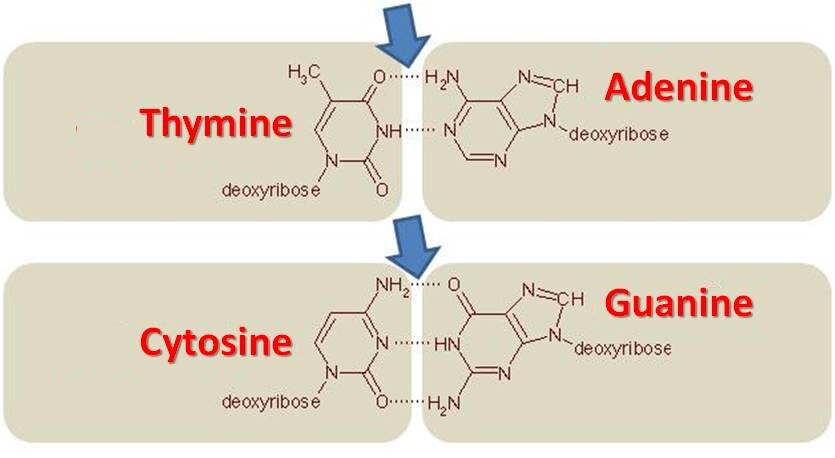
DNA uses four bases: Adenine (A), Guanine (G), Cytosine (C), and Thymine (T).
RNA also uses four bases, but it swaps out Thymine for a different base called Uracil (U). So, the RNA alphabet is A, G, C, and U.
| Component | DNA | RNA |
|---|---|---|
| Sugar | Deoxyribose | Ribose |
| Bases | A, G, C, T | A, G, C, U |
The Primary Structure
When we talk about the primary structure of a nucleic acid, we are simply referring to the order in which these nucleotides are strung together. Nucleotides link up by forming strong covalent bonds between the sugar of one nucleotide and the phosphate group of the next.
This creates a long chain with a sugar-phosphate backbone. The nitrogenous bases stick out from this backbone, like rungs on a ladder.
The sequence of these bases is what carries the genetic information. A sequence like A-G-C-T in DNA carries a different instruction than T-G-C-A. It's this specific order, the primary structure, that forms the fundamental code for all life.
What are the three fundamental components that make up a single nucleotide?
A primary structural difference between DNA and RNA is the type of sugar each contains. Which sugar is found in RNA?
These basic building blocks and their sequences are the foundation of genetics. In more complex structures, these chains twist and pair up, but it all starts with the simple, linear order of nucleotides.