Technical Sketching and Form
Advanced Line Dynamics
The Eloquent Line
A simple outline tells you what an object is. But a dynamic line tells you what it feels like. By mastering line dynamics, you can make your sketches breathe. It’s the difference between a drawing that is merely seen and one that is experienced. This isn’t about shading; it’s about making the line itself do the heavy lifting of conveying form, weight, and emotion.
Line Weight
noun
The perceived thickness or thinness of a line in a drawing. It is controlled by applying more or less pressure with the drawing tool.
Modulating your line weight is the most direct way to add dimension. Think of it as a volume knob for your pencil. A consistent, unvarying line produces a flat, diagram-like image. But when you vary the pressure, lines become descriptive. Heavier lines suggest weight, shadow, and proximity. They pull parts of the drawing toward the viewer. Lighter lines indicate distance, highlights, or more delicate surfaces.
Use line weight and the density and grouping of objects to create a sense of light and shade, depth and structure.
Practice this by drawing a simple cube. Use heavy, strong lines for the edges closest to you. As the edges recede into the distance, lighten your touch. The back edges should be the faintest. Instantly, the cube gains a sense of three-dimensional space without any shading at all.
Speed and Rhythm
The speed of your stroke directly impacts a line’s character. A fast, confident stroke creates a smooth, energetic line. It’s perfect for suggesting movement or sleek surfaces. A slow, deliberate stroke produces a more controlled, and sometimes wobbly, line. This can be used to describe rough textures or uncertain forms. The interplay between speed and pressure creates rhythm in your drawing.
A key technique that combines pressure and speed is the tapered line. This is a line that starts thick and thins to a point, or vice versa. To create it, you apply pressure at the beginning of the stroke and then lift the pencil as you flick it to a finish. This creates a beautiful, calligraphic quality. Tapered lines are excellent for drawing hair, folds in fabric, and blades of grass—anything that has a natural, organic flow. This effect is a hallmark of confident draftsmanship and embodies the idea of Sprezzatura in art.
Building a Hierarchy
Line hierarchy is how you use different line qualities to organize visual information and create a sense of depth. Think of your drawing as having a foreground, midground, and background. By assigning different line weights to each layer, you can guide the viewer's eye and build a convincing illusion of space. The heaviest, darkest, and sharpest lines belong in the foreground. The midground uses medium-weight lines. The background should be rendered with the lightest, thinnest lines, which causes them to recede.
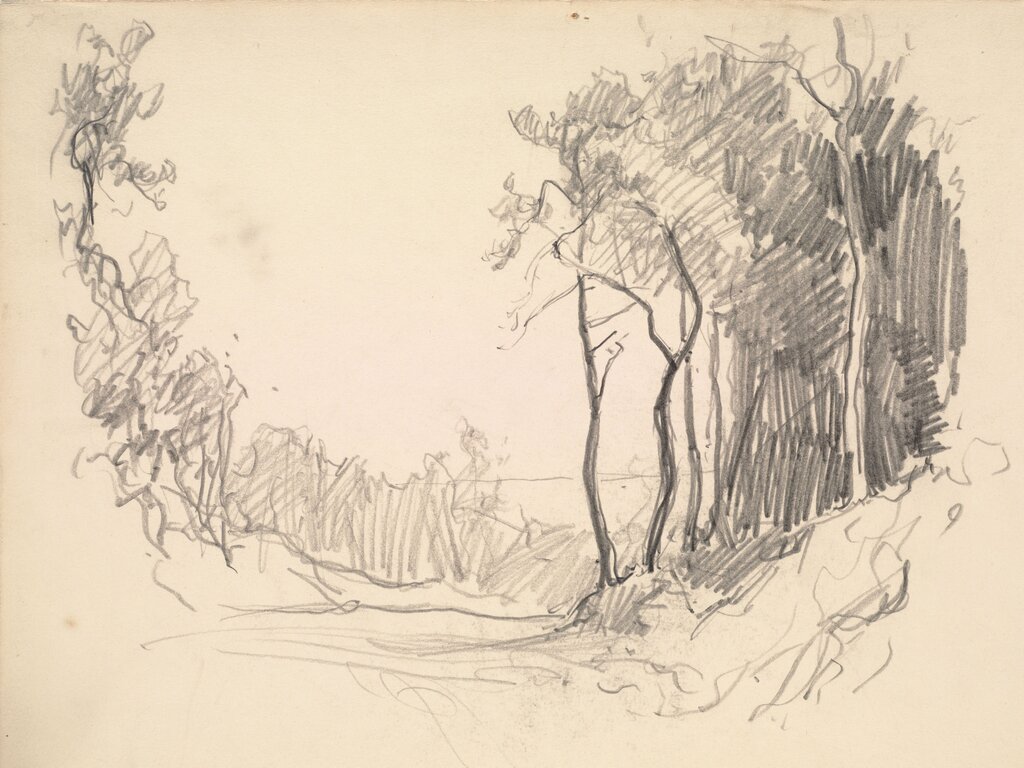
This principle also applies to objects within the same plane. The contour, or outline, of a form can be drawn with a slightly heavier line to separate it from other forms. Lines on the inside of a form, which describe its surface texture or smaller details, should be thinner. This contrast ensures the overall shape remains clear and readable.
Use your thickest lines for the closest objects, medium lines for what’s behind them, and your thinnest lines for what’s farthest away.
Sometimes the most powerful line is the one you don't draw. An implied line is created when the viewer's eye connects two or more separate elements. A row of dots, the direction of a person's gaze, or the break between two shapes can all create an invisible path for the eye to follow. These lines add subtlety and sophistication, engaging the viewer to participate in completing the image. Similarly, you can suggest an edge without a hard outline by letting two areas of texture or tone meet, letting the viewer's mind fill in the blank.
By moving beyond simple outlines and embracing these dynamic techniques, your lines become an active part of your storytelling. They can show force, fragility, distance, and texture all on their own.
Ready to test your understanding of line dynamics?
In the context of line dynamics, what does modulating your line weight primarily achieve?
When using line hierarchy to create depth in a landscape, where should the heaviest and darkest lines be placed?
Practice these techniques, and you'll find your sketches gain a new level of professionalism and vitality.