Structural Engineering and Mathematics
Calculus Basics
Calculus in Structures
Calculus is the mathematics of change, and structures are constantly subject to changing forces and stresses. It provides the tools to move from simple, uniform loads to complex, varying ones. Understanding calculus is key to predicting how a beam will bend, a column will buckle, or a bridge will handle traffic. We'll explore the core ideas: limits, derivatives, and integrals.
Limits and Continuity
The concept of a limit is about getting infinitely close to a value without necessarily reaching it. Think about walking toward a wall. You can get halfway there, then halfway again, and again. You get incredibly close, but you never technically touch it. In math, a limit is the value a function approaches as its input gets closer and closer to a certain number.
For a function , the limit as approaches a value is written like this:
This means as gets closer to , the function's output gets closer to . This idea is the foundation for everything else in calculus.
Continuity is a related concept. A function is continuous if you can draw its graph without lifting your pencil from the paper. There are no sudden jumps, holes, or breaks. For structural analysis, we assume materials are continuous. This allows us to model their behavior smoothly and predictably. A sudden break in our calculations would imply a sudden break in the material, which is exactly what engineers try to prevent.
Derivatives The Language of Change
A derivative measures the instantaneous rate of change. Imagine driving a car. Your speedometer tells you your speed at any given moment. That's a derivative—it's your rate of change of position at that instant.
In structural engineering, we aren't concerned with speed, but with how things like slope and force change along a beam or column. The derivative of a beam's deflection curve gives us its slope. The derivative of the slope gives us the bending moment, which is a measure of the internal forces that lead to bending. The derivative of the bending moment gives us the shear force.
Finding these maximum and minimum values, known as optimization, is one of the most powerful applications of derivatives. By setting the derivative of a function to zero, we can find the exact points where a beam experiences maximum bending or where deflection is greatest. This is critical for ensuring a structure is designed safely.
Mathematically, the derivative of a function , written as or , is the slope of the line tangent to the function at that point.
This formula calculates the slope of the curve at a single point by taking the slope between two points that are infinitesimally close together.
Integrals Summing It Up
If derivatives are about breaking things down into instantaneous moments, integrals are about summing them all up. An integral calculates the accumulation of a quantity. The classic example is finding the area under a curve by summing up an infinite number of infinitesimally thin rectangles.
In structural analysis, we use integration to go in the reverse direction of differentiation. If we know the distributed load on a beam (like the weight of snow on a roof), we can integrate it to find the total shear force. Integrating the shear force function gives us the bending moment. Integrating the bending moment (with some constants) gives us the slope, and integrating the slope gives us the deflection of the beam. This process allows us to determine the overall shape and stress within a structure based on the loads applied to it.
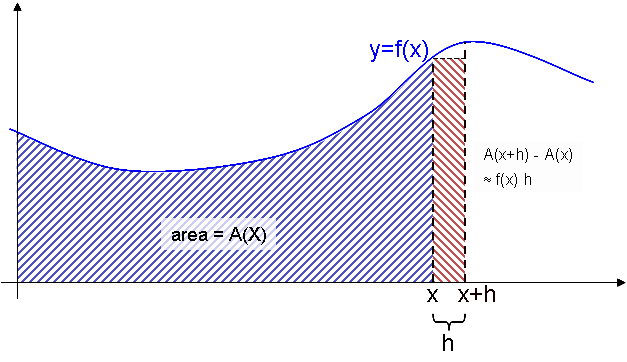
The definite integral of a function from a point to a point is written as:
This represents the cumulative effect or total accumulation of the function's value across that interval.
The Fundamental Theorem of Calculus
The Fundamental Theorem of Calculus is a beautiful and powerful idea that formally links derivatives and integrals. It states that differentiation and integration are inverse operations, just like multiplication and division are.
There are two parts to the theorem. The first part says that if you integrate a function and then take its derivative, you get the original function back.
If , then .
The second part gives us a practical way to calculate definite integrals. It says that to find the area under the curve of a function between points and , we just need to find its antiderivative, , and calculate the difference . An antiderivative is a function whose derivative is the original function .
This theorem is the backbone of calculus-based structural analysis. It allows us to move seamlessly between loads, shear, moment, and deflection, providing a complete picture of how a structure behaves under stress.
Calculus is built on two fundamental pillars: Differential Calculus and Integral Calculus.
A solid grasp of these core calculus concepts is not just about solving equations. It's about understanding the language used to describe the physical behavior of the structures all around us.
In calculus, what does the concept of a limit, represented as , describe?
If you know the function for the distributed load on a beam, what can you find by integrating it once?