Strategic Time Management and High-Performance Workflows
Advanced Prioritization Frameworks
Beyond the To-Do List
You're familiar with to-do lists and deadlines. But as responsibilities grow, just managing a list isn't enough. The real challenge is deciding what to work on when everything feels important. This requires moving from simple task management to strategic prioritisation. It's about understanding the difference between being busy and being effective.
What is important is seldom urgent and what is urgent is seldom important.
This insight, often attributed to U.S. President Dwight D. Eisenhower, is the foundation of a powerful decision-making tool. Instead of just looking at deadlines, we need a better way to evaluate our tasks. Let's explore how to sort through the noise and focus on what truly drives results.
The Eisenhower Matrix
The Eisenhower Matrix forces you to evaluate tasks based on two criteria: importance and urgency. Importance relates to your long-term goals and values. Urgency relates to time-sensitive demands, often coming from external pressures.
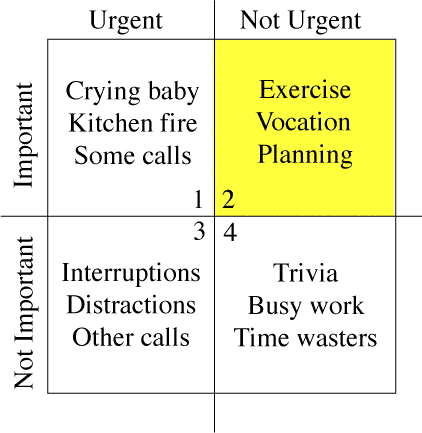
By plotting tasks on these two axes, you get four distinct quadrants, each with a clear strategy.
| Quadrant | Category | Action | Example |
|---|---|---|---|
| 1 | Urgent & Important | Do | A client crisis, a project with an immediate deadline. |
| 2 | Not Urgent & Important | Schedule | Strategic planning, professional development, building relationships. |
| 3 | Urgent & Not Important | Delegate | Some meetings, routine reports, other people's minor issues. |
| 4 | Not Urgent & Not Important | Delete | Trivial tasks, time-wasting activities, unnecessary perfectionism. |
Most professionals live in Quadrant 1, constantly 'firefighting'. The problem is that many urgent tasks feel important, but they aren't. They are distractions that keep you from Quadrant 2.
Quadrant 2 is where strategic progress happens. These activities, like planning, learning, and prevention, are easy to postpone because they lack a pressing deadline. However, consistently investing time in Quadrant 2 reduces the number of fires you have to put out later. It's the difference between being reactive and being proactive.
The key to sustained success is spending most of your time on important, non-urgent tasks. Proactively scheduling these prevents them from becoming future crises.
The Pareto Principle
Another powerful framework is the Pareto Principle, also known as the 80/20 rule. It suggests that for many outcomes, roughly 80% of the results come from 20% of the effort. This isn't a fixed mathematical law, but a common observation in business, economics, and personal productivity.
Think about your own work. Which few activities generate the most significant impact? Which clients bring in the most revenue? Which features of a product are used most by customers? Identifying this vital 20% is crucial for focusing your energy where it counts.
Applying the 80/20 rule means actively looking for high-leverage activities. Instead of trying to do everything, you strategically neglect or minimise the 80% of tasks that yield only 20% of the results. This frees up time and resources to double down on the critical 20%.
High-Leverage
adjective
Activities where a small amount of effort produces a large, disproportionate result. These are the tasks that align with the Pareto Principle's 'vital few'.
For example, in a sales role, 20% of clients might generate 80% of revenue. The high-leverage activity isn't just making more calls, but nurturing relationships with that key 20%. For a developer, fixing the 20% of bugs that cause 80% of user crashes is a more effective use of time than tackling minor cosmetic issues.
Putting It Together
These frameworks are not mutually exclusive; they complement each other. You can use the Pareto Principle to identify your most important, high-leverage tasks. These are your Quadrant 2 activities. Then, use the Eisenhower Matrix to schedule and protect the time to work on them, while consciously delegating or deleting the less important tasks that scream for your attention.
Dealing with complex stakeholder requests becomes easier with this approach. When a new request comes in, ask yourself:
- Is it important? Does it align with the 20% of activities that drive 80% of our goals?
- Is it urgent? Does it require immediate action, or can it be scheduled?
This two-step evaluation helps you respond strategically instead of just reacting to the latest demand. It's about making conscious choices about where to invest your most valuable resource: your attention.
Ready to test your understanding?
According to the Eisenhower Matrix, on what two criteria should tasks be evaluated?
Strategic, long-term progress, like planning and learning, is primarily achieved by focusing on tasks in which quadrant?
By moving beyond simple lists and applying these frameworks, you can ensure your efforts are not just busy, but truly productive.