Space Launch and Satellite Industry Leaders
Introduction to Space Launch Technologies
From Fireworks to Starships
The story of rockets begins not with space travel, but with celebrations and warfare. Over a thousand years ago in China, inventors packed gunpowder into bamboo tubes, creating the first fireworks. These simple rockets were also used as weapons, launching fiery arrows at enemies. For centuries, that was the primary use of rocketry.
The leap to space travel was a theoretical one at first. In 1903, a Russian schoolteacher named Konstantin Tsiolkovsky published what is now known as the Tsiolkovsky rocket equation. He worked out the fundamental math showing how a rocket could escape Earth's gravity. He also envisioned liquid propellants and multi-stage rockets, ideas far ahead of his time.
Tsiolkovsky's work laid the mathematical groundwork for all future spaceflight, proving it wasn't just science fiction.
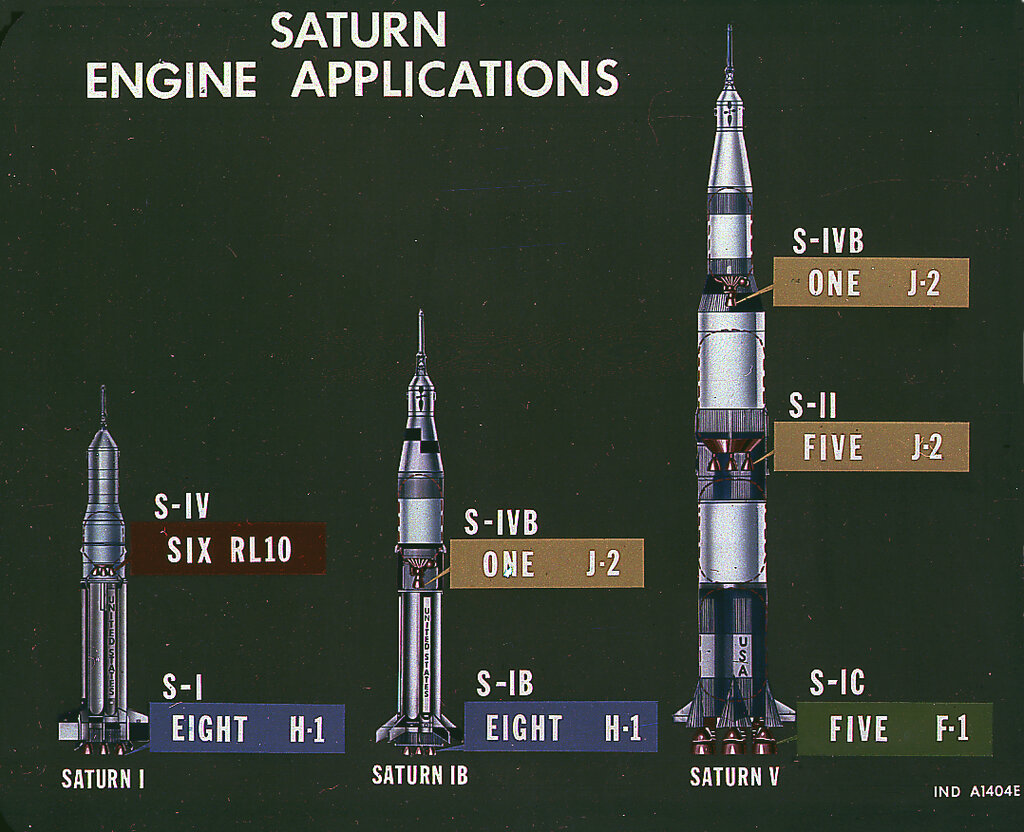
Then came the engineers who turned theory into reality. American physicist Robert Goddard is credited with launching the world's first liquid-fueled rocket in 1926. It was a modest flight, reaching just 41 feet, but it proved the concept worked. Later, Wernher von Braun, a German engineer who later worked for NASA, led the development of the powerful Saturn V rocket that carried Apollo astronauts to the Moon.
The Push to Go Up
How does a rocket actually fly? It's all about one of the most fundamental laws of physics: Newton's Third Law of Motion. For every action, there is an equal and opposite reaction.
Imagine standing on a skateboard and throwing a heavy bowling ball forward. As you push the ball away from you (the action), you and the skateboard will roll backward (the reaction). A rocket does the same thing, but instead of a bowling ball, it throws hot gas out of its engine nozzle at incredible speed.
The material ejected from the engine is called propellant. A common misconception is that rockets push against the air to move. In reality, they push against their own exhaust. This is why rockets work perfectly in the vacuum of space, where there is nothing to push against.
Rocket Fuel and Engines
The propellant a rocket uses defines its design and capabilities. Most launch vehicles fall into one of two main categories: liquid-fueled or solid-fueled.
Solid-fuel rockets are the simplest. They contain a solid block of propellant, which is a mixture of fuel and oxidizer. Once you light it, it burns until all the fuel is gone. You can't stop it or throttle it down. They provide a huge amount of thrust quickly, which makes them great as boosters to help a large rocket get off the launch pad.
Liquid-fuel rockets are more complex but also more flexible. They store their fuel and oxidizer as liquids in separate tanks. These are pumped into a combustion chamber where they mix and ignite. The key advantage is control. A liquid-fuel engine can be throttled up or down, shut down, and even restarted in space. This control is essential for precise maneuvers and for landing rockets back on Earth.
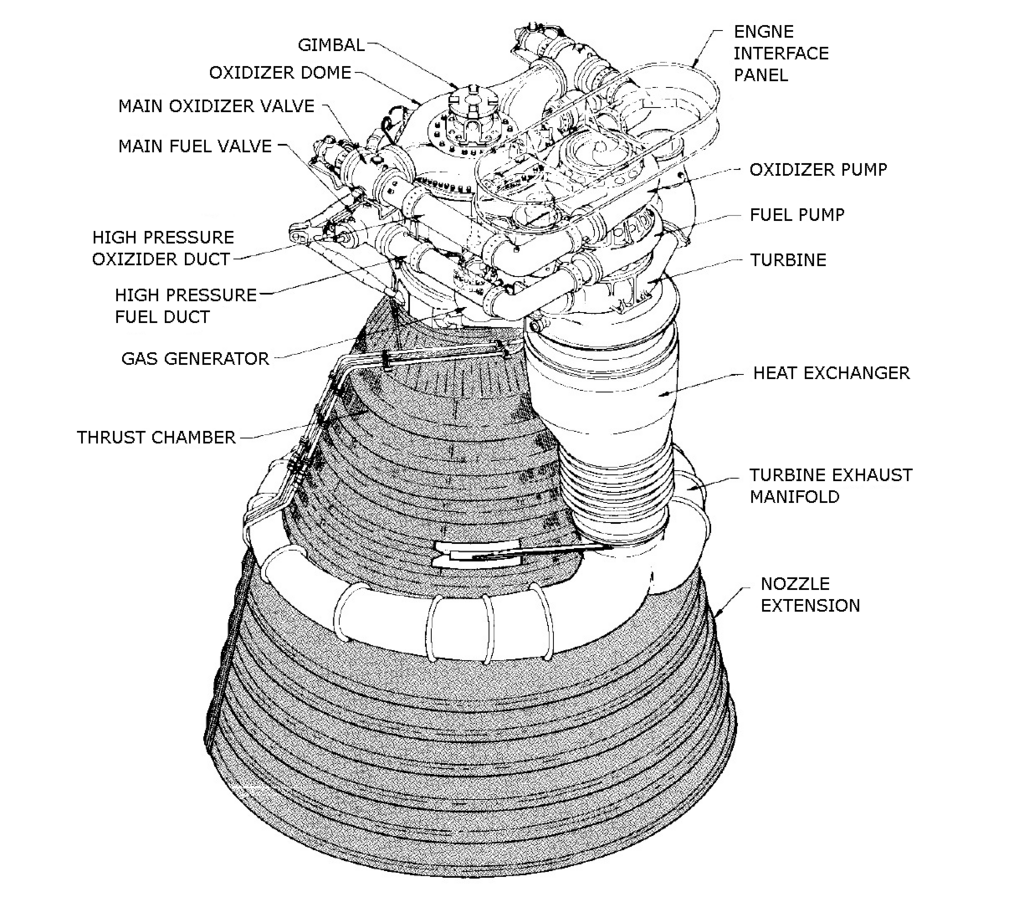
The choice between fuel types involves trade-offs between simplicity, cost, and control.
| Fuel Type | Pros | Cons |
|---|---|---|
| Solid | Simple, reliable, high thrust | Cannot be stopped or throttled |
| Liquid | Controllable, efficient | Complex, requires pumps and tanks |
Measuring Rocket Performance
How do we compare one rocket engine to another? Two key metrics are thrust and specific impulse.
Thrust
noun
The force that a rocket engine produces, pushing the vehicle upwards. It's a raw measure of power.
If thrust is the engine's power, specific impulse () is its efficiency. It measures how much push (impulse) is generated for a given amount of propellant. Think of it like a car's fuel economy, or miles per gallon.
A high specific impulse means the engine is very efficient and can provide thrust for a long time with less fuel. This is crucial for long journeys through space.
Often, there's a trade-off. Engines that produce immense thrust, like those needed for liftoff, tend to be less efficient. Highly efficient engines often produce lower thrust and are better suited for use in space, where there's no atmospheric drag or strong gravity to fight.
Shedding Weight with Staging
Getting to orbit is extremely difficult. The vast majority of a rocket's weight at liftoff is just its own fuel. It’s like trying to drive a car where the gas tank weighs more than the car itself. As you burn fuel, you're still carrying the heavy, now-empty tank.
The solution is staging. A multi-stage rocket is essentially several smaller rockets stacked on top of each other. The first, largest stage fires to lift the entire vehicle off the ground. Once its fuel is used up, the entire stage—including its heavy engines and empty tanks—is jettisoned. This makes the remaining rocket much lighter.
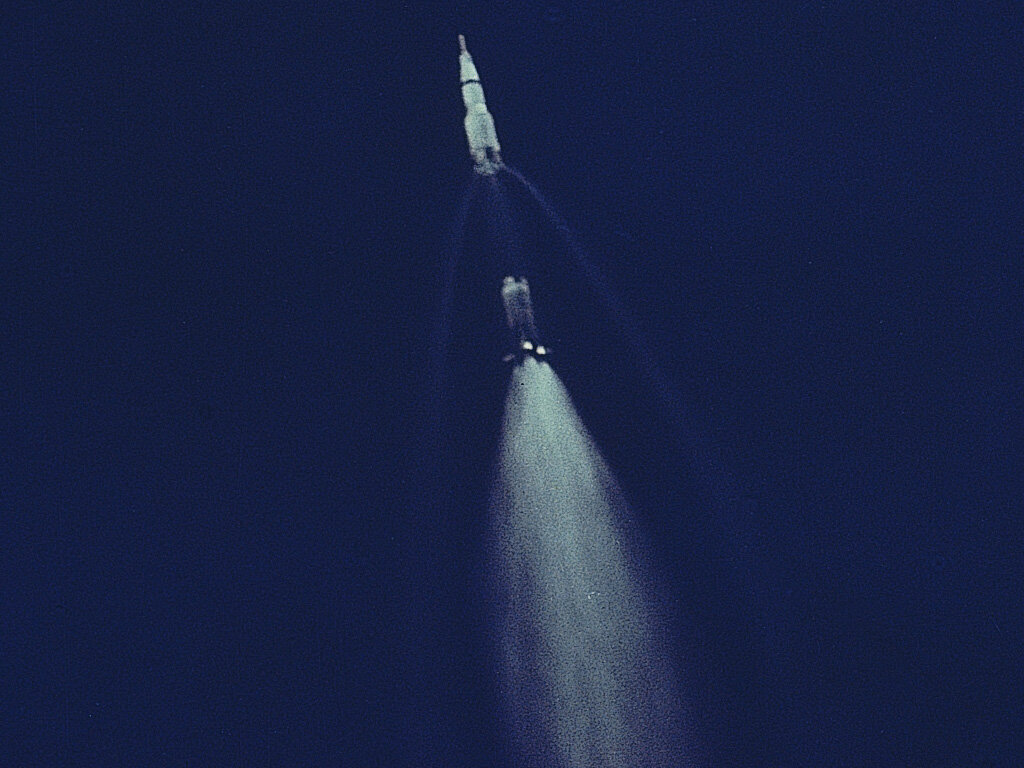
The second stage engine then ignites, pushing the now-lighter vehicle even faster and higher. This process can be repeated with third or even fourth stages. Each time a stage is dropped, the rocket becomes more efficient, allowing it to reach the incredible speeds needed for orbit. Without staging, reaching orbit with current technology would be impossible.
Let's review what we've covered.
Who is credited with developing the fundamental mathematical equation that showed how a rocket could escape Earth's gravity?
A rocket moves forward by expelling hot gas from its engine. This is a direct application of which physical principle?
From ancient fireworks to modern, reusable boosters, the core principles of rocketry combine clever engineering with fundamental physics to help us reach for the stars.