Space Explorer and Minecraft Architect
Cosmic Foundations
The Universe's Invisible Glue
Gravity is the force that pulls everything together. It’s what keeps your feet on the ground, the Moon circling the Earth, and the Earth orbiting the Sun. Think of it as the universe's invisible glue. Every object with mass, from a tiny grain of sand to a giant star, has a gravitational pull. The more massive an object is, the stronger its pull.
This force is responsible for the grand structure of the cosmos. Gravity pulls stars together to form galaxies and gathers galaxies into massive clusters. Without it, the universe would be a scattered, chaotic soup of particles.
The more mass an object has, the more it pulls on other objects.
But how does it work across the vast emptiness of space? Albert Einstein had a revolutionary idea. He suggested that space isn't just empty nothingness. Instead, space and time are woven together into a single, flexible fabric called a bit like a giant trampoline.
Imagine placing a heavy bowling ball in the middle of this trampoline. It sinks down, creating a dip or a curve in the fabric. Now, if you roll a smaller marble nearby, it won’t travel in a straight line. It will follow the curve created by the bowling ball, spiralling towards it. That’s gravity in action. Stars and planets curve the spacetime around them, and this curvature is what we feel as gravity. It’s what keeps smaller objects, like planets, in orbit around larger ones, like stars.
Cosmic Messengers
Gravity shapes the universe, but we can't see it directly. So how do we know anything about distant stars and galaxies? We rely on light. Light travels across the universe, carrying information like a cosmic messenger. Everything we know about what's out there comes from capturing and decoding this light.
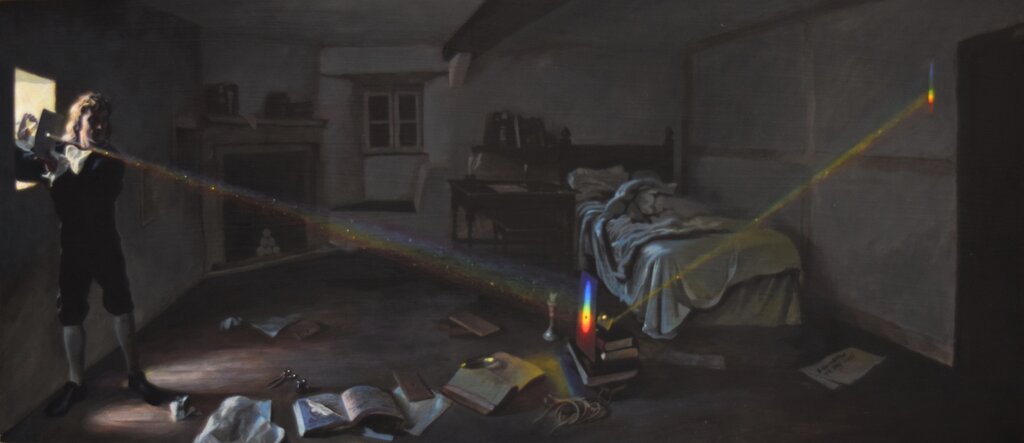
When astronomers analyse the light from a star, they can figure out what it's made of, how hot it is, and even how it's moving. For example, the colour of a star tells us its temperature—bluer stars are hotter, while redder stars are cooler. By looking for specific missing colours, or absorption lines, in a star's light, we can identify the chemical elements in its atmosphere.
Light also tells us if an object is moving towards or away from us. This is thanks to the , the same principle that makes an ambulance siren sound higher-pitched as it approaches and lower-pitched as it moves away. When a star moves away from us, its light waves get stretched out, making them appear redder (redshift). If it moves towards us, the light waves are squashed, making them look bluer (blueshift).
Gravity Bends Light
The two invisible forces, gravity and light, are connected. Because massive objects curve spacetime, they can also bend the path of light. Imagine light as a marble rolling across the trampoline we talked about earlier. As it passes the heavy bowling ball, its path will curve.
This effect is called gravitational lensing. A massive galaxy or cluster of galaxies can act like a giant magnifying glass in space, bending and amplifying the light from an object behind it. This allows astronomers to see galaxies that are too far away and faint to be observed otherwise. It’s a powerful tool that helps us peek into the very distant, early universe.
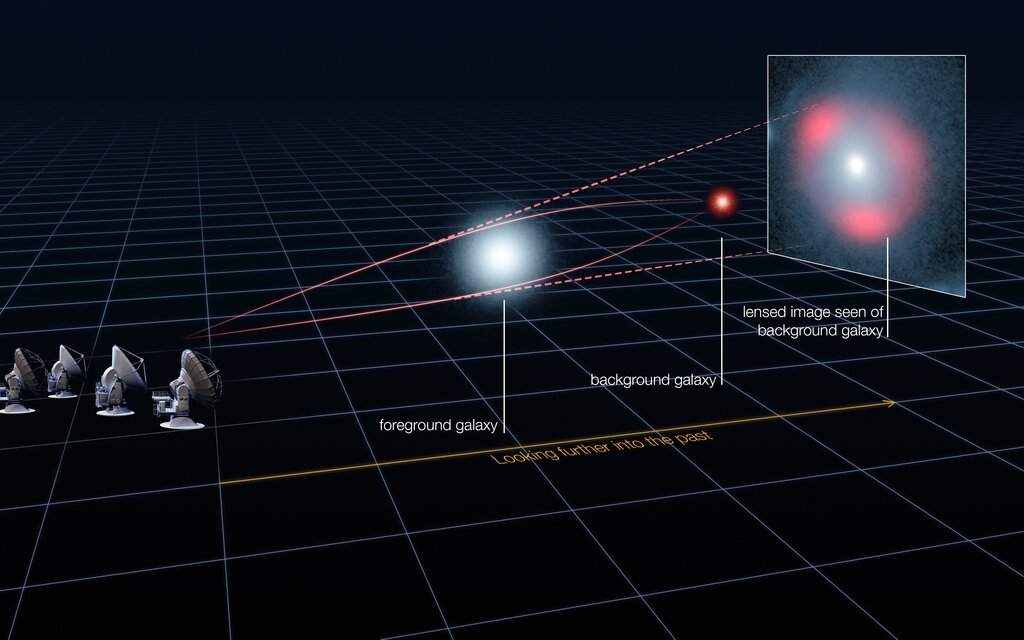
Understanding these two foundational concepts, gravity and light, is the key to unlocking the secrets of the cosmos. They are the basic rules of the universe that everything else follows. A great way to get a feel for how spacetime curves is to build a physical model.
What is the primary factor that determines the strength of an object's gravitational pull?
According to Albert Einstein's theory, what we perceive as gravity is actually the result of...
Now you have a grasp of the fundamental forces that govern the universe. Next, we'll explore how we use this knowledge to discover what's out there.