RESTful API Essentials
Introduction to RESTful APIs
The Universal Language of the Web
Imagine you’re in a restaurant. You don’t walk into the kitchen to cook your own meal. Instead, you use a menu to see what's available and tell a waiter what you want. The waiter takes your order to the kitchen, and the kitchen prepares your food. The waiter then brings the food back to you. You never need to know the recipe or how the oven works; you just need to know how to ask for what you want.
An API, or Application Programming Interface, works a lot like that waiter. It’s a messenger that takes a request from one piece of software, delivers it to another, and then brings the response back. APIs allow different applications, built by different people, in different programming languages, to talk to each other in a standardized way.
An API is a set of rules and tools for building software applications. It specifies how software components should interact.
REST is a popular style for designing these APIs. It's not a specific technology, but rather a set of guiding principles for how web services should communicate. An API that follows these principles is called a RESTful API.
REST
noun
Stands for Representational State Transfer. It's an architectural style for designing networked applications, relying on a stateless, client-server communication protocol.
Let's break down the name, "Representational State Transfer."
-
Resource: The core idea in REST is the resource. A resource can be anything: a user profile, a photo, a blog post, a product listing. Each resource is identified by a unique URL, like a specific web address.
-
Representational: You don't get the actual resource from the server (you don't get the database itself). Instead, you get a representation of it. This is usually a file formatted in a lightweight, human-readable way, most commonly JSON.
-
State Transfer: When you ask for a resource, the server transfers the state of that resource to you in the form of its representation. For example, if you request user information, the server sends back the current state of that user's profile.
The Client-Server Model
REST is built on the client-server model. This principle separates the user interface concerns from the data storage concerns. By keeping them separate, you can improve the portability of the user interface across multiple platforms and improve scalability by simplifying the server components.
The client is the application that needs the data (like your web browser or a mobile app). The server is the system that holds the data and provides it upon request. The client and server are independent. The server doesn't know or care what the client does with the data, and the client doesn't need to know how the server stores it. They just agree to communicate through the API.
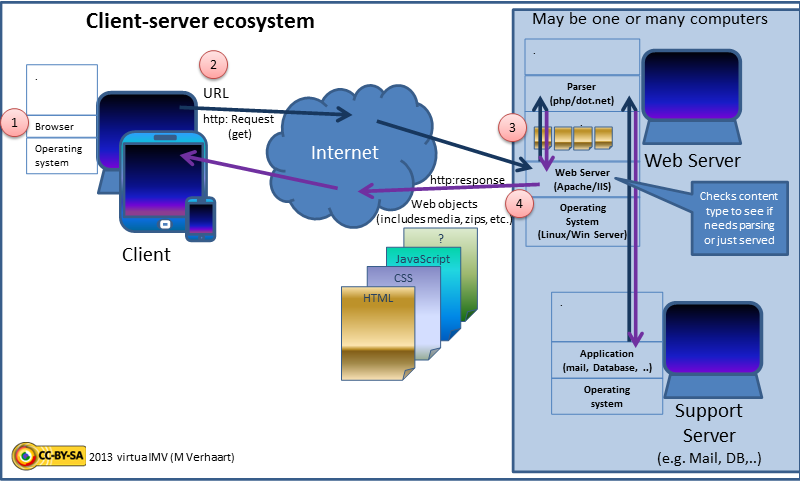
This separation is powerful. It means a development team can work on the front-end (the client) at the same time another team works on the back-end (the server). It also means the same back-end can serve data to a website, an iOS app, and an Android app, all using the same RESTful API.
APIs have become the backbone of modern software architectures, facilitating seamless integration and data exchange across various platforms.
Basic Principles
RESTful APIs follow a few key principles that make them reliable and easy to use. One of the most important is that communication is stateless. This means each request from the client to the server must contain all the information the server needs to understand and process the request. The server doesn't store any information about the client between requests. Every request is treated as a brand new interaction.
Think of it like using a vending machine. Each time you want a snack, you put in money and make a selection. The machine doesn't remember your previous purchase. This stateless approach simplifies the server design and makes the system more scalable, as any server can handle any request.
Another core idea is the uniform interface. This means there's a consistent way for clients to interact with the server, regardless of the device or application type. This principle simplifies the architecture and makes the system easier to understand and evolve over time.
By following these simple rules, RESTful APIs provide a flexible and powerful way for the countless applications and services on the internet to work together seamlessly.