Quantum Computing Fundamentals
Introduction to Quantum Computing
A New Kind of Computing
Classical computers, like the one you're using now, think in bits. A bit is a tiny switch that can be either on or off, represented by a 1 or a 0. All the amazing things computers do, from sending emails to playing games, boil down to manipulating billions of these simple 1s and 0s.
Quantum computing is a completely different approach. It's built on the principles of quantum mechanics, the strange and fascinating rules that govern the universe at the scale of atoms and particles. Instead of bits, quantum computers use something far more powerful: qubits.
Meet the Qubit
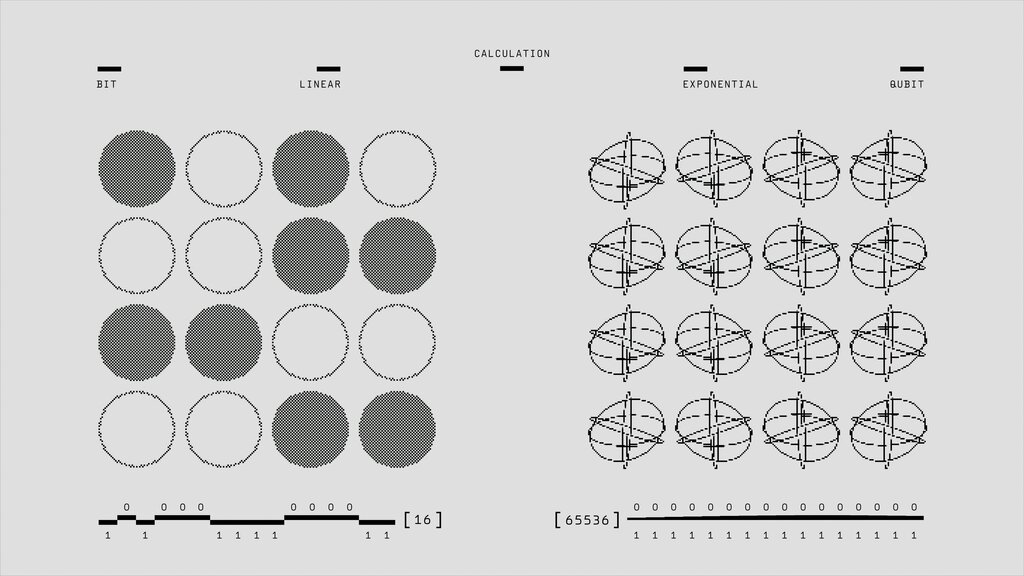
A qubit is the basic unit of quantum information. Like a classical bit, it can be a 0 or a 1. But here’s the twist: it can also be both at the same time. This mind-bending property is called superposition.
Superposition
noun
A fundamental principle of quantum mechanics where a quantum system, like a qubit, can exist in a combination of multiple distinct states at the same time.
Think of a spinning coin. While it's in the air, it's not heads and it's not tails. It's in a fuzzy, probabilistic state that is a mix of both possibilities. Only when it lands, or when we measure it, does it settle into a definite state of either heads or tails. A qubit in superposition is like that spinning coin. It holds the potential for both 0 and 1 until it's measured.
Because a single qubit can represent multiple values at once, a quantum computer can explore a vast number of possibilities simultaneously. This ability grows exponentially with each added qubit.
Spooky Connections
The other key concept is entanglement. This is a special connection that can exist between two or more qubits. When qubits are entangled, their fates are linked, no matter how far apart they are.
Imagine you have a pair of gloves, and you put each one into a separate box without looking. You mail one box to a friend on the other side of the world. The moment your friend opens their box and sees a left-handed glove, you instantly know that your box contains the right-handed one. There's no message sent between the boxes; the information is revealed instantly because their states were correlated from the start.
Entanglement links qubits in a way that is much deeper than classical correlations. Measuring one entangled qubit immediately influences the state of the other(s), providing a powerful tool for computation.
This property, which Einstein famously called "spooky action at a distance," allows quantum computers to perform complex calculations that would be impossible for even the most powerful supercomputers.
Why Bother?
Quantum computers aren't meant to replace your laptop. They are specialized machines designed to solve specific types of problems that are currently intractable. The principles of superposition and entanglement give them an enormous advantage in certain areas.
| Field | Potential Application |
|---|---|
| Medicine | Designing new drugs by simulating molecules with high accuracy. |
| Materials Science | Discovering new materials with desired properties, like better superconductors. |
| Finance | Optimizing complex financial models and investment strategies. |
| Cryptography | Breaking current encryption standards and developing new, secure ones. |
We are still in the early days of quantum computing, much like the 1950s for classical computers. But by harnessing the strange logic of the quantum world, this technology promises to revolutionize science, industry, and our understanding of the universe itself.
What is the fundamental unit of information in a quantum computer called?
The principle of superposition is often compared to a spinning coin because, until measured, a qubit can be: