Quantum Computing Fundamentals
Introduction to Quantum Computing
Beyond Bits and Bytes
Classical computers, from your smartphone to the most powerful supercomputers, think in a language of bits. A bit is the smallest unit of data and can only be in one of two states: a 0 or a 1. It's a simple, reliable switch, either on or off. This binary system has served us well, building the entire digital world.
Quantum computing operates on a completely different level. It uses the strange and wonderful rules of quantum mechanics to process information. Instead of bits, it uses qubits.
qubit
noun
The basic unit of quantum information. It is the quantum analogue of the classical bit.
A qubit can be a 0, a 1, or something else entirely. Thanks to a principle called superposition, it can exist in a combination of both states at the same time. This opens up a vast new space for computation.
The Power of Superposition
Imagine a spinning coin. While it's in the air, it's neither heads nor tails. It's in a fuzzy, probabilistic state—a combination of both possibilities. Only when it lands (when we measure it) does it settle into a definite state of either heads or tails. Superposition is the quantum version of this spinning coin.
A qubit isn't just a 0 or a 1. It's a blend of both states, described by probability amplitudes. We can write the state of a qubit, called (pronounced "ket psi"), like this:
Here, and are complex numbers that represent the probability amplitudes for the qubit being in the or state, respectively. The probabilities of measuring 0 or 1 are given by and , which must sum to 1. This ability to exist in multiple states at once is what gives quantum computers their immense potential power.
While a classical computer with 3 bits can only represent one of 8 possible combinations at a time (e.g., 001, 101), a quantum computer with 3 qubits can represent all 8 combinations simultaneously.
Entanglement's Spooky Connection
Another core concept is entanglement. This is a special connection that can exist between two or more qubits. When qubits are entangled, their fates are linked, no matter how far apart they are.
Think of two magic coins. If you entangle them, you know that if one lands on heads, the other will instantly land on tails, and vice versa. The outcome is correlated. The strange part is that this connection is instantaneous, even if one coin is on Earth and the other is on Mars. Albert Einstein famously called this "spooky action at a distance."
This isn't just a curiosity; it's a powerful tool. Entanglement allows for incredibly complex correlations between qubits, which is essential for running sophisticated quantum algorithms. It creates states that are impossible to describe by looking at each qubit individually. You have to consider the system as a whole.
Quantum Gates
So how do we actually compute with qubits? We use quantum gates. Just as classical computers use logic gates like NOT, AND, and OR to manipulate bits, quantum computers use quantum gates to manipulate qubits.
Quantum gates are operations that change a qubit's state. Since a qubit's state is a continuous blend of 0 and 1, these gates are like rotations on that sphere of possibilities we saw earlier.
Let's look at two fundamental gates:
| Gate | Symbol | Action |
|---|---|---|
| X-gate | X | The quantum equivalent of a classical NOT gate. It flips a qubit's state from $ |
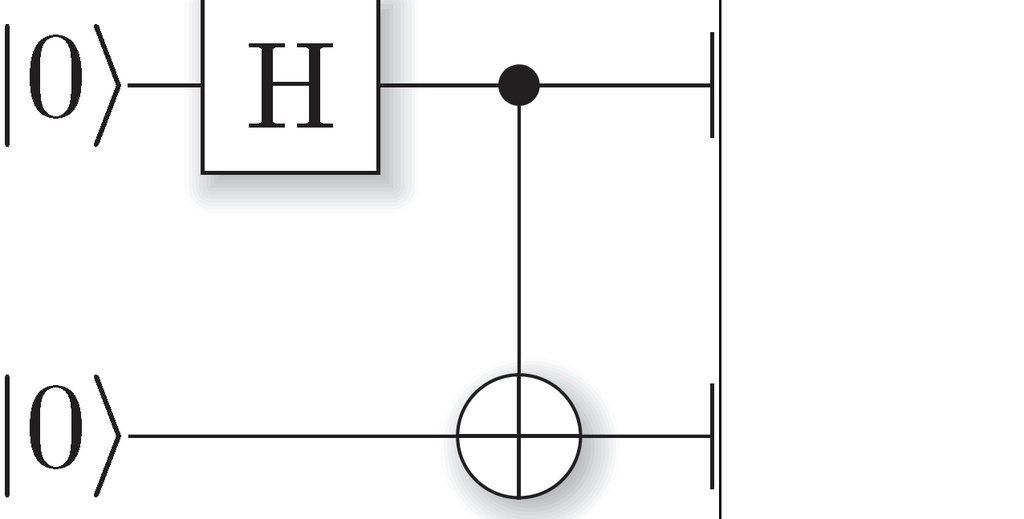
| Hadamard gate | H | This is a crucial gate that puts a qubit into a perfect superposition. If you apply it to a qubit in the $ |
By combining these and other gates in a sequence, known as a quantum circuit, scientists can perform complex calculations.
We've covered the basics of how quantum computers work. Now let's test your understanding.
What is the key difference between a classical bit and a quantum qubit?
True or False: Once two qubits are entangled, their states remain correlated no matter how far apart they are.
These concepts—qubits, superposition, and entanglement—are the foundation of this revolutionary new form of computing. They allow quantum machines to tackle problems that are far too complex for even the most powerful classical computers of today.