Quantum Computing for Data Scientists
Quantum Computing Basics
Beyond Bits and Bytes
Classical computers think in bits, which are like light switches: they can be either on (1) or off (0). This binary system has powered every digital innovation you've ever used. But some problems are so complex that even the fastest supercomputers would take billions of years to solve them.
Quantum computing takes a different approach. Instead of bits, it uses qubits. A qubit can be a 0, a 1, or both at the same time. This strange 'both-at-once' property is called superposition, and it's the first key to unlocking quantum power.
qubit
noun
The basic unit of quantum information. A qubit can represent a one, a zero, or any quantum superposition of these two states.
Think of a spinning coin. While it's in the air, it's not definitively heads or tails—it's a blur of both possibilities. Only when it lands (when we measure it) does it settle into one state. A qubit is like that spinning coin. Mathematically, we describe its state as a combination of two basis states, and (pronounced 'ket 0' and 'ket 1').
A qubit's state, written as |\[\text{psi}\]\rangle, can be any combination: |\[\text{psi}\]\rangle = \alpha|0\rangle + \beta|1\rangle
Here, and are complex numbers called probability amplitudes. When you measure the qubit, the probability of finding it in the state is |\[\text{alpha}\]|^2, and the probability of finding it in the state is |\[\text{beta}\]|^2. These probabilities must add up to 1, so |\[\text{alpha}\]|^2 + |\[\text{beta}\]|^2 = 1.
Spooky Connections
Superposition is strange enough, but quantum mechanics has another trick: entanglement. This is a deep connection linking two or more qubits. Once entangled, their fates are intertwined, no matter how far apart they are.
Imagine you have a pair of gloves, one left and one right. You put each one in a separate box and mail one to a friend on the other side of the world. Before anyone opens a box, you don't know which is where. But the moment your friend opens their box and sees a left glove, you instantly know, without looking, that yours must be the right one.
Entanglement works similarly. If you have two entangled qubits, measuring one instantly influences the state of the other. For instance, in a common entangled state called a Bell pair, the two qubits will always have the same measurement outcome. If you measure one and get 0, the other will also be 0. If you get 1, the other will be 1. This happens even if they are light-years apart.
Albert Einstein famously called entanglement 'spooky action at a distance.' This perfect, instantaneous correlation between entangled particles is one of the most powerful and counter-intuitive features of quantum mechanics.
Programming with Physics
So how do we use these quantum properties to compute? In classical computing, we use logic gates like AND, NOT, and OR to manipulate bits. In quantum computing, we use quantum gates to manipulate qubits.
Quantum gates are operations that rotate a qubit's state on the Bloch sphere or create entanglement between multiple qubits. For instance, a common single-qubit gate is the Hadamard gate (H). Applying it to a qubit in the state puts it into an equal superposition of and . Applying it again returns the qubit to its original state.
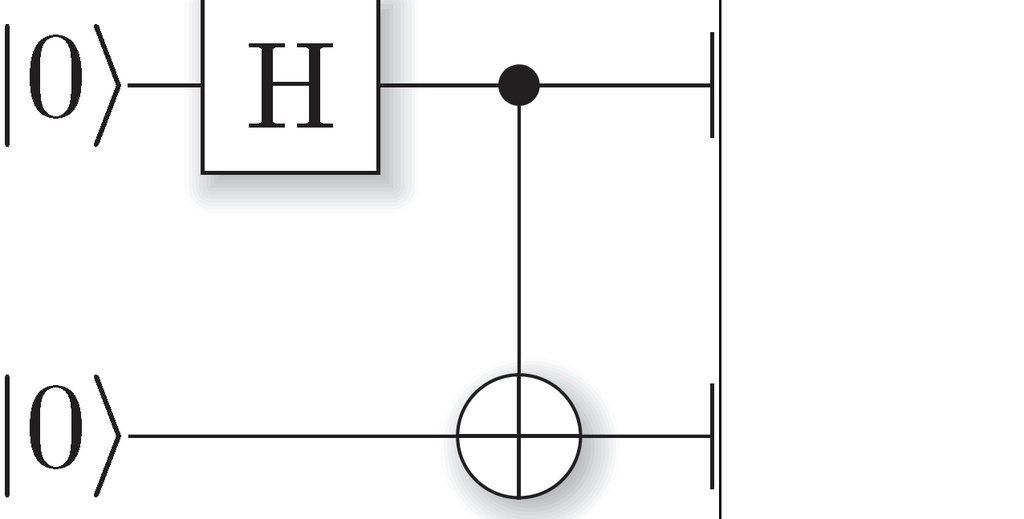
Another crucial gate is the Controlled-NOT (CNOT) gate. This is a two-qubit gate. It flips the second qubit (the target) if, and only if, the first qubit (the control) is in the state . The CNOT gate is fundamental for creating entanglement between qubits, which is essential for most quantum algorithms.
A sequence of these gates applied to a set of qubits is called a quantum circuit. This is the quantum equivalent of a classical computer program.
| Feature | Classical Computing | Quantum Computing |
|---|---|---|
| Basic Unit | Bit (0 or 1) | Qubit ($ |
| State | Deterministic (either 0 or 1) | Probabilistic (until measured) |
| Core Power | Processing bits sequentially | Superposition & Entanglement |
| Computation | Logic gates (AND, NOT, OR) | Quantum gates (Hadamard, CNOT) |
The core difference lies in parallelism. A classical computer with 3 bits can only represent one of 8 possible combinations ($2^3$) at any single moment. But a quantum computer with 3 qubits can represent all 8 combinations simultaneously in superposition. With each additional qubit, the computational space doubles. A system with 300 qubits can explore more states than there are atoms in the observable universe. This exponential scaling is what gives quantum computers their incredible potential for certain types of problems.
Ready to test your knowledge on these foundational concepts?
What is the primary characteristic that distinguishes a qubit from a classical bit?
If a qubit is in the state , what is the probability of measuring it in the state ?
Understanding qubits, superposition, and entanglement is the first step into the world of quantum computing. These principles allow quantum machines to approach problems in a way that is fundamentally different from their classical counterparts.