Python Programming from Scratch
Computer Communication Basics
Giving the Computer Instructions
At its heart, programming is just a way to give instructions to a computer. Think of it like a recipe. A recipe lists steps in a specific order to get a final result, like a cake. A computer program, often called a script, is a list of steps for the computer to follow to get a result, like displaying a message or calculating a number.
Computers don't understand English, so we need a special language to write these instructions. That's where a programming language like Python comes in. It acts as a translator, turning our human-like logic into commands the machine can execute. Python is popular with beginners because its rules, or syntax, are designed to be clean and readable, almost like plain English.
Setting Up Your Workspace
Before you can start writing Python code, you need two things: the Python interpreter itself and a place to write your code. The interpreter is the program that reads your Python script and translates it for the computer.
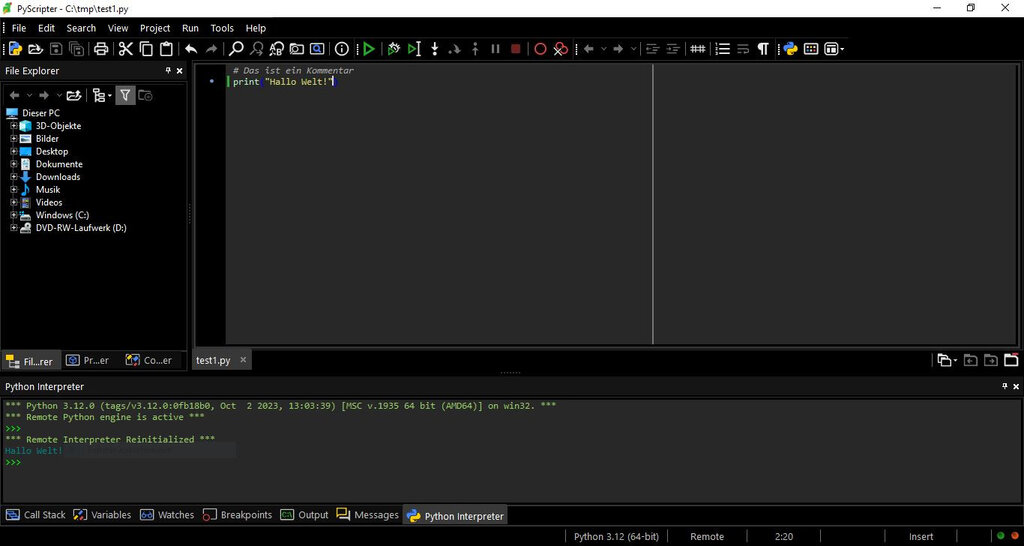
You can download Python for free from its official website. The installation is straightforward. Once it's installed, you need a code editor. While you could use a simple text editor, most programmers use an Integrated Development Environment (IDE). An IDE is like a word processor specifically for code. It helps you by color-coding your text, catching errors, and organizing your files.
Your First Program
Let's write our first instruction. In programming, the traditional first step is to make the computer display the message "Hello, World!". In Python, this is incredibly simple. We use a built-in command called the print function.
print("Hello, World!")
When the computer runs this line of code, it will display Hello, World! on the screen. The text inside the quotation marks is what gets printed. The parentheses are part of the function's syntax, telling Python what information the print command should use.
It's important to know that Python is case-sensitive. print is not the same as Print or PRINT. You have to type it in all lowercase for it to work.
Leaving Notes in Your Code
As your scripts get more complex, you might want to leave notes for yourself or for other programmers who might read your code. These notes are called comments. The Python interpreter completely ignores them.
To write a comment, you just start the line with a hash symbol (#). Anything after the hash on that same line is considered a comment.
# This is a comment. The computer will ignore it.
print("This line will run.") # You can also add comments here.
A computer script is a lot like a checklist. The computer reads the first line, does what it says, then moves to the second line, and so on, from top to bottom.
You now have the fundamental building blocks for writing simple instructions in Python. You know how to set up your environment, tell the computer to display text, and leave comments in your code.
What is the fundamental purpose of a computer program?
Which line of code will correctly display the message "Welcome!" on the screen in Python?