Python Machine Learning Fundamentals
Introduction to Machine Learning
What Is Machine Learning?
Machine learning lets computers learn from data and experience, much like humans do. Instead of writing explicit step-by-step instructions for a task, we provide a large amount of data and let an algorithm figure out the patterns on its own. Think of it like teaching a child to recognize a dog. You don't list out all the rules for what makes a dog. You just show them pictures of dogs, and eventually, they learn to identify dogs they've never seen before.
Machine Learning
noun
A field of artificial intelligence that uses statistical techniques to give computer systems the ability to "learn" from data, without being explicitly programmed.
This ability to learn from data makes machine learning incredibly powerful. It's the engine behind many modern technologies, from recommendation systems that suggest what you should watch next to the software that helps doctors diagnose diseases.
Three Flavors of Learning
Machine learning isn't a single technique but a broad field with several approaches. The three most common types are supervised, unsupervised, and reinforcement learning. Each is suited for different kinds of problems.
Supervised Learning
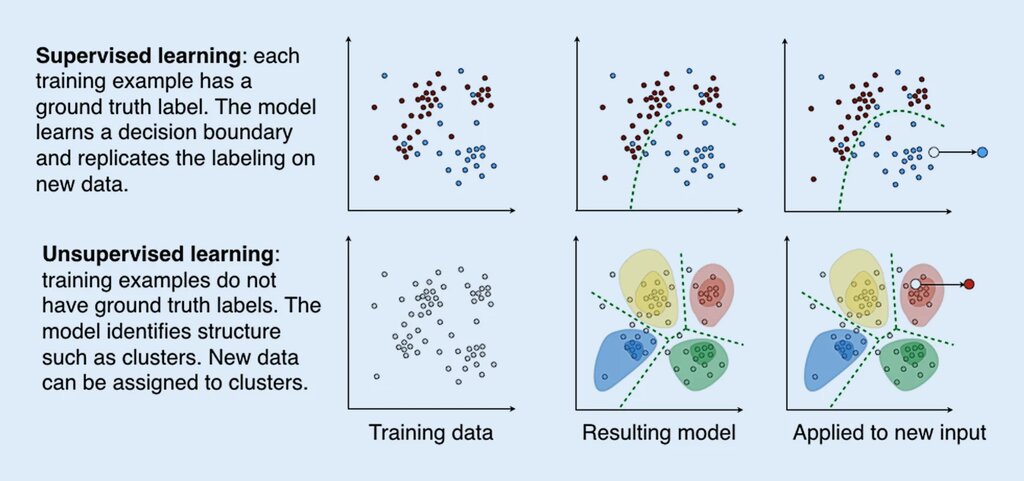
This is like learning with a teacher. The algorithm is given a dataset where the "right answers" are already known. For example, you might provide thousands of emails that have been labeled as either "spam" or "not spam." The algorithm's job is to learn the relationship between the content of the emails and their labels. Once trained, it can predict whether a new, unlabeled email is spam.
Unsupervised Learning
Here, the algorithm is on its own, like being asked to organize a messy room without instructions. It receives data that has not been labeled or categorized. The goal is to find hidden patterns or structures within the data. A common use is customer segmentation, where a business might use purchasing data to discover different groups of customers with similar habits.
Reinforcement Learning
This type of learning is based on trial and error. An algorithm, or "agent," learns to make decisions by performing actions in an environment to achieve a goal. It receives rewards for good actions and penalties for bad ones. Over time, the agent learns the best strategy to maximize its total reward. This is the approach used to train AIs to play complex games like chess or Go, and it's also used in robotics and self-driving cars.
| Type | Input Data | Goal | Analogy |
|---|---|---|---|
| Supervised | Labeled | Predict outcomes | Learning with flashcards |
| Unsupervised | Unlabeled | Discover patterns | Sorting laundry by color |
| Reinforcement | No initial data | Maximize reward | Training a pet with treats |
The Machine Learning Workflow
A machine learning project is more than just choosing an algorithm. It's a structured process that goes from understanding a problem to deploying a solution. While the details can vary, most projects follow a similar lifecycle.
-
Define the Problem: The first, and most important, step is to clearly define the goal. What question are you trying to answer? Are you trying to classify something, predict a value, or find groupings? A poorly defined problem leads to a useless model.
-
Collect Data: Once you know the problem, you need data to solve it. This could involve gathering data from databases, APIs, or creating a new dataset from scratch. The quality and quantity of your data will directly impact your model's performance.
-
Prepare Data: Real-world data is often messy. It might have missing values, errors, or inconsistencies. This step, often called data preprocessing or cleaning, involves getting the data into a usable format for the model.
-
Train the Model: This is where the learning happens. You select an appropriate algorithm and feed it your prepared data. The algorithm adjusts its internal parameters to find patterns in the data.
-
Evaluate the Model: After training, you need to check how well your model works. This is typically done by testing it on a separate set of data that it hasn't seen before. This helps ensure the model can generalize to new, real-world situations.
-
Deploy & Monitor: If the model's performance is good enough, it can be deployed for real-world use. But the job isn't done. It's crucial to monitor the model's performance over time to make sure it continues to make accurate predictions as new data comes in.
Tools of the Trade
The Python programming language is the de facto standard for machine learning, thanks to its simplicity and a rich ecosystem of specialized libraries.
-
Scikit-learn: This is the perfect starting point. It provides simple and efficient tools for data mining and data analysis, including a wide range of machine learning algorithms. It's built on other core Python libraries like NumPy and SciPy.
-
TensorFlow: Developed by Google, TensorFlow is a more powerful and flexible library. It's a great choice for large-scale machine learning and is particularly popular for deep learning, a subfield of machine learning that uses complex neural networks.
-
PyTorch: Developed by Facebook's AI Research lab, PyTorch is another major player in the deep learning space. It's known for its flexibility and ease of use, making it a favorite among researchers and developers who need to rapidly prototype new ideas.
Start with Scikit-learn for basic machine learning tasks and gradually move to TensorFlow or PyTorch for more complex projects.
Now that you have a high-level view of machine learning, let's test your understanding.
What is the key difference between machine learning and traditional programming?
An e-commerce company wants to group its customers into different segments based on their purchasing habits, but it doesn't have any pre-defined labels for these groups. Which type of machine learning would be most suitable for this task?
Understanding these core concepts is the first step on a long and exciting journey into the world of machine learning.