Programming Basics with Claude Code
Introduction to Programming
Telling Computers What to Do
At its heart, programming is simply the act of giving instructions to a computer. Think of it like writing a very detailed recipe. If you miss a step or write it unclearly, you won't get the cake you wanted. Computers are similar, but they're even more literal. They don't have intuition or common sense, so the instructions have to be perfectly clear and logical.
programming
verb
The process of creating a set of instructions that tell a computer how to perform a task.
These instructions are written in a special language that the computer can eventually understand. We call this collection of instructions a program, or 'code.' When you open an app on your phone, browse a website, or use a cash machine, you're interacting with a program that a person, or a team of people, wrote.
Programming turns a general-purpose machine, a computer, into a specialized tool for a specific task.
This ability is what makes computers so powerful. Without programming, your smartphone would just be a piece of glass and metal. Software is what allows it to be a camera, a map, a messaging device, and a music player all at once. Programmers write the software that powers our digital world, from video games to the systems that manage banking and air traffic control.
From Human Language to Machine Code
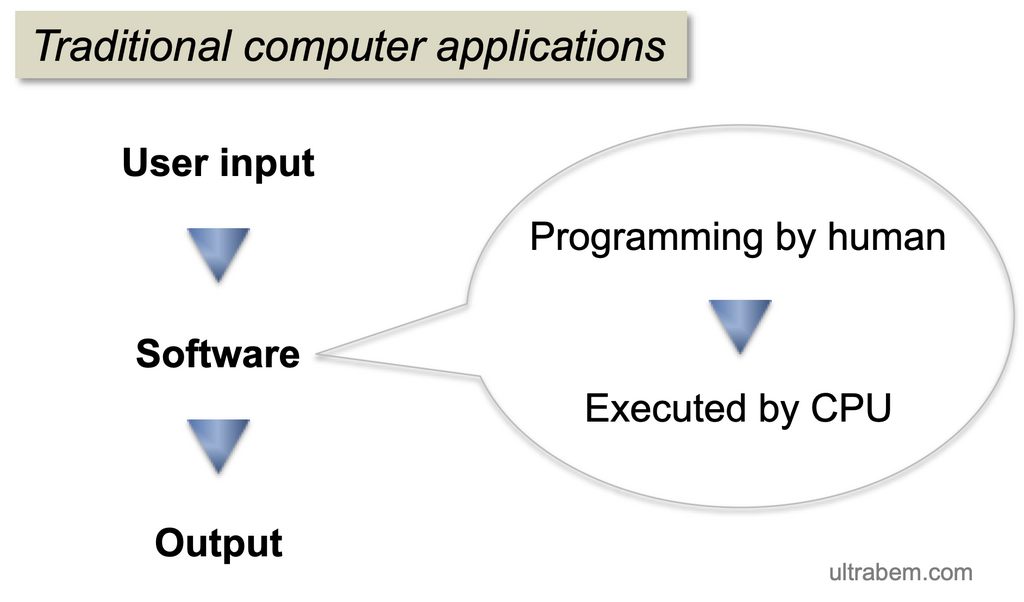
So how does a computer actually understand the code we write? We write code in programming languages like Python or JavaScript, which are designed to be readable by humans. But a computer's brain, the Central Processing Unit (CPU), only understands one very basic language: machine code. Machine code is just a series of ones and zeros.
Getting from our human-readable code to machine code requires a translator. This translator is itself a special program, usually a compiler or an interpreter. It takes the source code we've written and converts it into the binary instructions the CPU can execute directly.
Once the code is in a language the machine understands, the CPU can execute the instructions one by one, performing calculations, moving data, and ultimately running the program as intended. This entire process happens incredibly fast, often millions or billions of times per second.
No matter how complex a program is, it's built from simple, logical instructions that a computer can follow.
Understanding this basic flow is the first step on the journey to programming. It's not about magic; it's about learning how to speak the language of logic that computers are built on.
Ready to check your understanding of these core ideas?