Principles of Architecture
Welcome! I am excited to explore the world of architecture with you. Before we dive into the core concepts, I would love to know what brings you here today so I can tailor our conversation to your background.
I am a professional in a related field.
It's wonderful to meet a fellow professional! Since you already work in a related field, you likely appreciate how design choices directly shape human behavior and experiences.
To kick off our journey, let's lay out our learning roadmap so you can see exactly where we are headed.

Beyond Four Walls and a Roof
Continue to the Vitruvian Triad
Let's dive straight into the foundational DNA of architectural theory: the .
Over two thousand years ago, an Roman architect named Marcus Vitruvius Pollio declared that every successful building must balance three fundamental qualities: Commodity, Firmness, and Delight. If you compromise on any one of these, the structure ceases to be true architecture and becomes either a fragile sculpture or a utilitarian box.
Think of it as a three-legged stool. If you shorten the leg of structural integrity, the stool collapses. If you remove functional planning, it becomes unusable. And without beauty, it fails to inspire.
| Latin Term | English Translation | Core Meaning |
|---|---|---|
| Utilitas | Commodity | Function, layout, and how well the space serves its purpose. |
| Firmitas | Firmness | Structural integrity, material durability, and standing the test of time. |
| Venustas | Delight | Aesthetics, sensory experience, beauty, and emotional impact. |
To see this in action, think about a modern library.
Commodity dictates the quiet study zones, accessible book stacks, and intuitive navigation. Firmness is found in the reinforced concrete foundations and steel columns holding up thousands of pounds of heavy paper. Delight is that breathtaking moment when you look up and see natural sunlight flooding through a massive glass atrium.
When we look at iconic buildings, we can instantly trace how these forces interact.
Make a diagram of the Vitruvian Triad forces
I would love to show you how these abstract forces play out in a real design. Let's look at how commodity, firmness, and delight constantly balance and pull against one another to shape a building.

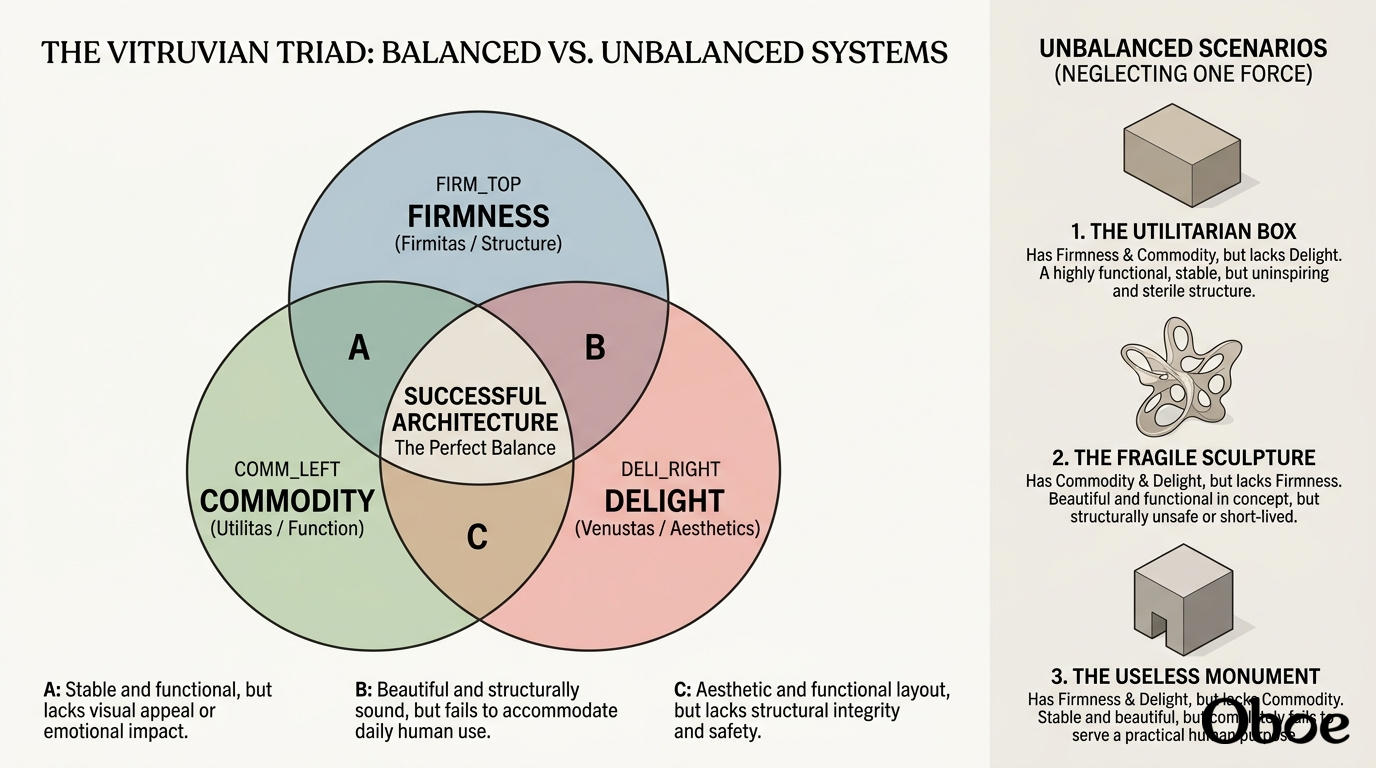
This diagram illustrates how these three forces are in constant tension.
When an architect starts a project, they have to navigate these trade-offs. For instance, if you want massive glass walls to maximize natural light (delight), you have to find innovative engineering workarounds to ensure the roof is still structurally supported (firmness), all while making sure the heat gain from the glass doesn't make the space uncomfortable for the people inside (commodity).
If you push too far in any one direction, the other two start to suffer. True architecture is found right in that sweet spot where all three forces meet.
Continue to how function, structure, and aesthetics work together
It's easy to look at commodity, firmness, and delight as individual items on a checklist, but in reality, they aren't separate steps. They are highly dependent on one another and work together in a .
To see this in action, let's look at how a design actually develops. An architect doesn't finish the structural engineering (firmness) and then hand it to an interior designer to make it pretty (delight). Instead, they iterate on all three at once.
For instance, if you want to design a sustainable office building with massive windows:
- Delight pushes for maximum glass to connect workers with the outdoors.
- Firmness responds by requiring stronger, specialized steel framing to support those huge glass panes.
- Commodity steps in to ensure the sun's heat passing through that glass doesn't roast the office workers, which might require adding architectural shades or high-performance coatings.
Every decision you make in one category immediately reshapes the other two. When you strike the perfect balance, you create a space that feels unified and effortless.