Practical AI Architecture and Implementation
Selecting Optimal Paradigms
Prediction vs. Discovery
The most common decision in machine learning is choosing between prediction and discovery. This choice steers you toward either supervised or unsupervised learning. It’s not about which is better, but what you need the machine to do.
Supervised learning excels at prediction. If you have a dataset with historical outcomes—what we call labeled data—you can train a model to predict those outcomes on new, unseen data. Think of it as teaching by example. You show the model thousands of customer records, each labeled as "churned" or "not churned." The model learns the patterns associated with churning and can then predict which current customers are at risk.
This approach is perfect when your business goal is tied to a specific, measurable outcome. Common use cases include forecasting sales, identifying fraudulent transactions, or predicting equipment failure. The primary constraint is the need for clean, accurately labeled data, which can be expensive and labor-intensive to create.
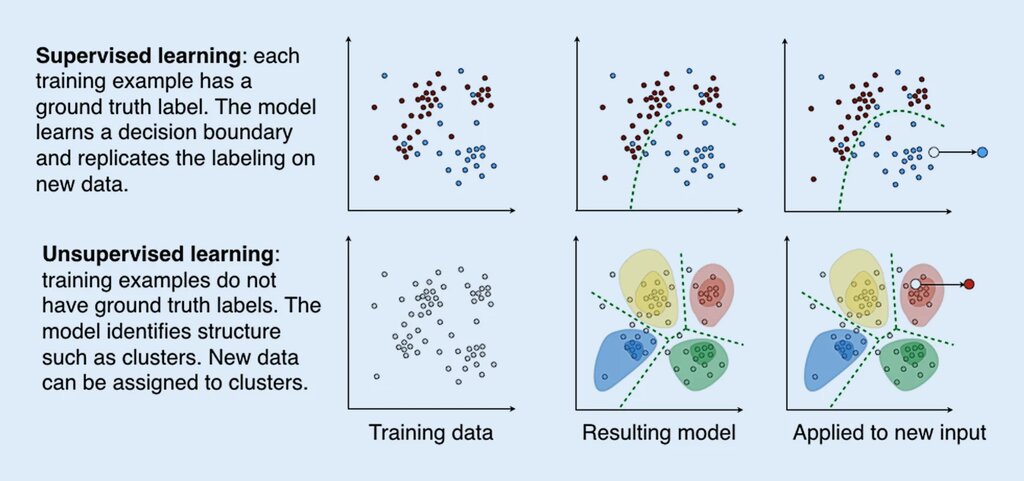
Unsupervised learning, on the other hand, is about discovery. It works with unlabeled data, sifting through it to find hidden structures and relationships you didn't know existed. Instead of predicting a known target, it groups similar data points together or simplifies complex datasets.
This is the right tool when your goal is exploratory. A marketing team might use clustering to perform , identifying distinct groups of customers based on their purchasing behavior. Another common use is , where the algorithm reduces the number of features in a dataset while retaining the most important information, making it easier to visualize or use in another model.
The core trade-off: Supervised learning offers high predictive accuracy for known targets, but requires labeled data. Unsupervised learning uncovers hidden patterns without labels, but the results often need human interpretation to be actionable.
Learning from Interaction
Some problems aren't about a single prediction but a sequence of decisions over time. For these dynamic environments, reinforcement learning (RL) is the paradigm of choice. Here, a software "agent" learns to make decisions by performing actions in an environment to maximize a cumulative reward.
It's a process of trial and error. The agent isn't given a set of correct answers; it's simply told when it does something good (a reward) or bad (a penalty). Over millions of trials, it learns a strategy, or "policy," that maximizes its long-term reward. This is how AI learns to play complex games like Go, but its business applications are vast.
RL is ideal for optimizing systems with many interacting parts, such as managing a supply chain, setting dynamic pricing for an airline, or controlling a robotic arm in a warehouse. A key challenge in RL is managing the , where the agent must balance trying new actions to see if they yield better rewards (exploration) with sticking to actions it already knows are effective (exploitation).
Finding a Middle Ground
What if you have a massive dataset, but only a tiny fraction of it is labeled? This is a common and practical problem. Labeling data, especially when it requires expert knowledge like identifying tumors in medical scans, is a significant bottleneck. This is where semi-supervised learning comes in.
This approach combines a small amount of labeled data with a large amount of unlabeled data. The model first learns from the labeled examples and then uses that initial knowledge to infer labels for the unlabeled data, progressively refining its understanding. It leverages the underlying structure of all the data to make better predictions than it could with the labeled data alone.
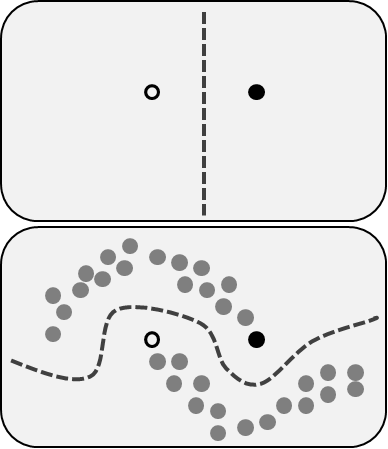
Semi-supervised learning is a pragmatic compromise that can significantly reduce the need for manual labeling. It’s highly effective in fields like speech analysis, web page classification, and medical imaging, where unlabeled data is abundant but labeled data is scarce and expensive.
From Goals to Models
Ultimately, selecting the right paradigm starts with your business objective and constraints. Your Key Performance Indicators (KPIs) are your guide.
If your KPI is to predict a value, like next quarter's revenue, you're in the supervised learning camp. If it's to discover new customer profiles, that's an unsupervised clustering task. If the goal is to optimize a dynamic system, like inventory flow, you should explore reinforcement learning.
Beyond the KPI, consider real-world constraints. How much labeled data do you have? What are your computational resources? Does your industry require high ? Answering these questions will narrow the field from a wide array of possibilities to a few logical choices.
Matching the problem's structure to the right ML paradigm is the first and most critical step in building a system that delivers real value.
Time to check your understanding of these concepts.
A retail company wants to forecast sales for the next quarter. They have access to several years of historical sales data, where each record includes the date, marketing spend, and total sales. Which machine learning paradigm is best suited for this task?
What is the primary purpose of unsupervised learning?
Choosing the right approach is a strategic decision that balances your goals, data, and constraints. By understanding the core strengths and weaknesses of each paradigm, you can build models that effectively solve real-world problems.