Polynomial Equations Explained
Introduction to Polynomials
What Are Polynomials?
In algebra, a polynomial is an expression made up of variables, coefficients, and exponents, combined using addition, subtraction, and multiplication. The key rule is that variables can only have non-negative, whole-number exponents. Think of them as the building blocks for many algebraic concepts.
polynomial
noun
An expression of more than two algebraic terms, especially the sum of several terms that contain different powers of the same variable(s).
Let's break down a typical polynomial: .
- Terms: The parts separated by addition or subtraction. Here, the terms are , , and .
- Coefficients: The numbers that multiply the variables. The coefficients are 5 and -2.
- Variables: The letters, like .
- Exponents: The powers the variables are raised to, like the 3 in .
- Constant: A term without a variable, like 1.
Expressions with negative exponents (like ) or variables in the denominator (like ) are not polynomials. The same goes for variables inside a square root ().
Standard Form and Degree
To keep things organized, we usually write polynomials in standard form. This simply means arranging the terms in order from the highest exponent to the lowest. For example, the polynomial $7 + 3x^2 - 4x$ becomes $3x^2 - 4x + 7$ in standard form.
The degree of a polynomial is the value of its highest exponent when written in standard form. The term with the highest exponent is called the leading term.
| Polynomial | Standard Form | Leading Term | Degree |
|---|---|---|---|
| 2 | |||
| 3 | |||
| 1 | |||
| 0 |
Knowing the degree helps us classify polynomials. A polynomial with a degree of 2 is called a quadratic, and one with a degree of 3 is a cubic.
Combining Polynomials
Adding and subtracting polynomials involves a simple idea: combining like terms. Like terms are terms that have the exact same variable raised to the exact same power. You can add $3x^2$ and $5x^2$, but you can't add $3x^2$ and $5x$. It's like adding apples and apples, but not apples and oranges.
To add two polynomials, you just combine the coefficients of their like terms.
Subtraction works the same way, but with one extra step. You must first distribute the negative sign to every term in the polynomial being subtracted. This flips the sign of each term.
Multiplying Polynomials
To multiply polynomials, you use the distributive property. This means you multiply every term in the first polynomial by every term in the second polynomial.
Let's start with a simple case: multiplying a single term (a monomial) by a polynomial with multiple terms.
When multiplying two polynomials with multiple terms, the process is the same, just with more steps. You distribute each term from the first polynomial across all terms in the second, then combine any like terms.
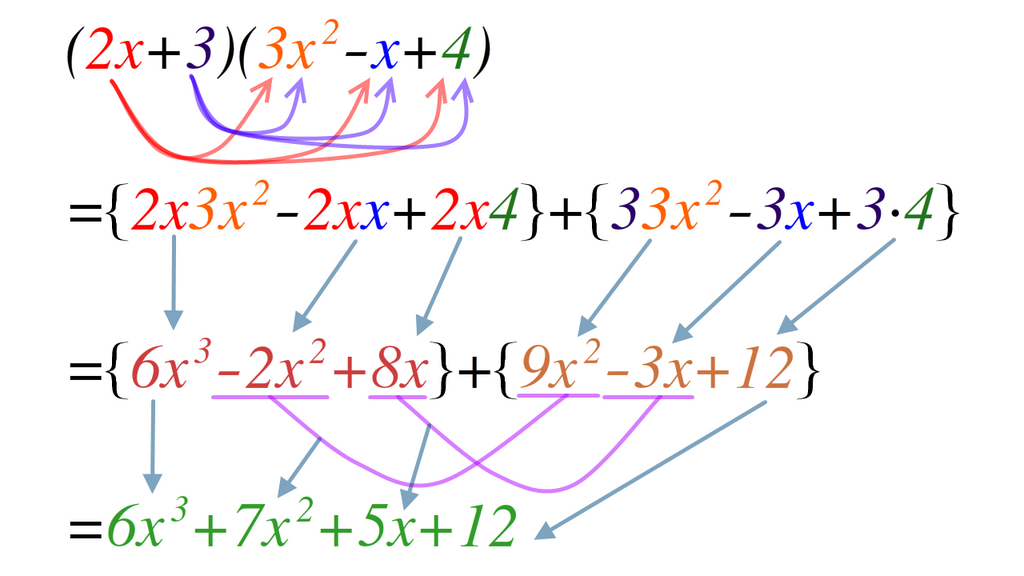
Here's an example of multiplying two binomials, .
- Multiply the first term of the first binomial by each term in the second: and .
- Multiply the second term of the first binomial by each term in the second: and .
- Combine all the results and simplify: .
Ready to check your understanding? Let's try a few questions.
Which of the following expressions is a polynomial?
In the polynomial , what is the coefficient of the term?
Understanding these basic properties and operations is the first step. They provide the foundation for working with more complex algebraic equations and functions.