OpenStack Cloud Computing Essentials
Introduction to OpenStack
An Operating System for the Cloud
Imagine a data center filled with servers, hard drives, and networking gear. How do you manage all of that hardware efficiently? Instead of manually configuring each piece, you could use a single platform to pool all those resources together. That's the basic idea behind OpenStack.
OpenStack is a free, open-source software platform for cloud computing. It lets you control large pools of compute, storage, and networking resources throughout a data center, all managed through a single dashboard.
Think of it as an operating system for your data center. Just as an OS like Windows or macOS manages the resources of a single computer (CPU, memory, storage), OpenStack manages the collective resources of many machines. This allows organizations to build and manage their own private or public clouds, offering services similar to those provided by giants like Amazon Web Services (AWS) or Google Cloud.
A Brief History
OpenStack didn't appear out of thin air. It was born from a collaboration between two very different organizations with a common need.
Back in 2010, Rackspace and NASA launched a project called OpenStack, which was meant to become an open source option for running an AWS-style cloud inside of private data centers.
NASA needed a powerful platform to manage its massive computing and data processing needs. Rackspace, a cloud hosting company, wanted a better way to power its own cloud offerings. They open-sourced their individual projects and combined them to create the foundation of OpenStack. The goal was to create a standard, open alternative to proprietary cloud platforms, preventing vendor lock-in and fostering a community-driven approach to cloud infrastructure.
Since then, the project has grown tremendously. It's now managed by the Open Infrastructure Foundation and supported by a global community of developers and major tech companies. This wide support ensures it continues to evolve and stay relevant.
OpenStack's Place in the Cloud
So, where does OpenStack fit in a world dominated by public cloud providers? Its primary role is in creating private clouds.
OpenStack allows enterprises to manage their own AWS-like private clouds on-premises.
While public clouds offer convenience, some organizations need more control over their infrastructure for security, compliance, or performance reasons. OpenStack gives them the power to build a cloud on their own hardware, tailored to their specific needs. It's also a popular choice for telecommunications companies, scientific research, and academic institutions.
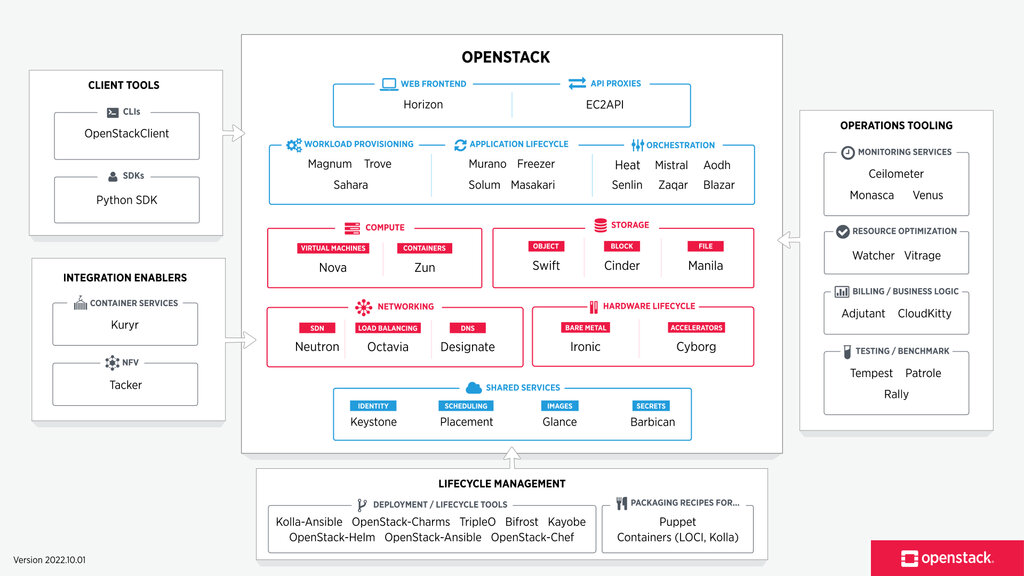
OpenStack's design is modular, meaning it's not one single piece of software. It's a collection of separate but interconnected projects, often called services. Each service handles a specific function. For instance, one service manages virtual machines, another handles object storage, and yet another takes care of networking.
This modularity is a key strength. Users can deploy only the components they need, creating a customized cloud environment. This flexibility allows OpenStack to power a wide variety of cloud setups, from small development environments to massive, multi-datacenter infrastructures.
Now that you have a high-level view of what OpenStack is and why it exists, let's test your understanding.
What is the primary function of OpenStack?
Which two organizations collaborated to create the initial foundation of OpenStack?
In the next section, we'll start to peel back the layers and look at the core services that make up an OpenStack cloud.