Object-Oriented Programming in Python
Introduction to OOP
Thinking in Objects
Most programming is about managing complexity. As programs grow, keeping track of all the moving parts becomes difficult. Object-Oriented Programming, or OOP, is a way to structure your code to make it more organized, reusable, and easier to understand. Instead of writing long lists of instructions, you create self-contained "objects" that bundle together data and the functions that operate on that data.
Think about a real-world object, like a car. A car has properties (data) like its color, model, and current speed. It also has behaviors (functions) like start_engine(), accelerate(), and brake(). In OOP, we model this by creating a Car object that holds all this information and functionality in one neat package. This approach helps you model real-world things in your code, which often makes complex problems simpler to solve.
Object-Oriented Programming (OOP) is a programming paradigm that uses objects and classes to structure code in a more organized, reusable, and maintainable way.
Blueprints and Buildings
The two core concepts in OOP are classes and objects. It's helpful to think of them using an analogy: a class is like a blueprint for a house, and an object is the actual house built from that blueprint.
class
noun
A blueprint for creating objects. It defines a set of attributes (data) and methods (functions) that the created objects will have.
A blueprint isn't a house itself. It just describes what a house should have: how many bedrooms, where the doors are, and so on. Similarly, a class doesn't do anything on its own. It's a template that defines what its objects will look like and what they can do.
# A simple class definition
class Dog:
    # This is a special method called a constructor.
    # It runs when a new object is created.
    def __init__(self, name, breed):
        self.name = name
        self.breed = breed

    # This is a method (a function inside a class)
    def bark(self):
        return f"{self.name} says woof!"
Once you have the blueprint, you can build as many houses as you want. Each house is a separate instance, but they all follow the same plan. In OOP, these instances are called objects.
object
noun
An instance of a class. It's a concrete entity created from a class blueprint, containing actual data.
Using our Dog class, we can create multiple Dog objects. Each one is distinct with its own data, but they all share the same structure and behaviors defined by the class.
# Creating objects (instances) of the Dog class
fido = Dog("Fido", "Golden Retriever")
sparky = Dog("Sparky", "Terrier")

# Accessing object attributes
print(fido.name)    # Output: Fido
print(sparky.breed) # Output: Terrier

# Calling object methods
print(fido.bark())  # Output: Fido says woof!
A class defines the template. An object is a usable instance of that template with its own data.
The Core Principles
OOP is built on a few key principles that enable its power and flexibility. We'll look at three of the most important ones: encapsulation, inheritance, and polymorphism.
Encapsulation is the idea of bundling data and the methods that operate on that data within a single unit, the class. This protects the data from outside interference and misuse. Think of it like a capsule for medicine: the plastic casing holds the medicine together and protects it from the outside world. In our Dog class, the name and breed data are encapsulated with the bark method.
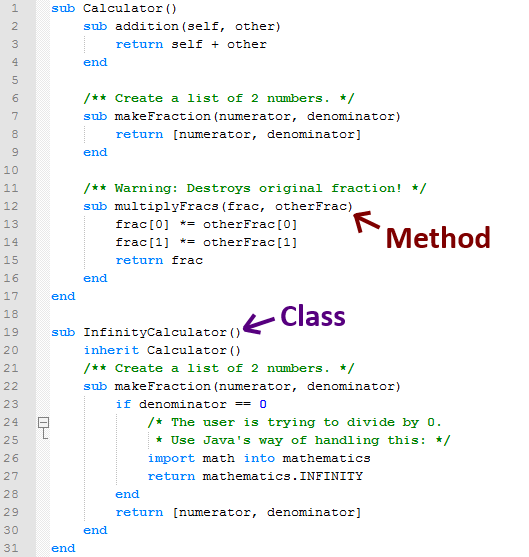
Inheritance allows a new class to take on the properties and methods of an existing class. This is a powerful way to reuse code. The existing class is called the parent or base class, and the new class is the child or derived class. A child class can add its own new methods or override its parent's methods.
For example, we could have a general Animal class, and then have Dog and Cat classes that inherit from it. Both dogs and cats are animals, so they share common traits like having a name, but they also have unique behaviors.
class Animal:
    def __init__(self, name):
        self.name = name

    def speak(self):
        raise NotImplementedError("Subclass must implement this method")

# Dog inherits from Animal
class Dog(Animal):
    def speak(self):
        return f"{self.name} says woof!"

# Cat inherits from Animal
class Cat(Animal):
    def speak(self):
        return f"{self.name} says meow!"

my_dog = Dog("Rex")
my_cat = Cat("Whiskers")

print(my_dog.speak()) # Output: Rex says woof!
print(my_cat.speak()) # Output: Whiskers says meow!
Polymorphism is a Greek word meaning "many shapes." In programming, it means that objects of different classes can be treated as if they are objects of a common parent class. It's often used with inheritance to allow methods to have the same name but different implementations in different classes. Notice in the code above how both Dog and Cat have a speak() method, but it does something different for each. This is polymorphism in action.
You can call the same method (
speak()) on different objects (my_dog,my_cat), and get a different result for each. The object itself determines which version of the method to run.
Time to check your understanding.
What is the primary goal of Object-Oriented Programming (OOP)?
Using the analogy of a blueprint and a house, the 'class' in OOP is like the _______, and the 'object' is like the _______.
These principles—encapsulation, inheritance, and polymorphism—work together to help you write code that is modular, flexible, and easy to maintain. By thinking in terms of objects, you can build powerful and complex applications more effectively.