No-Code AI Agent Development
Introduction to No-Code AI
AI Without the Code
For a long time, building anything with artificial intelligence was a job for specialists. You needed to know complex programming languages and understand deep mathematical concepts. It was like trying to build a car from raw metal and bolts. You had to be an expert engineer.
Then came a shift, starting with websites and apps. No-code platforms let people build things visually, dragging and dropping elements instead of writing code. Now, this revolution has reached artificial intelligence.
no-code AI
noun
Platforms that allow users to create and deploy AI-powered applications using visual interfaces and pre-built modules, without writing any code.
The core idea is simple: make AI accessible to everyone. Instead of needing to be a programmer, you just need to understand your problem. This opens the door for business analysts, marketers, designers, and entrepreneurs to build their own AI solutions.
No-Code AI Automation democratizes AI by enabling business analysts, marketers, and other non-technical professionals to create and manage AI-powered workflows.
Building with Visual Blocks
So how does it work? Imagine building with digital LEGOs. Instead of writing lines of code to define a process, you drag a block labeled "Get customer email," connect it to one labeled "Summarize text," and then link that to "Send summary to Slack." You're building a logical flow, an AI-powered workflow, just by connecting visual components.
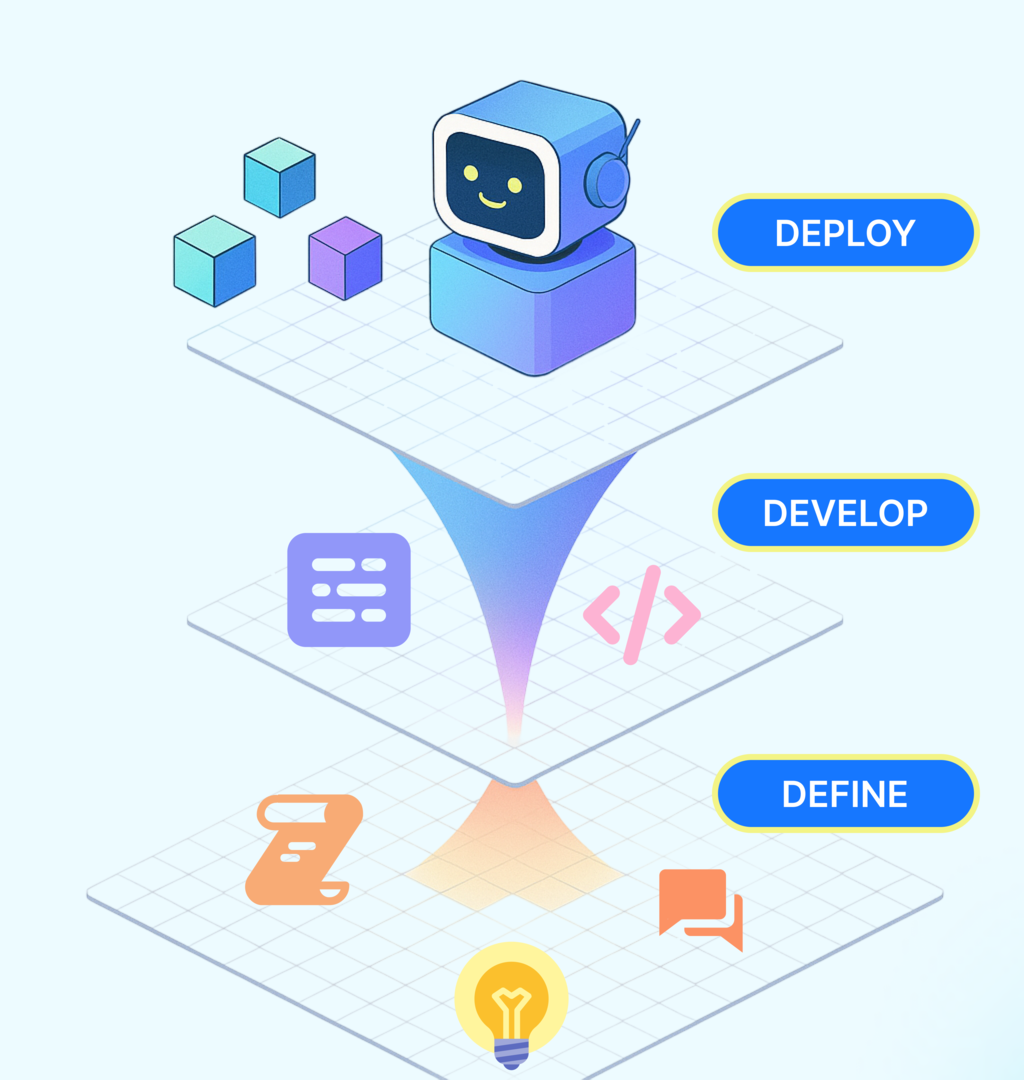
This visual approach is common across many platforms, though they often specialize in different areas. Some are great for building chatbots, while others excel at analyzing data or automating business tasks. The field is growing quickly, with tools available for nearly any need.
| Platform | Primary Use Case |
|---|---|
| Google Vertex AI Agent Builder | Building enterprise-grade search tools and chatbots. |
| Microsoft Copilot Studio | Creating and customizing AI assistants within Microsoft's ecosystem. |
| Voiceflow | Designing, prototyping, and launching conversational agents for voice and chat. |
Benefits and Limitations
The most significant benefit of no-code AI is speed. An idea that might take a team of developers months to build can be prototyped and launched in a matter of days or even hours. This allows for rapid experimentation and innovation.
It's also much more cost-effective. You reduce the need to hire specialized AI developers, empowering the team you already have to solve problems with new tools.
But no-code isn't a perfect solution for every situation. By design, these platforms offer less flexibility than writing custom code. You're working with the building blocks the platform provides, which means highly specific or unusual features might be out of reach. Think of it as the difference between a pre-fabricated home and one designed by an architect. The pre-fab is faster and cheaper, but the custom home is tailored exactly to your needs.
Another potential downside is vendor lock-in. If you build your entire workflow on one platform, it can be difficult and costly to switch to another one later.
Finally, while many platforms can handle significant workloads, the most demanding, large-scale applications might eventually require a more robust, custom-coded solution to perform optimally.
What is the primary goal of no-code AI platforms?
The text uses the analogy of building with "digital LEGOs." What does this analogy describe?
No-code AI is a powerful shift that puts advanced technology into the hands of more people. Understanding its strengths and weaknesses helps you decide when it's the right tool for the job.