Neuromuscular System Dynamics
Motor Unit Physiology
The Motor Unit: Your Body's Control System
Every move you make, from lifting a heavy weight to typing on a keyboard, is orchestrated by the nervous system. But how does a thought in your brain translate into a physical action? The answer lies in the fundamental building block of movement: the motor unit.
A motor unit consists of two parts: a single motor neuron and all the individual muscle fibers it connects to, or innervates. Think of the neuron as a commander and the muscle fibers as its dedicated squad of soldiers. When the commander gives an order, the entire squad acts in unison.
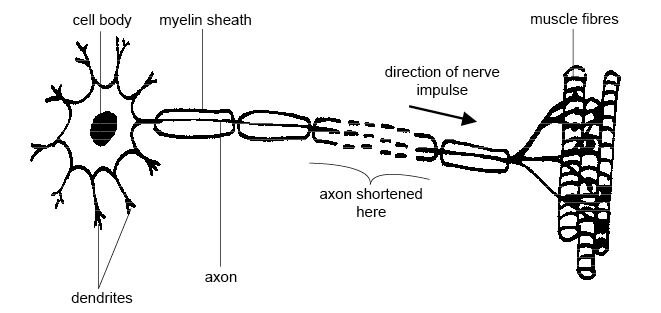
The commander of this unit is a specific type of nerve cell called an whose cell body resides in the spinal cord or brainstem. A long, thread-like extension called an axon travels from the neuron's cell body all the way to a target muscle. Near the muscle, the axon branches out, with each small branch connecting to a single muscle fiber. This elegant structure ensures that one signal can activate multiple muscle fibers at once.
All or None
A defining characteristic of a motor unit is its commitment. When the alpha motor neuron fires an electrical signal—an action potential—it doesn't just nudge some of its connected muscle fibers into action. It activates all of them, and it activates them completely. This is the of muscle contraction.
Either all muscle fibers in a motor unit contract, or none of them do. There is no in-between.
This might seem inefficient. If you only need a small amount of force, why activate an entire unit? This is where the brain's genius for control comes in. Your body doesn't produce varying levels of force by making muscle fibers contract 'harder' or 'softer'. Instead, it carefully adjusts two things:
- The number of motor units it recruits.
- The frequency at which those units fire.
For a delicate task like threading a needle, your brain might recruit just a few small motor units. To lift a heavy box, it calls in the cavalry, recruiting many large motor units to generate the necessary power. This process is called motor unit recruitment.
Precision vs. Power
Not all motor units are created equal. The difference lies in their innervation ratio: the number of muscle fibers controlled by a single motor neuron. This ratio is the key to understanding the difference between gross and fine motor control.
| Muscle Group | Typical Innervation Ratio | Primary Function |
|---|---|---|
| Extraocular (Eye) Muscles | 1:3 - 1:5 | Precise, rapid movements |
| Finger Muscles | 1:100 | Fine motor dexterity |
| Quadriceps (Thigh) | 1:1000 - 1:2000+ | Gross motor power |
Muscles responsible for fine motor control, like those that move your eyes or fingers, have low innervation ratios. A single neuron might control only a handful of fibers, allowing for incredibly precise adjustments. In contrast, large, powerful muscles like the quadriceps in your thigh have high innervation ratios. One neuron can command thousands of fibers, which is perfect for generating force but lacks finesse.
The Chemical Handshake
The final piece of the puzzle is how the electrical signal from the neuron makes the muscle fiber contract. The connection point between the axon terminal and the muscle fiber is a specialized synapse called the (NMJ). Here, the electrical signal is converted into a chemical one.
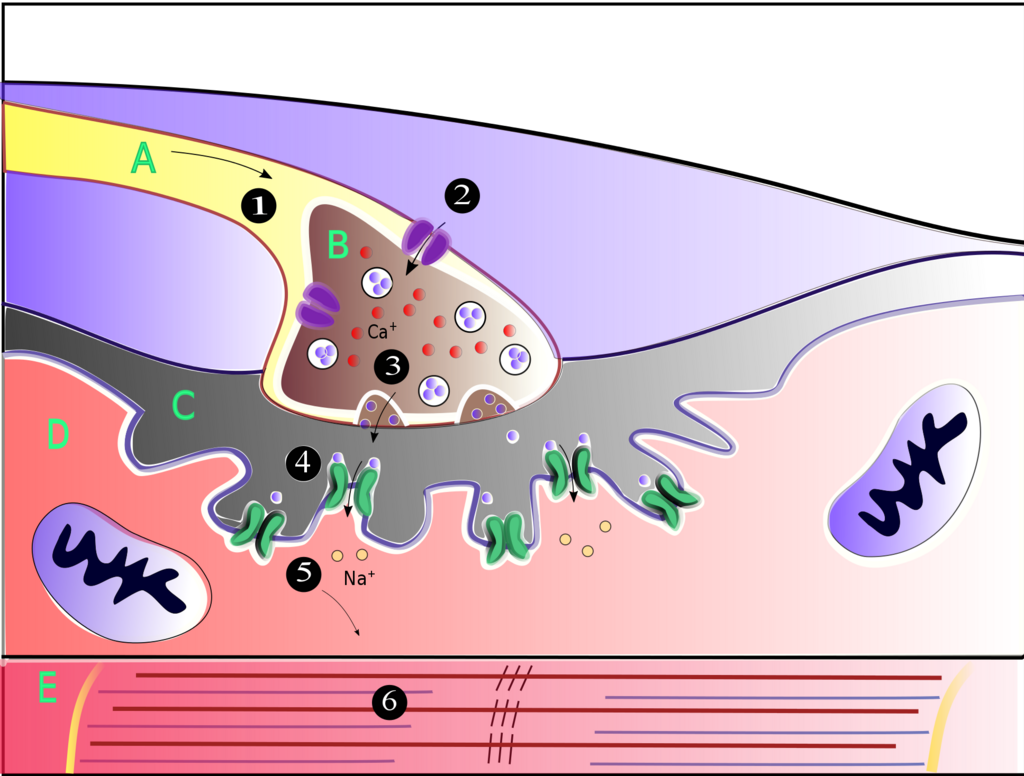
When an action potential arrives at the axon terminal, it triggers the release of a neurotransmitter called acetylcholine (ACh) into the tiny gap between the nerve and muscle. ACh molecules drift across this gap and bind to special receptors on the muscle fiber's surface. This binding opens ion channels, causing a new electrical wave to sweep across the muscle fiber, initiating the chain of events that leads to mechanical contraction.
The neuromuscular junction (NMJ) is a critical synapse where motor neurons communicate with skeletal muscle fibers to control muscle contraction.
This remarkable process, from a single neuron firing in your spinal cord to a coordinated muscle contraction, happens in milliseconds. Understanding the motor unit reveals the elegant efficiency of the body's design, where simple on/off switches are combined in complex ways to produce the full spectrum of human movement.
What are the two primary components of a motor unit?
According to the All-or-None Law, when a motor neuron fires, all the muscle fibers in its unit contract completely.