Naval Architecture Fundamentals and Applications
Ship Geometry
The Lines Plan
Every ship begins as a set of lines on a page. This drawing, known as the lines plan, is the definitive blueprint of the hull's shape. It's a two-dimensional representation of a complex three-dimensional object, and it serves as the foundation for nearly all subsequent design calculations. A lines plan consists of three distinct views that work together to describe the hull's form from every angle.
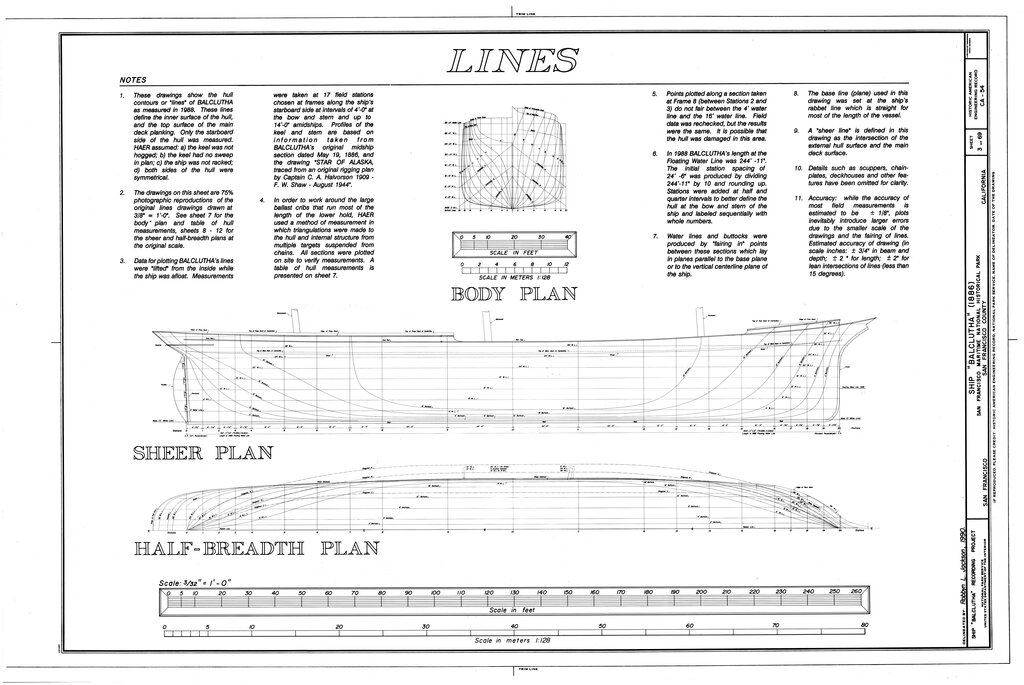
- Sheer Plan: This is the profile or side view of the ship. It shows the contour of the deck and the shape of the bow and stern.
- Half-Breadth Plan: This is a top-down view. Because a ship's hull is symmetrical about its centerline, only one half is drawn. It displays the shape of the waterlines and the maximum breadth of the hull at various points.
- Body Plan: This view shows the ship's cross-sections at regular intervals, called stations. It looks at the ship head-on. The right side shows the sections from the middle of the ship (midship) to the bow (fore body), while the left side shows the sections from midship to the stern (after body).
Together, these three views provide a complete and unambiguous geometric definition of the hull. From this plan, a naval architect can derive all the necessary data to analyze the ship's performance.
Hull Form Coefficients
While a lines plan is precise, it's not very good for quick comparisons. To solve this, naval architects use hull form coefficients. These are dimensionless numbers that describe the “fullness” or “fineness” of the hull shape, allowing for a quantitative comparison between different designs.
Think of coefficients as a shorthand for the hull's character. A few simple numbers can tell you whether you're looking at a bulky cargo carrier or a sleek racing yacht.
The most fundamental of these is the Block Coefficient (). It compares the actual underwater volume of the hull to the volume of a rectangular box that has the same maximum length (), breadth (), and draft () as the ship.
A value close to 1.0 indicates a very full, boxy hull, typical of bulk carriers or oil tankers that need to maximize cargo volume. A low value, perhaps around 0.5, suggests a fine, slender form with sleek lines, like a fast naval vessel or a competitive sailboat.
Another key metric is the Prismatic Coefficient (). This coefficient relates the hull's displaced volume to the volume of a prism. This imaginary prism has the same length as the ship and a constant cross-section equal to the ship's largest cross-sectional area, known as the midship section ().
The prismatic coefficient describes how the volume is distributed along the ship's length. A high means the hull has full ends, like a barge, indicating that the volume is spread out towards the bow and stern. A low signifies that the volume is concentrated in the middle of the ship, resulting in fine, sharp ends. This coefficient is particularly important for predicting a ship's wave-making resistance, as it directly relates to how the hull 'parts' the water as it moves.
Curves of Form
To visualize and refine the distribution of volume described by the coefficients, naval architects use curves of form. These are graphs derived directly from the lines plan that illustrate key geometric properties.
The engineering issues involved in this discussion are in the realm of the mathematics and physics of naval architecture, fluid mechanics, solid geometry, trigonometry and calculus.
The Sectional Area Curve, or curve of areas, is one of the most important. It's a plot showing the immersed cross-sectional area at each station along the ship's length. The shape of this curve is a direct indicator of the longitudinal distribution of displacement. Naval architects carefully shape this curve to be smooth and fair, as abrupt changes can lead to increased wave resistance and poor performance.
Finally, Waterline Curves represent the shape of the hull at different water levels. Each curve in the half-breadth plan is a waterline. By analyzing the shape of these waterlines, an architect can understand how the ship will interact with the water's surface. The shape of the design waterline (the waterline at which the ship is designed to float) is especially critical for determining resistance and stability characteristics.
What is the primary purpose of a ship's lines plan?
A naval architect is designing a large oil tanker that needs to maximize its cargo volume. Which hull form coefficient would they expect to be high, approaching 1.0?