Monitoring Process Variability
Understanding Process Variability
The Enemy of Consistency
Imagine you're baking a batch of chocolate chip cookies. You follow the recipe perfectly, just like last time. Yet, this batch comes out a little crispier. Some cookies are bigger than others. One is slightly burnt. Why? No two cookies are ever identical, even when they come from the same batch of dough and the same oven.
This natural inconsistency is at the heart of every process, from baking to manufacturing cars. Every process has some level of variation. The question isn't whether variation exists, but how much exists and where it comes from.
Process Variability
noun
The natural and expected fluctuations or differences that occur within any given process.
Two Types of Variation
To improve a process, you first need to understand the source of its variability. Variation isn't just random noise; it falls into two distinct categories.
Common Cause Variation
noun
The inherent, predictable variability of a process that is stable and in control. It's the 'background noise' you can always expect.
Think of common cause variation as the sum of many small, unavoidable factors. In our cookie example, this includes minor fluctuations in the oven's temperature, slight differences in the size of each scoop of dough, or the humidity in the kitchen. These factors are a normal part of the process. You can't point to a single cause; they are built into the system.
Special Cause Variation
noun
Variability that comes from external, unpredictable, or unusual events. It is not an inherent part of the process.
Special cause variation is different. It's a signal that something out of the ordinary has happened. Maybe a baker used salt instead of sugar by mistake. Or perhaps the oven door was left ajar for five minutes. These are not part of the normal baking process. They have a specific, identifiable cause and can usually be fixed.
| Characteristic | Common Cause Variation | Special Cause Variation |
|---|---|---|
| Source | Inherent to the process | External to the process |
| Predictability | Predictable, stable | Unpredictable, sporadic |
| Nature | Many small, random factors | A few specific, identifiable factors |
| Action | Requires fundamental process change | Requires investigation and correction |
Why Variability Matters
Understanding and controlling variability is essential for quality and efficiency. When a process is highly variable, the outcome is unpredictable. Customers expect a consistent product every time. A burger that’s perfectly cooked one day and burnt the next will quickly lose a restaurant its customers.
This concept applies to any process. Think of trying to hit a target. The goal is to be accurate (on target) and precise (consistent). Variability affects both.
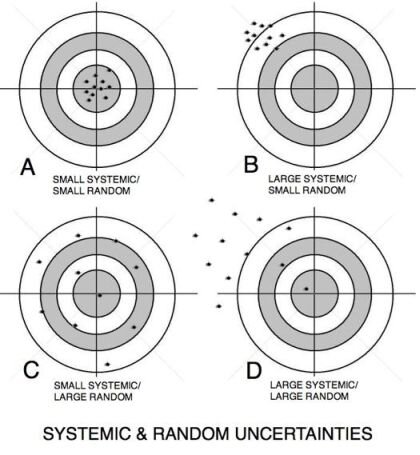
In this image, the bullseye is the target specification.
- Diagram A is the ideal: low variability, with all shots clustered on target. This is a stable, capable process.
- Diagram B shows a process with low random variation (it's precise) but high systemic variation (it's inaccurate). The process is consistent, but it's consistently wrong. This often points to a common cause problem, like a miscalibrated machine.
- Diagram C has high random variation. The shots are scattered widely, but their average is on target. This suggests an unstable process, likely affected by special causes.
- Diagram D is the worst-case scenario: both inaccurate and imprecise. The process is out of control.
Beyond quality, variability hurts efficiency. An unpredictable process leads to more inspections, more scrap and rework, and more wasted time and materials. It forces companies to hold extra inventory just in case a batch fails, which costs money.
The less variability in a process, the more predictable it becomes. And predictability is the foundation of efficiency and quality.
By learning to distinguish between common and special cause variation, you can begin to ask the right questions. Is the problem built into our system, or did something unusual just happen? Answering that question is the first step toward meaningful process improvement.