MongoDB Essentials
Introduction to NoSQL and MongoDB
Beyond Rows and Columns
For a long time, the world of data was dominated by relational databases. Think of a giant, perfectly organized spreadsheet. Everything has its place in a predefined row and column. This structure, which uses a language called SQL (Structured Query Language), is powerful and reliable for many tasks, like managing bank transactions or store inventories. Data is predictable and consistent.
But what about data that isn't so neat? Consider the data from a social media platform. A user has a profile, a list of friends, posts they've made, comments, and likes. Trying to cram all of this interconnected and varied information into rigid tables can get complicated and inefficient. You might need to spread a single user's information across a dozen different tables and then piece it back together every time you need it. This is where a different approach comes in handy.
The NoSQL Approach
NoSQL doesn't mean "no to SQL." It means "Not Only SQL." It's a category of databases designed for a world of massive, fast-changing, and diverse data. Instead of enforcing a strict structure upfront, NoSQL databases are built for flexibility and scale.
The core idea is simple: the database's structure should follow the data's structure, not the other way around.
NoSQL databases come in several flavors, like key-value stores, graph databases, and wide-column stores. One of the most popular types is the document database, which we'll focus on. They also handle growth differently. Instead of buying a single, more powerful server (vertical scaling), they are designed to distribute data across many commodity servers (horizontal scaling), which is often more cost-effective.
| Feature | Relational (SQL) | NoSQL |
|---|---|---|
| Data Model | Structured, predefined tables | Dynamic, flexible documents or key-value pairs |
| Schema | Rigid, defined in advance | Flexible, can evolve with the application |
| Scaling | Vertical (bigger servers) | Horizontal (more servers) |
| Best For | Transactional data, consistency | Big data, unstructured info, rapid development |
Meet MongoDB
MongoDB is one of the leading document-oriented NoSQL databases. It stores data in flexible, JSON-like documents. JSON (JavaScript Object Notation) is a text format that is easy for both humans to read and machines to parse. In MongoDB, the format is actually BSON, a binary version of JSON that is more efficient for the database to work with.
MongoDB is a NoSQL database that stores data in flexible, JSON-like documents.
Instead of rows in a table, MongoDB has documents. These documents are grouped into collections, which are similar to tables in a relational database. The key difference is that not every document in a collection needs to have the same structure.
For example, here’s how you might store information about a user in a single MongoDB document:
{
  "_id": "user123",
  "username": "alex_w",
  "email": "alex@example.com",
  "join_date": "2023-10-26",
  "interests": ["hiking", "photography", "coding"],
  "last_login": {
    "timestamp": "2024-08-15T10:00:00Z",
    "ip_address": "192.168.1.1"
  }
}
All the relevant information is nested together in one place. In a relational database, this might have required three separate tables: one for user info, one for interests, and one for login history. This self-contained structure makes data easy for applications to use, especially in modern web development.
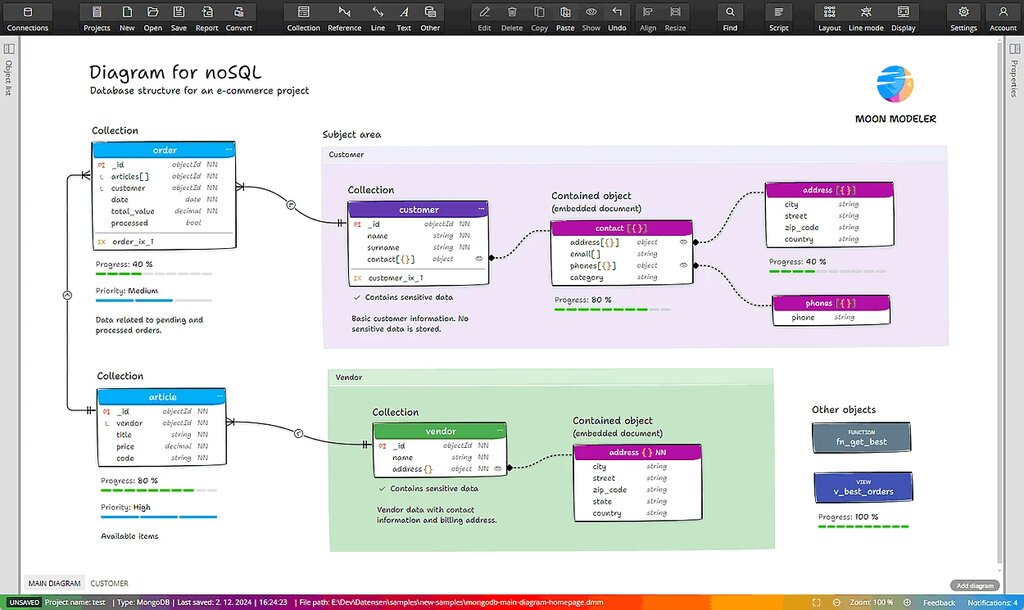
This flexibility is a major advantage. If you later decide to track a user's preferred language, you can simply add a "language": "en" field to new user documents without having to restructure the entire database. Old documents that don't have this field can still coexist peacefully in the same collection.
Time to check your understanding of these core concepts.
The term 'NoSQL' is often misunderstood. What does it actually stand for?
Which of the following scenarios is the best fit for a document-oriented NoSQL database like MongoDB over a traditional relational (SQL) database?
Understanding the difference between relational and NoSQL databases, and where MongoDB fits in, is the first step to leveraging its power for building modern, scalable applications.