Mobile Design and Construction
Introduction to Mobile Sculptures
Art That Moves
Most sculptures stand still. They are solid, permanent objects rooted to the spot. But what if a sculpture could dance? What if it could respond to the slightest breeze, constantly changing its shape and form? This is the idea behind a mobile.
mobile
noun
A type of kinetic sculpture constructed to take advantage of the principle of equilibrium. It consists of a number of rods, from which weighted objects or further rods hang.
The name, which is French for "motion," was suggested by artist Marcel Duchamp for a new kind of artwork he saw in the early 1930s. The artist was an American in Paris named Alexander Calder, and his playful, abstract creations would come to define this new art form. Calder, who had a degree in mechanical engineering, combined his technical skills with a whimsical artistic vision. He abandoned the traditional sculptor's materials of stone and bronze in favor of industrial materials like wire and sheet metal, crafting delicate, balanced structures that seemed to float in the air.
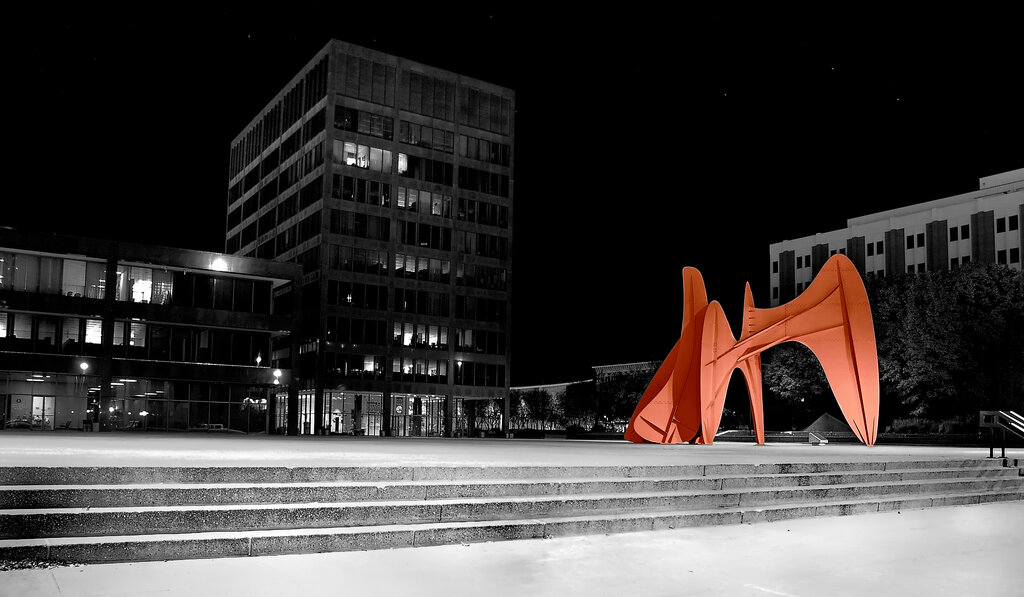
His early works were often motorized, but he soon discovered the beauty of creating sculptures that moved naturally with air currents. These are the classic mobiles we think of today, artworks that are never the same from one moment to the next.
The Physics of Balance
A mobile is essentially a puzzle of balance. Each part is a small balancing act, and they all combine to create a larger, stable system. The core principle at play is the same one you use on a playground seesaw. A heavier person has to sit closer to the center pivot point, or fulcrum, to balance with a lighter person sitting farther away.
In a mobile, the pivot point for each rod is carefully placed so that the weights on either side cancel each other out.
This relationship is based on a concept from physics called a lever. The balancing equation is straightforward: the weight on one side multiplied by its distance from the fulcrum must equal the weight on the other side multiplied by its distance.
Let's look at a simple example. Imagine a rod with a 3-ounce shape hanging 10 inches from the fulcrum. To balance it, a 6-ounce shape would need to be placed 5 inches from the fulcrum on the other side, because and . A mobile is just a series of these levers, stacked on top of one another.
The magic of a Calder-style mobile is that the entire structure is free to rotate. Each rod can turn independently, and the whole assembly can spin. This freedom of movement allows the sculpture to catch air currents and create an ever-changing, three-dimensional dance. It's a perfect blend of art and physics, where simple principles create complex and beautiful results.
Ready to check your understanding?
Who is the artist most famously associated with creating the art form known as the mobile?
A mobile arm has a 4-ounce weight hanging 9 inches from the fulcrum. Where would you need to place a 6-ounce weight on the other side to make it balance?
By understanding these fundamentals of balance and movement, you can begin to appreciate the subtle engineering behind these graceful works of art.