Microcontroller Fundamentals
Microcontroller Basics
What Is a Microcontroller?
Think of a microcontroller as a tiny, dedicated computer on a single chip. Unlike the processor in your laptop or phone, which is designed to do many things at once, a microcontroller is a specialist. It’s built to perform a specific task, over and over again.
A microcontroller (MCU) is a small computer on a single integrated circuit that is designed to control specific tasks within electronic systems.
The microcontroller in your microwave, for example, has one job: to run the microwave. It reads button presses, controls the timer, and turns the heating element on and off. It doesn't browse the internet or play games. This single-minded focus makes microcontrollers incredibly efficient and reliable for controlling devices.
Essentially, a microcontroller is a 'simple computer' that runs one program in a loop.
The Core Components
Even though it's small enough to sit on your fingertip, a microcontroller packs all the essential components of a computer onto one chip. This is why it's often called a "system on a chip" (SoC).
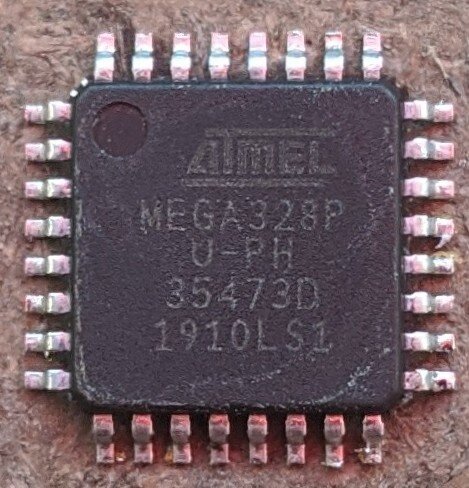
Every microcontroller contains three fundamental parts that work together: a processor, memory, and input/output peripherals.
Let's break these down:
- CPU (Central Processing Unit): This is the brain. It fetches instructions from memory, performs calculations, and makes decisions. It's the part that runs the program.
- Memory: This is where the microcontroller stores its program (the instructions it follows) and any temporary data it needs to work with. There are typically two types: non-volatile memory (like Flash) that holds the program even when the power is off, and volatile memory (like RAM) for temporary data that disappears when power is lost.
- Input/Output (I/O) Ports: These are the microcontroller's connection to the outside world. They allow it to read information from sensors (like temperature or light), detect button presses (input), and control things like lights, motors, and displays (output).
The Brain of Embedded Systems
Microcontrollers are the heart of what we call embedded systems. An embedded system is a combination of computer hardware and software designed for a specific function within a larger mechanical or electrical system.
If a device has a specific, programmable job to do, it probably has a microcontroller inside.
Your digital watch, your car's anti-lock braking system, the smart thermostat on your wall, and even a child's electronic toy are all examples of embedded systems. The microcontroller acts as the control center, taking input from the environment or the user and producing a specific output. It's the component that adds the "smart" to everyday objects.
Without microcontrollers, many of the devices we rely on for convenience, safety, and entertainment would be far less capable, or wouldn't exist at all. They are the invisible workhorses of modern electronics.
What is the primary characteristic that distinguishes a microcontroller from a general-purpose processor found in a personal computer?
A microcontroller is often called a 'system on a chip' (SoC) because it integrates the CPU, memory, and I/O ports into a single integrated circuit.