Mastering Triangle Geometry
Triangle Classification Systems
Naming Triangles by Their Sides
The simplest way to categorize a triangle is by looking at the lengths of its three sides. Are they all the same? Are two the same? Or are all three different? These three conditions give us our first set of labels.
Equilateral
adjective
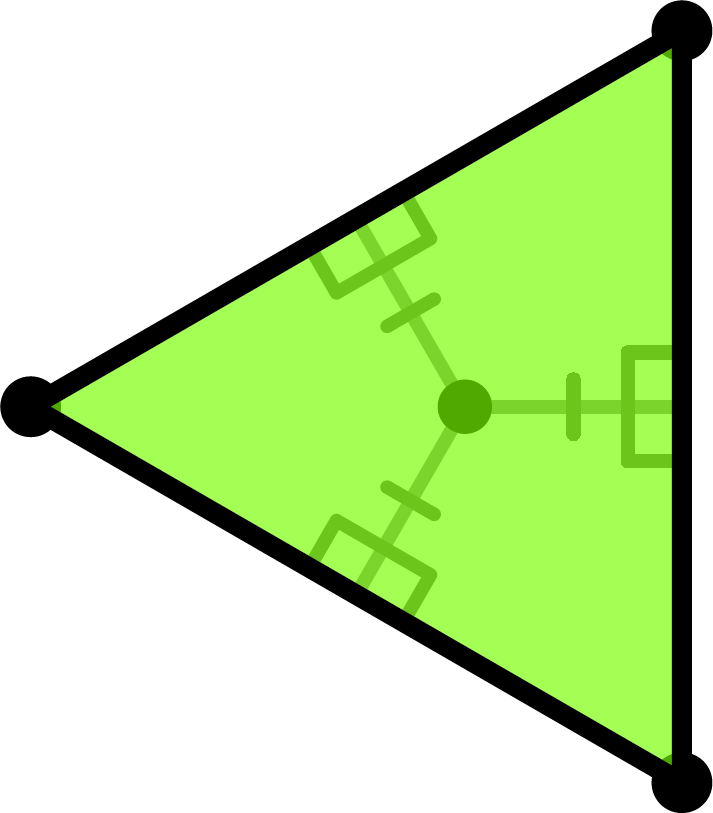
A triangle where all three sides are of equal length. Consequently, all three internal angles are also equal, each measuring 60 degrees.
The is the most symmetrical type of triangle. Because all its sides are equal, all its angles must also be equal. Since the total degrees in any triangle is 180°, each angle in an equilateral triangle is always 60°.
An isosceles triangle has two sides of equal length. This equality has a direct consequence for its angles. The two angles opposite the two equal sides are also equal to each other. This rule is a cornerstone of geometry known as the and is incredibly useful for solving problems where you have limited information.
Finally, a scalene triangle is a triangle where none of the sides are equal in length. As a result, none of its angles are equal either. It's the most general type of triangle, with no special symmetrical properties.
A Second Name From Angles
Besides side lengths, we also classify triangles by their internal angles. This gives every triangle a second name that describes its largest corner.
Remember, the three angles in any flat triangle always add up to 180°.
An acute triangle is one where all three angles are acute, meaning they are all less than 90°. Think of it as a triangle with three 'sharp' corners.
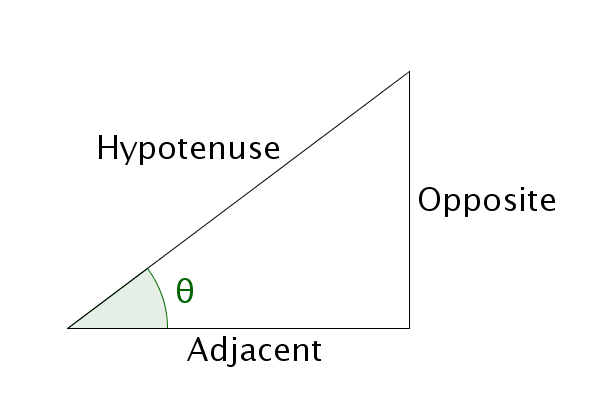
A right-angled triangle (or simply a right triangle) has one angle that is exactly 90°. This right angle is often marked with a small square. The other two angles in a right triangle must be acute, and they will always add up to 90°.
An obtuse triangle has one angle that is obtuse, meaning it is greater than 90°. A triangle can only have one obtuse angle. If it had two, the sum would already exceed 180° before even adding the third angle.
Putting It All Together
Every triangle has two names: one from its sides and one from its angles. This gives us a more precise way to describe them. For instance, you could have a right isosceles triangle, which has a 90° angle and two equal sides. Or you might see an obtuse scalene triangle, with one angle over 90° and three different side lengths.
| Classification by Sides | Classification by Angles | Possible Combinations |
|---|---|---|
| Equilateral | Acute | Equilateral Acute (all are) |
| Isosceles | Acute, Right, Obtuse | Isosceles Acute, Isosceles Right, Isosceles Obtuse |
| Scalene | Acute, Right, Obtuse | Scalene Acute, Scalene Right, Scalene Obtuse |
Let's check your understanding of these classification systems.
A triangle has side lengths of 5 cm, 5 cm, and 7 cm. How would this triangle be classified based on its sides?
What is the measure of each angle in an equilateral triangle?
Understanding these classifications is the first step in mastering geometric proofs and solving complex problems. By identifying a triangle's type, you immediately know some of its properties, which can unlock the solution.